
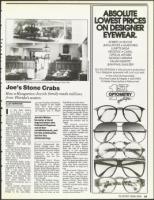

Pho to courtesy o f Joe's Stone Crabs' archives
ABSOLUTE
LOWEST PRICES
ON DESIGNER
EYEINEAR.
A picture of Joe and Jennie Weiss hangs in the dining room of the modern-day Joe's Stone Crabs.
ROBERT LA ROCHE
JEAN LAFONT • ALAIN MIKLI
LUNETTE BADA
NEOSTYLE • CAZAL
OPTICAL AFFAIRS
GIORGIO ARMANI
ITALIAN GRAFITTI
JEAN PAUL GAULTIER
NO EXCEPTIONS! • We prove it everyday!
Your designer eyewear will cost you less!
In the Old Orchard Mall
Orchard Lake & Maple • 626-9590
Outside Prescriptions Welcome!
Or r
Joe's Stone Crabs
How a Hungarian Jewish family made millions
from Florida's waters.
ELLEN BERNSTEIN
Special to the Jewish News
I
n the days before
bridges and
causeways, wealthy
Miamians ferried across Bis-
cayne Bay to an undeveloped
peninsula to swim in the
Atlantic and lunch on Joe
Weiss's sandwiches.
Weiss, a Hungarian im-
migrant, waited on tables in
New York City restaurants
before asthma forced him to
seek a warmer climate. In
1913 he opened a pine wood
concession stand on the
southern tip of Miami Beach,
then an insect-infested
backwater with only 150
residents.
Weiss and his Hungarian-
born wife Jennie eked out a
living serving good food, but
it was an indigenous stone
crab that would turn his
eatery into a multi-million
dollar empire.
In the early 1920s, a Har-
vard trained scientist, study-
ing marine life in the area,
suggested to Weiss that he
cook a crab many people
knew about but few would
eat. Weiss began boiling,
chilling and cracking the
shiny, black-tipped stone
crab claws, turning the
maligned crustacean into a
delicacy.
More tourists discovered
Joe's Shore Diner with the
completion of the Collins
Bridge in the mid-1920s,
now the Venetian Causeway.
Film legends of the 1930s
and '4 Os and other
luminaries as disparate as
Al Capone and J. Edgar
Jennie Weiss
became a local
legend when she
kicked Al Capone
out of her
establishment, not
for his criminality,
but for his
philandering.
Hoover frequented the
quaint seafood joint. The
dour Jennie Weiss became a
local legend when she kicked
Capone out of her estab-
lishment, not for his
criminality, but for his
philandering.
Renamed Joe's Stone
Crabs, the restaurant grew
in popularity as Miami
Beach grew as a resort. And
despite South Miami Beach's
decline during the 1960s and
'70s, its oldest eating estab-
lishment thrived, proving to
the _locals that some things
never change.
Today the seafood restau-
rant, with more than a 100
items on its menu, attracts
hordes of locals, tourists and
celebrities. Up to a thousand
customers a day wait two to
three hours to dine on the
$14-$24 per pound claws.
During the winter season,
the family harvests as many
as 5,000 crabs a day in their
own fishery on Cedar Key on
the Florida panhandle. From
there, Joe's Stone Crabs
ships the seasonal crabs to
wholesalers and restaurants
around the country and in
Japan.
The family recently
expanded the 400-seat res-
taurant and three years ago
added a carry out. There's
even a toll-free number for
overnight delivery.
The original owners died
more than a half-century ago
and the business is now in
the hands of the third and
fourth generation. Grand-
daughter Jo Anne Sawitz
Bass, the wife of a Miami
surgeon, is now grooming
her 31-year-old son Stephen
Sawitz to take over the busi-
ness some day.
Stephen Sawitz isn't sure
that his great-grandparents
even considered the possi-
bility that their restaurant
would endure as long as it
has.
"I don't know if they envi-
sioned the continuity of
Joe's," he says. "They were
an experiment, the first gen-
eration. They didn't Federal
Express things. They didn't
have phones. They were
probably worried more about
hurricanes."
"I don't know," he con-
tinues, "how businesses sur-
vived in the old days."0
(OPTOMETRY)
tifie
gpeo
••
•
THE DETROIT JEWISH NEWS
29