

FOCUS
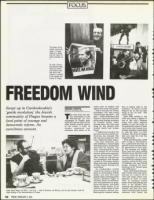
The porter of the
Jewish community
center in Prague
holds up a poster
with his choice for
Czech president on
it.
Far right: Commu-
nity activist Andrej
Ernyei (on banjo)
and another musi-
cian give a free
concert to students
in the Jewish com-
munity of Prague.
FREE D OM WIND
Swept up in Czechoslovakia's
`gentle revolution,' the Jewish
community of Prague became a
focal point of courage and
democratic reform. An
eyewitness account.
EDWARD SEROTTA
Special to The Jewish News
he route from the rab-
bi's apartment to the
699-year-old Alt Neu
synagogue in Prague goes
right through the heart of the
most famous Jewish ghetto
in the world, a maze of
streets, cemeteries and
museums that seems to be
Rabbi Daniel Mayer, the chief — and only — rabbi of Bohemia and Moravia, and his wife, Hannah, recall the
heady feelings of the demonstrations in Prague.
90
FRIDAY, FEBRUARY 9, 1990
made more of shadow and
legend than brick and mortar.
And it was here, on Friday,
November 17th, that young
Daniel Mayer, the chief — and
only — rabbi of Bohemia and
Moravia, heard the news that
police were beating students
on Narodni Street, really
beating them, that they were
lying on the ground with
cracked skulls and broken
bones.
"I walked into the shul, but
the news was there before me.
Everyone was stunned. The
old ones, the young ones. This
was a difficult Friday night."
The next afternoon, just
after Shabbat, a rumor began
circulating that a student had
died from his injuries. The
rabbi, recounting the events
as he looked out his kitchen
window while snow was settl-
ing over the city said, "That's
when I took my wife and our
two daughters, and brought
candles to Wenceslas Square
along with tens of thousands
of other Czechs. We had to do
something."
As loudspeaker trucks
combed the streets trying to
quiet an increasingly hostile
public, and more and more
people began jamming public
squares, petitions began to
circulate, letters of condemna-
tion were plastered on store-
fronts and houses. And Rabbi
Mayer, hardly known as an
activist, wrote a letter to then
prime minister Adamec con-
demning the violence, asking
him to please talk to the
students. "It wasn't a brave
thing to do. It was the only
thing to do," he said. "The
moral thing."
Soon after writing it, the
rabbi was asked to appear in
one of the city's theaters
along with other religious
leaders to read his letter to
the gathering crowds. Copies
were made, and Jewish corn-
munity members volunteered
to take the letter to other
theaters. The Jews of Prague
had cast their lot with the
demonstrators.
With something like 12,000
Jews living in Czechoslova-
kia, a good deal less than 10
percent of that number ident-
ify themselves as such open-
ly. The reasons are simple.
First came the Nazis, killing
200,000 of the 250,000 in the
country. After the war, Jew-
ish merchants by the thou-
sands fled the coming of com-
munism, and in the first years
of Stalinist rule, anti-Jewish
purges cleansed the party
hierarchy of all "Zionist spies
and infiltrators."
Party chief Rudolf Slansky
and 10 other Jews were execu-
ted (out of a total of 13) in
1953 and many others were
demoted or fired. In early
1967, an American Jewish
leader was found floating face
down in the Moldau after
meeting with skittish Jewish
leaders, and later that year,
when Czechoslovakia severed
relations with Israel, the