

•
Life with the Beneke-Miller Orchestra was
the ritz, Pitt says. He worked with the group
for three years, playing in Hollywood, perform-
ing a solo on the first recording of "St. Louis
Blues March" and staying in fancy hotels
where valets carried their instruments.
Before one of those trips, Pitt had the oppor-
tunity to introduce Beneke to his parents.
Pitt was staying at his parents' home in
Newark. They lived in back of his father's deli
in a depressed area of town.
"The Tex Beneke-Glen Miller Orchestra"
written in large, colorful letters across its side,
the band's bus pulled in front of the eatery.
Pitt's mother invited the troupe in.
Pointing to her son, she told Beneke, "Make
sure you take care of him." Then she served
the men latkes with sour cream.
Pitt's parents later left New Jersey for
Detroit; they followed their daughter, who had
married a native of the Motor City. During a
visit with his family, Pitt also made the deci-
sion to move to Detroit.
A friend brought him to a party, where Pitt
caught sight of an attractive young blonde
Detroiter named Dotty. "I saw her," Pitt says
of his future wife, "and I fell in love im-
mediately."
Pitt found work on WXYZ Radio's staff or-
chestra and played regularly on "Starlight
Stairway." He gave music lessons; one of his
students was band leader Mickey Wolf.
"Mickey Wolf heard I was here," Pitt says.
"So he called up and asked me for saxophone
lessons. At the time he had a job selling mat-
tresses. I said, 'I'll give you sax lessons and you
give me a mattress."'
Not long after coming to Detroit, Pitt, who
often performs with the Detroit Symphony Or-
chestra, started his own band. He played at
clubs like The Wonder Bar and at society par-
ties in Grosse Pointe. Later, almost all his jobs
were for Jewish functions.
Pitt says the secret to his long-lasting
success is "remembering that I'm not there to
please myself; I'm there to please the
customer. If I don't see people dancing or en-
joying the music, I know I'm doing something
wrong."
The only time Pitt took out from music was
to finish the studies he stopped when he was
16. Learning her husband had never received a
degree, Dotty Pitt secured his New Jersey high
school transcripts. Then she took him to
Wayne State University, where Pitt passed his
GED with flying colors, and later received his
bachelor and master degrees and studied for a
Ph.D. He worked as a teacher, counselor and
principal at area schools until he retired five
years ago.
Pitt's wife also took over as manager of his
band and served as president of his fan club,
through which he for many years received
hundreds of letters. Today, when visiting New
York, Mack and Dotty Pitt are still approached
by fans who remember the sax player's days
with the Shaw and the Beneke-Miller or-
chestras.
Pitt stays in touch with Artie Shaw, Tex
Beneke and his friends from the old days. They
call each other from time to time, and their
autographed pictures grace the walls of his
house.
He pulls out an album filled with pictures of
the musicians — from contemporary shots to
black-and-white photos taken during the war.
One picture shows Pitt beside Tex Beneke, a
cigarette in his left hand, a bright-red bow tie
on his neck.
"He calls me Max," Pitt says, pointing to
Beneke. "And every time I tell him, 'It's
MACK, Tex. It's Mack.'
'Yeah,' he responds. 'That's what I just
said. Max."' El
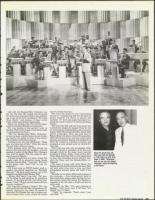
Mack Pitt (third from left,
front row) with Tex Beneke
in 1948 (top) and with Artie
Shaw in 1989: "Whenever I
took out my sax and played,
I thought I could do anything
in the world."
THE DEIROIT JEWISH NEWS
27