

sonal experiences of busi-
nesses in turmoil. When
Meyers ran out of "war
stories," he then brought in
his friends —CEOs of major
corporations — to tell their
"war stories."
The lists of top executives,
who are guests speakers for
the course, reads like a
chapter from Who's Who in
Business. Some of the top
brass include: William Agee,
former chairman of Bendix;
Charles Brown, former
chairman of American Tele-
phone & Telegraph; Bernard
Winograd, president of The
Taubman Investment Co.;
and Ira Stepanian, CEO of
the Bank of Boston.
Meyers even recruited
Dennis Levine, the convicted
trader at Drexel Burnham
Lambert, fresh out of jail to
have a discussion with the
class. Campus guards
whisked Levine from the
airport to the university
with such intense security
that the press never got a
chance to talk to him.
Meyers said that Levine fas-
cinated the class with his
experience.
"I found the class an
excellent experience for me,
and I think the students
were very bright, very quick,
asked lots of good questions
and there was a good discus-
sion on the subject," says
John L. Weinberg, senior
partner at Goldman Sachs &
Co., who was also a guest
speaker at the class.
During the class, teams of
students study the theory
behind business crises and
role play with real problems
that companies have en-
dured. Teams make oral pre-
sentations and conduct press
conferences, while dealing
with other role-playing
classmates acting as union
leaders, shareholders and
governmental represen-
tatives. The guest speaker
serves as the top executive of
the company in crisis, while
Meyers is the Geraldo
Rivera component, asking
the provocative questions.
Business Week's Guide to
the Best Business Schools re-
cently profiled Carnegie
Mellon University. The
guide reveals that the most
popular class in the
graduate school of industrial
administration is Meyers'
class. The magazine further
states that students rate
Meyers a 4.79 percent out of
5 for excellence in teaching.
An outgrowth of his
teaching skills became a
highly praised book When It
Hits The Fan, Managing the
Nine Crises of Business
(Houghton, Mifflin, 1986).
Meyers collaborated with
John Holusha, then the
Detroit bureau chief of the
New York Times. Holusha,
now a financial writer with
the New York Times in New
York, says that the book
took eight months to write.
Meyers wrote his thoughts
in long hand, while Holusha
punched them into the com-
puter putting it together.
When It Hits The Fan
defines and discusses the
"nine crises of business":
public perception, sudden
market shift, product
failure, top management
succession, cash industrial
relations, hostile takeover,
adverse international event,
and regulation/deregulation.
Meyers does not believe that
these are the only crises, but
they are the ones that are
prevelant today.
One blurb on the jacket
quotes Robert L.
Dilenscheneider, president
and CEO of Hill and
Knowlton, Inc., as saying
that those who learn the
secrets of the book can save
tens of millions of dollars for
their corporation.
Meyers is busy working on
a second book but refuses to
give any details. When he
began touting When It Hits
The Fan before it was
published, another publisher
rushed to print a book on the
same topic.
Meyers also shares his ex-
pertise at groups and
organizations. He has lec-
tured to prestigious groups
including the American and
New York Stock Exchanges,
National Press Club,
American Bar Association
and American Telephone
and Telegraph. He has a
spiral notebook filled with
speakers' organizations and
his lectures sometimes fetch
a five figure fee.
" There are plenty of crises
around and many experi-
enced people like Gerry
Meyers can make a con-
tribution to industry's learn-
ing how to deal with these
problems," says Weinberg of
Goldman Sachs.
Businesses entering the
new decade will certainly
face crises equal to the Ex-
xon oil spill, Tylenol poison-
ing and Union Carbide leak.
Meyers is available to help
companies manage crises ,
hopefully before the turmoil
happens. Meyers maintains
that some crises are
foreseeable and businesses
must learn to manage rapid
change.
In a Business Month inter-
view Meyers admits that
mangaging change is pain-
ful. In order to get a handle
on managing change, com-
panies must look for in-
dividuals who are quick
thinking and instill some
Whenft
HitstheFan
'*4' _Managing
theNineCrises
ofBusines
Gerald C. Me y ers
Former Chairman ofAmeriam Alotors
11014,1110 ,
withJohn Hohtsha
,11,11, 1,1
flexiblity into the company.
In Detroit, Meyers is
quoted on the status of
automobile companies. He
believes that the recession
that we are entering could
last two to three years and
will be harder on the do-
mestic auto companies to
recoup than the previous
recession in 1980s. Meyers
talks about the changing
1990s market with the
steady growth of Japanese
owned auto factories on US
soil. "They are blowing our
doors in," Meyers says. He
adds that the Japanese
transplants are ferocious.
The Japanese, as well as
the Germans, French and
Italians also are interested
in crisis management,
reading copies of Meyers'
translated book. The Ger-
man book came out a week
before the Berlin Wall
tumbled. Meyers heard that
the book was selling briskly.
"My life is nothing but good
timing." ❑
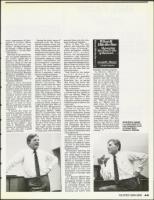
Gerald Meyers engaged
in a heated debate at his
crisis management course
at Carnegie Mellon
University in Pittsburgh.
THE DETROIT JEWISH NEWS
A-9