
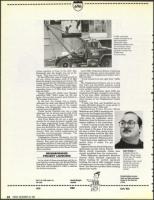

In 1984, construction
workers contracted by the
state transportation
department began
demolishing several homes
and businesses. Among
them was this Oak Park
apartment complex near
10 Mile Road.
Photo by Bob McKeown.
citizen quarters in front of the JCC. But,
Steinhardt said, the temple was not as for-
tunate. "They got to mow their lawn."
By the 1980s, after years of steady growth as
the only reform synagogue south of 14 Mile
Road, the temple was running out of room. The
temple started off with 72 families and grew to
almost 700 families. The freeway made expan-
sion at the rear of the temple impossible, while
expanding closer to 10 Mile Road would have
been too costly.
Temple Emanu-El's Rabbi Lane Steinger
admitted 1-696 "didn't make our life any
better. But now that is pretty much behind us.
We're happy with it now."
In the end, the temple was a winner.
Although the state had offered $161,400 for
the 3.1-acre parcel north of the temple
building, with Steinhardt's help the temple
secured more than $509,000.
United Jewish Charities also won a large
settlement for its 4.6-acre parcel north of the
JCC. The state had offered $241,600, but
UJCharities received more than $725,000.
Only B'nai Moshe did not win a large set-
tlement for its corner lot parcel, enough room
for a large, single-family house. Although the
state offered $7,000, B'nai Moshe asked for
more than $100,000 for the vacant land and for
the seven parking spaces taken by the
freeway. They also wanted compensation for
possible environmental damage. The
synagogue settled for $9,900.
Congregation Shaarey Shomayim was the
only Jewish institution to lose a building to the
freeway. Ever since the state condemned the
synagogue building 12 years ago for $471,900,
Rabbi Leo Goldman has conducted daily morn-
ing and evening services at the Jimmy Prentis
Morris building.
NEIGHBORHOOD
PROJECT LAUNCHED
In the midst of these proceedings and the ac-
tual highway construction, the Jewish Welfare
Federation began the Neighborhood Project in
Oak Park and Southfield in 1985 to stabilize
the Jewish community.
Part H of I.696 opens on
the east.
Larry Ziffer, Federation director of planning
and agency relations, said it was merely coin-
cidence that the Neighborhood Project and I-
696 coincided.
"It just seemed to be the right time," Ziffer
said.
The Neighborhood Project's aim is to help
Oak Park and Southfield maintain strong
Jewish neighborhoods and slow the movement
to the northern suburbs.
In a time of uncertainty about 1-696, the
Neighborhood Project managed to give stabili-
ty to the area. Ziffer estimates about 300
Jewish families have moved into those two
cities because of the Neighborhood Project
program.
"I think Oak Park and Southfield are ex-
tremely affordable places for young people to
establish their roots," Ziffer said.
Neighborhood Project Director Rhoda
Raderman said 1-696 is anything but
positive for the Neighborhood Project.
With the landscaping 'and the brick
walls along the residential areas,
Raderman views the freeway as an at-
tractive addition to the community.
"I think it's going to take away the
uncertainty people had when they
buy a home in the area. A lot of peo-
ple were in limbo. They waited to see
what the freeway would be like. But
now that is here they are confident it
will be an attribute," Raderman said.
"I don't know of any negatives. I'm so
excited about it maybe I've got
blinders on."
Agencies like the Jewish Federation
Apartments and the Jimmy Prentis
Morris Jewish Community Center have
already benefitted from the construction.
When Federation Apartments Executive
Director Helen Naimark negotiated for
federal funding for another apartment
building, the loss of older residents' homes
and apartments in the area to 1-696 was a key
factor. The Harriett and Ben Teitel building
opened last month.
Ronald Reagan
elected.
T
1980
Huntington Woods tax
attorney. "We just moved
into the area. We wanted
to live near the
expressway. I have a boat
at Lake Saint Clair and
what was a 40-minute
drive is now about 15
minutes."
Condemnation process
heats up. State purchases
homes for the final link
of 696.
IMIIMIIIIIIIMMIIIIMIUMINI=N101•11111•1•1•1•11MIIM2111•111EMINIMMIIIIMININMIMIIIIMMINIINNIMINONINE
1979
GARY NITZKIN, 27,
.1 4;
-7-immonammommimmimmi
•
Early '80s