I FOCUS
The Fine Art
Of Marriage
The ancient art of handmade
ketubot is undergoing a renaissance.
ADRIEN CHANDLER
Special to The Jewish News
W
well-
careful,
placed strokes,
placed
Marsha Goldfine is
transforming a large piece of
white watercolor paper into a
work of art. The soft scrat-
ching of stainless steel pen tip
will continue for several
hours as the ink flows to form
the Aramaic lettering of a
traditional ketubah, or mar-
riage contract.
Goldfine must complete the
lettering in one sitting, "or
the pen stroke will change,"
she says. "And it won't look
the same?'
The lettering is one of many
steps involved in making an
illuminated ketubah. By the
time Goldfine is done, that
blank piece of paper will be
filled with Aramaic, Hebrew
and/or English text, and col-
orful illustrations that might
range from traditional Jewish
motifs to a pictorial chronicle
of how the couple-to-be met
and fell in love.
,Goldfine, a former Detroiter
who now lives in
Gaithersburg, Md., is one of
many artists participating in
a resurgence of interest in
Judaic art. Custom-designed
ketubot are part of that
rekindled interest.
The ketubah could be con-
sidered the "fine art" of mar-
riage. Scholars date to the
earliest ketubah to 400 B.C.E.
It originally evolved to protect
the bride, since women had no
rights at that time. The con-
tract specified the man's
obligations to his wife, along
with exact financial ar-
rangements in the case of the
husband's death or divorce.
No one is sure when artists
began illuminating ketubot,
but the tradition of beautify-
ing the contract dates back
many centuries and is an in-
tegral part of Jewish custom
and law.
While the custom may have
existed for hundreds of years,
hand-made ketubot have
undergone a renaissance in
popularity. In New York,
"everybody has to have an
original ketubah in the Or-
thodox community," says
Southfield aritst Amos
Dunst. "It's more uncommon
not to get one that to get one.
If nothing else, they get a fan-
cy litho(graph)."
The interest isn't just
limited to New York's Or-
thodox Jews. Couples in
Detroit in all aspects of
Jewish practice are increas-
ingly seeking out artists to
create a personal statement
for their marriage. "It seems
to be on the upswing," says
Alicia Nelson, who sells
Judaic artwork, including
ketubot, in her Southfield
gallery, Tradition! Tradition!
Rabbi Elimelech Goldberg
of Young Israel of Southfield
agrees. He has noticed about
a 50 percent increase in the
use of original ketubah art in
the marriages he performs.
The contract is often given to
the couple as a wedding -gift.
Rabbi Daniel Polish, senior
rabbi at Temple Beth El, says
he sees a lot of people who
want to beautify that part of
the ceremony. "More and
more, a healthy proportion of
our weddings have elaborate
ketubot. A couple of years
ago, we really didn't get
anyone wanting one"
Since a marriage contract is
not required in Reform wed-
dings, as it is in Orthodox and
Conservative vow-taking,
Rabbi Polish is pleased with
the trend. "It's very impor-
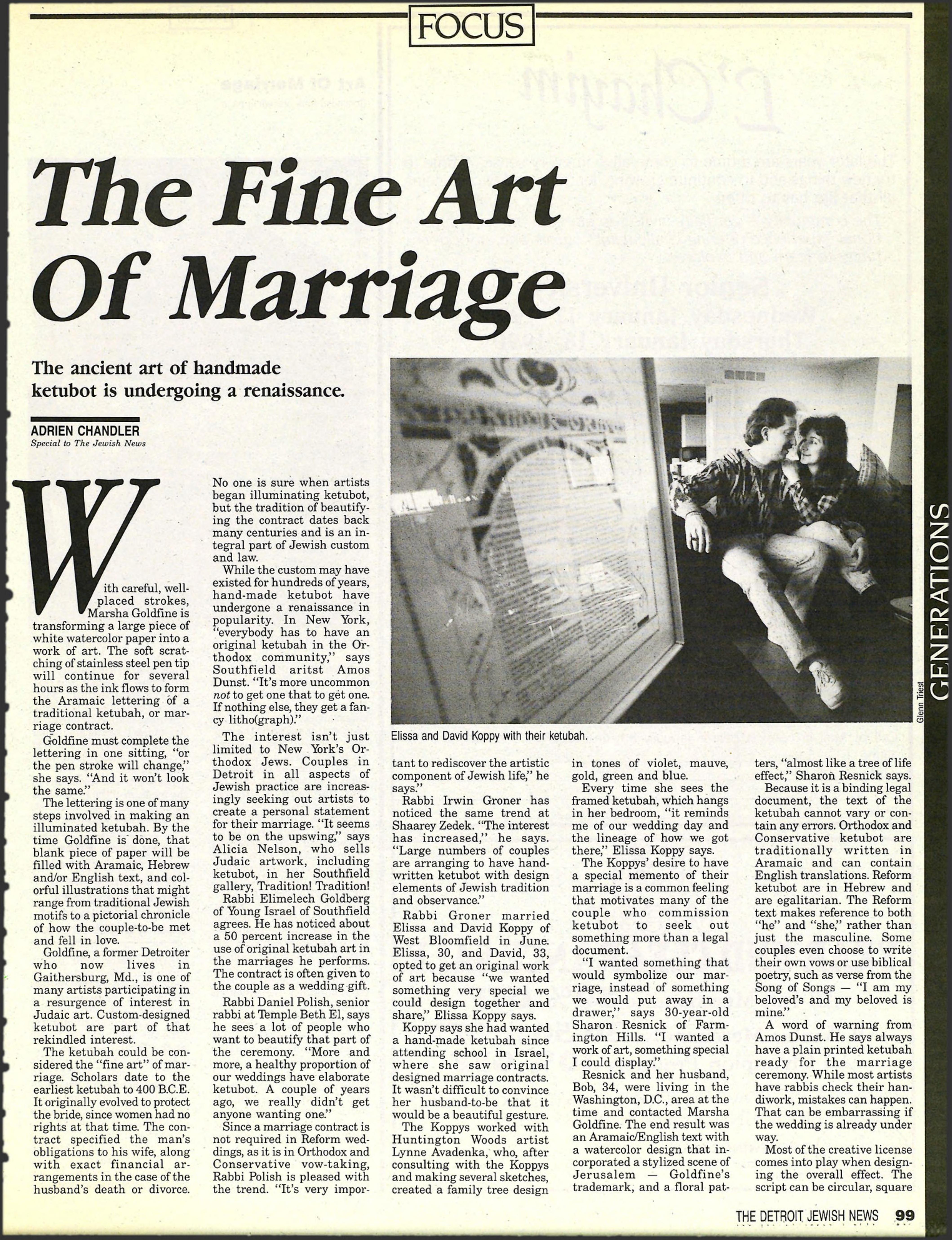
Elissa and David Koppy with their ketubah.
tant to rediscover the artistic
component of Jewish life," he
says?'
Rabbi Irwin Groner has
noticed the same trend at
Shaarey Zedek. "The interest
has increased," he says.
"Large numbers of couples
are arranging to have hand-
written ketubot with design
elements of Jewish tradition
and observance."
Rabbi Groner married
Elissa and David Koppy of
West Bloomfield in June.
Elissa, 30, and David, 33,
opted to get an original work
of art because "we wanted
something very special we
could design together and
share," Elissa Koppy says.
Koppy says she had wanted
a hand-made ketubah since
attending school in Israel,
where she saw original
designed marriage contracts.
It wasn't difficult to convince
her husband-to-be that it
would be a beautiful gesture.
The Koppys worked with
Huntington Woods artist
Lynne Avadenka, who, after
consulting with the Koppys
and making several sketches,
created a family tree design
in tones of violet, mauve,
gold, green and blue.
Every time she sees _ the
framed ketubah, which hangs
in her bedroom, "it reminds
me of our wedding day and
the lineage of how we got
there," Elissa Koppy says.
The Koppys' desire to have
a special memento of their
marriage is a common feeling
that motivates many of the
couple who commission
ketubot to seek out
something more than a legal
document.
"I wanted something that
would symbolize our mar-
riage, instead of something
we would put away in a
drawer," says 30-year-old
Sharon Resnick of Farm-
ington Hills. "I wanted a
work of art, something special
I could display!'
Resnick and her husband,
Bob, 34, were living in the
Washington, D.C., area at the
time and contacted Marsha
Goldfine. The end result was
an Aramaic/English text with
a watercolor design that in-
corporated a stylized scene of
Jerusalem — Goldfine's
trademark, and a floral pat-
ters, "almost like a tree of life
effect," Sharon Resnick says.
Because it is a binding legal
document, the text of the
ketubah cannot vary or con-
tain any errors. Orthodox and
Conservative ketubot are
traditionally written in
Aramaic and can contain
English translations. Reform
ketubot are in Hebrew and
are egalitarian. The Reform
text makes reference to both
"he" and "she," rather than
just the masculine. Some
couples even choose to write
their own vows or use biblical
poetry, such as verse from the
Song of Songs — "I am my
beloved's and my beloved is
mine." -
A word of warning from
Amos Dunst. He says always
have a plain printed ketubah
ready for the marriage
ceremony. While most artists
have rabbis check their han-
diwork, mistakes can happen.
That can be embarrassing if
the wedding is already under
way.
Most of the creative license
comes into play when design-
ing the overall effect. The
script can be circular, square
THE DETROIT JEWISH NEWS
p9
Scanned image of the page. Keyboard directions: use + to zoom in, - to zoom out, arrow keys to pan inside the viewer.
December 22, 1989 - Image 107
- Resource type:
- Text
- Publication:
- The Detroit Jewish News, 1989-12-22
Disclaimer: Computer generated plain text may have errors. Read more about this.