

PEOPLE
OF LETTERS
I needed someone who would listen to my problems
without judging my actions. My answer;
for nearly a decade was a pen pal I'd never met.
HOPE EDELMAN
Special to the Jewish News
T
he first letter arrived in
a plain white envelope
and was peppered with
exclamation points and
smiley faces. Hi! My name is
Sylvia! I live in Minnesota.
Then Magazine sent me your
name and said you'd like to
have a pen pal. Well, me too!
It was 1974, and I was 10
years old, growing up in a
suburb of New York City and
dreaming of a future as an ur-
ban career woman who wears
high heels. I knew little about
the Midwest except that it
sat somewhere to the left of
New York on the giant wall
map in my fifth-grade
classroom. ("Minnesota?" I
could hear my grandmother
ask. "Are there any Jewish
people there?")
My only concrete images of
Sylvia's home — cornfields,
harsh winters, locust attacks
— were straight from what
I'd read about the Great
Plains in my Laura Ingalls
Wilder books. Do you wear
snowshoes? I wrote back to
her. Do you live in a log
cabin?
Sylvia's life wasn't that dif-
ferent from my own, but it
was different all right. She
knew most of the people in
rl
Hope Edelman is an
associate editor of Special
Report: Living. © 1989 Whit-
tle Communications, Special
Reports.
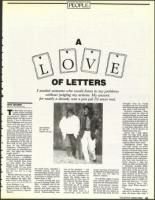
Hope Edelman,
left, with her
longtime pen pal.
her small town, attended a
Catholic church, and went
snowmobiling during school
vacations. No one in her fami-
ly had gone to college, and her
father drove a bus.
It wasn't exactly like that
for me in Spring Valley, New
York. I attended one of the
seven local elementary
schools and knew only the
kids in my grade and Hebrew
school. Snowmobiling was
out of the question — not
enough space and too many
cars. We took family vaca-
tions in the Caribbean in-
stead. My father woke up
before dawn to ride a bus to
his office in the city; 80 per-
cent of my friends would
eventually go off to college
and come back to lead lives
much like their parents'.
It was clear, even to a
10-year-old, that Sylvia
wasn't the kind of friend I'd
be allowed to bring home. But
she was just the kind of
friend I wanted.
On a Friday night 15 years
later, Sylvia waits for me to
step into the Minneapolis/St.
Paul International Airport.
When I do, we cry out and
hug each other hard. Jordan,
her 5-year-old son, stares at
me and shrinks back. He had
thought that he would
recognize me, but he's nearly
four times the age and size he
was when I last saw him.
Sylvia's husband, Dan,
stands to greet me. After an
awkward pause, we exchange
a stiff hug. We've never met,
but I know that he works in
construction; is the father of
Sylvia's second son, Joey; and
is living at home again after
a year-long separation from
his wife. I bet he knows an
earful about me, too.
Sylvia and I hug again.
Then we step back, grasp
each other's elbows, and smile
shyly. We know everything
about each other. We know
nothing about each other.
Throughout junior high
and high school, we wrote
twice a month. Most of those
letters contained hefty doses
of adolescent angst. My face
wouldn't stop breaking out;
she wanted to lose 10 pounds.
My parents were overprotec-
tive; hers were involved in a
bitter divorce. I told her
about my first real boyfriend,
a reformed juvenile delin-
quent who let me wear his Ar-
my jacket, wrote me love let-
ters on lavender paper, and
then cheated on me when I
went away to summer camp.
She wrote about losing her
boyfriend, Kris. I'm still so in
love with that guy — I can't
stop thinking about him.
Hope, help! What should I
do?
Writing to Sylvia was a
safe way to develop a friend-
ship; she knew only what I
THE DETROIT JEWISH NEWS
97