

ISRAEL
Ate Too, Brute?
J
erusalem — Guests to
the Cardo Culinaria
are welcomed with
the sound of the lyre
and are led to one of
several triclinia, U-shaped
configurations of three tables
and three benches. Tunic-clad
staff members tie toga-like
sheets around the guests who
then settle back under vaulted
ceilings and amid walls
painted Pompeii red, a
salmon-colored hue, and
adorned with frescoes showing
no human figures.
Laid out on the limestone
tables are blue and green
glass dishes and cups, wide
serrated knives . and large
spoons with bent handles.
Tiny oil lamps dot each table.
A search for a fork would
prove fruitless. They weren't
invented until the Middle
Ages and the Cardo Culinaria
— located along the recon-
structed Byzantine shopping
thoroughfare in the Old City's
Jewish Quarter — is strictly a
Roman eatery.
More precisely, it is a
reconstruction of how
Romanized upper-class Jews
may have dined during the
days of King Herod, 2,000
years ago. The Culinaria
(Latin for kitchen) is an idea
whose time has gone and
come again. At least, that's
the hope of owners Fran and
Bernie Alpert, former
Americans who run an ar-
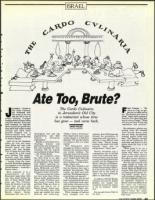
The Cardo Culinaria
in Jerusalem's Old City
is a restaurant whose time
has gone — and come back.
DAVID HOLZEL
Israel Correspondent
cheological tour and dig
organization, and Rafi
Nahum, a Jerusalem
restaurateur.
Besides a novel blend of ar-
cheology, history and
gastronomy, the Culinaria of-
fers some parallels for Jews
wrestling with the cultural
encroachment of today's Rome
— the United States.
"In any civilization where
the Jews lived in an open
society there was an amount
of assimilation," Fran Alpert
says. lbday's American ex-
ports to the world include blue
jeans, McDonalds and MTV.
Rome had its own exports that
foreigners found irresistible.
"If you go across the empire
you have some basic things:
Roman baths, amphitheaters
and a cardo. Trinclinia have
been found in London, Paris
and Italy. There are three in
Israel and they're not in
Roman houses," Alpert says.
Just like today, Jews 2,000
years ago wanted the latest
fashions and technology.
"Sadie, I want a triclinium,"
Fran Alpert calls out to some
unseen spouse in a Herodian
mansion. "For me, the tension
is to remain a Jew in a larger
society."
The Romanized Jews
managed to strike a balance
between the imperial culture
and Jewish tradition. The
Culinaria tries to do the same.
While Most American Jews go
out to "kosher-style" delis, the
Culinaria's "Roman-style"
fare is kosher to modern stan-
dards, Alpert says.
"If the Jews wanted to eat
like the Romans they had a
problem;' she continues. "The
number one foods were pork
and hare. The Romans also us-
ed partridge and peacock!'
The Herodians, who by and
large maintained Jewish prac-
tices, substituted treife meat
with kosher alternatives like
chicken when preparing their
Roman recipes, Alpert says.
The Culinaria does the same.
While concepts of kashrut
have changed over the
millenia, Jews 2,000 years ago
followed the proscription of
separating milk and meat —
perhaps a less difficult task
than today. "Except cheese,
nothing was made with milk
because there was no
refrigeration," Alpert says.
Herod's Jerusalem was a
cosmopolitan city of 100,000
souls whose ranks were swell-
ed three times a year by Jews
coming from other parts of the
country and the Diaspora for
Pesach, Shavuot and Sukkot,
Alpert says. The city limits ex-
tended beyond today's Old Ci-
ty to the south and the City of
David and to the north to
what is now the central post
office on Jaffa Road.
In addition, Herod's Temple
attracted not just the Jewish
faithful, but "people who
wandered around the empire
to see its wonders;' Alpert
says.
But enough history. Back to
the food.
F
first Course — "We
serve no Coke, no gin-
ger ale, no coffee and no
tea. The Romans had none of
these," Alpert tells a group of
families from Maryland who
are on a tour of Israel. "What
will you eat then? Fruits and
vegetables and poultry."
She indicates a pitcher con-
taining wine. It's watered
down because Roman wine
was very thick, she explains.
Another pitcher holds malt
beer. The Romans thought
beer was for barbarians, but
malt beer was known in this
region since the time of the
Egyptians
"We're going to do you a
favor and give you water,"
Alpert says. Water was not
drunk in the empire because
most sources were polluted.
She offers another concession
to modern habits — napkins.
Now the staff come by with
copper basins to wash the
guests' hands. Large pitot are
served. Some are dusted with
oregano. Four types of salads
are presented in ceramic ser-
ving bowls: carrots; lettuce
and cucumbers; cabbage, broc-
coli and cauliflower; and pickl-
ed vegetables. Unknown in
Roman times and absent from
the menu are tomatoes,
potatoes, corn and eggplant.
Sampling the wine, one diner
says it tastes like claret;
another compares it to a light
fruit wine.
.
THEDETROIT JEWISH NEWS
43