

■
PROFILE
This Endures
And Will Not
Diminish
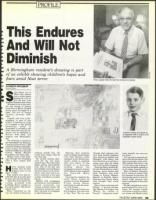
A Birmingham resident's drawing is part
of an exhibit showing children's hopes and
fears amid Nazi terror.
Henry Leopold holds the book that includes his drawing.
ELIZABETH APPLEBAUM
pl,,,tures Editor
S
ome places are so
filled with history
that a slight breeze
passing by will re-
vive the past, poet
Siegfried Sassoon once wrote.
No breeze stirs in this room,
but the sounds of history
come alive as Henry Leopold
slowly turns the pages of a
book; The Art of Jewish
Children,. Germany: 1936-
1941.
Leopold, who lives in Bir-
mingham, is part of this
history. A drawing he made
as a student in the Jewish
elementary school in
Dusseldorf is included in the
book. Later this year, the col-
lection will be exhibited in
Detroit, New York, Los
Angeles and Washington,
D.C.
The collection is housed in
the Dusseldorf City Museum.
Consisting of more than 1,000
works by children and profes-
sional artists, the drawings
had been hidden by a German
woman, Mieke Monjau
throughout the Nazi years.
Menjou came to the draw-
ings through her friendship
with a man named Julo
Levin.
H
enry Leopold could
hardly wait for first
grade to start. It was
April 1, 1933.
Nazi leaders were also ex-
cited that day. It was the start
of their anti-Jewish boycott.
"Don't Buy From Jews!" the
writing screamed from
buildings Henry passed on
his way to school. "Die, Jews!"
others read.
Henry continued on his
way, his mother protectively
Leopold's drawing and (above) as
he appeared while a student at the -
Dusseldorf Jewish school.
walking beside 'him. He
would never forget what he
saw that day.
For several months after-
ward the city was quiet,
Leopold says. Then the orders
began, quietly and methodi-
cally. One of the first new
laws forbade "overcrowding in
German schools and univer-
sities." Jews were not to ex-
ceed 1.5 percent of the total
number of students in public
schools.
Replete with synagogues
and yeshivot, the Dusseldorf
Jewish community was
vibrant, Leopold recalls. He
remembers seeing men wear
their top hats to synagogue
on Rosh Hashanah.
Hearing their students
could no longer attend classes
with other German youth,
members of the Jewish com-
munity rallied to establish
their own school. It was
located in a four-story
building behind the
synagogue courtyard. Among
the hundreds of new students
was 8-year-old Henry
Leopold.
Carrying his sandwich for
lunch, Henry walked 25
minutes to to the Dusseldorf
Private Jewish School;
sometimes, he rode the street-
car with friends.
One of his best friends was
Eric Leighton, who now lives
in New York. The two met
through their parents, who
were close friends. Leighton
often played toy soldiers and
Monopoly with Henry and
describes him as an attentive
young man who got along
well with his fellow students.
Each day Henry studied Bi-
ble and Jewish history, math,
German, social science and
shop. Students also took
classes in French, Hebrew,
Spanish or English, depen-
ding upon the country where
they thought they could
resettle.
Henry chose conversational
Hebrew. "I learned phrases
like 'Mother, I'm hungry' and
`What's the capital of
France?' — things you would
never actually use once you
got there."
Art was also a required sub-
ject at the Jewish school. The
class was taught in the cellar.
The teacher, Julo Levin, was
"a very artsy type of person"
who wore his beret creased up
at the edges, Leopold recalls.
Born in Stettin, Germany,
Levin loved art almost from
the moment he was born. By
the time he was 6, he had col-
lected 3,000 pictures that
came in packages of chocolate
squares.
He later attended art school
and displayed his work in ex-
hibits. He became friends
with fellow artist Franz Mon-
jau, whose wife, Mieke, saved
THE DETROIT JEWISH NEWS
59