
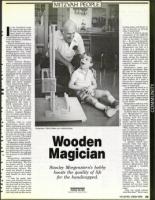

Morgenstern, Patrick Weeks and a standing frame.
Wooden
Magician
Stanley Morgenstern's hobby
boosts the quality of life
for the handicapped.
SUSAN SALTER
Special to The Jewish News
tending class, and there's no
way to describe my feelings
when I heard that."
Dr. Barry R. Berlin, the ad-
ministrator of the SMI-SXI
center, calls Morgenstern's ar-
rival on the scene "a lucky
day — for me and especially
for my students." Both Berlin
and Adler point to the way
Morgenstern can look at a
picture in a catalogue, in-
evitably of a high-priced piece
- of commercial therapy equip-
ment, and re-create it in
wood, saving the students'
families and the health and
education agencies con-
siderable amounts of money
in the process.
Morgenstern enjoys one-
upping the catalogues. Take
the case of the teetertotter.
What he saw in the catalogue
'was just a fulcrum with a
flat top and a board. Sixty-
three dollars! So I built a
fulcrum for a recessed board
between two uprights with a
piece of closet pole.
"I recessed the board so it
couldn't move from side to
side, cut half-circles into the
wood to ride on the pole
without sliding backward or
forward. I put a support board
on the backs and handholds
on the fronts."
Morgenstern ended up with
a vastly improved version of
the catalogue teetertotter,
"and mine ran less than $20."
As Berlin sees it, carpentry
isn't Morgenstern's only
talent. He also has a gift for
working with his young
• charges. "Many people in our
• society haven't had contact
• with people who have severe
impairments," Berlin says.
"What makes Stan unique is
that he doesn't get so con-
stantly distraught around the
students that he can't go for-
ward. He sees them all an in-
dividuals with special needs,
and that's extraordinary."
"I distance myself emo-
tionally from the kids,"
Morgenstern admits. "Hav-
ing a handicapped child is a
big enough burden for
families without the financial
burden [of buying expensive
equipment]." By not charging
for his services, and having
state agencies help the
parents for the building
material, Morgenstern feels
he is making a valuable
contribution.
"Until I started this work,
I never appreciated how these
kids were called 'special' "
Because of their multiple
handicaps, "some of these
kids can't really express
themselves. But their
teachers tell me how much
they love some of their equip-
ment."
"How can words express
what Stan does?" Berlin says.
THE DETROIT JEWISH NEWS
33
NOMUMZITI
III n the Southfield condo
he shares with his wife,
Brinah, Stanley Morgen-
stern points out pieces
of polished cabinetry he's
handcrafted over the years —
a chest of drawers, a bookcase,
some end tables.
They're all beautiful, but to
the staff and students of Oak
Park's SMI-SXI training
center at Einstein School,
Morgenstern's true wood-
working genius comes in the
form of balance beams, tray-
tables, and the occasional
teetertotter.
That's because Morgen-
stern, a freelance insurance
broker, has been donating his
time and talents for the last
eight years to building
therapeutic and assistance
equipment for the students of
SMI-SXI, a facility for
children and adults with
severe mental impairments
(SMI) and severe multiple
motor impairments (SXI).
It began during World War
II, when Morgenstern was
stationed in Sardinia with
the Air Force. "I wanted a
chair to sit in, so I built one,"
says the self-taught carpenter.
Household furniture pro-
jects followed and, by 1981,
Morgenstern felt ready to
tackle community work. A
trip to Montreal, where he
visited a relative who worked
at a center for crippled
children, inspired Morgen-
stern to contact some Detroit-
area agencies, but to his sur-
prise, "Nobody was in-
terested."
Nobody, that is, until
Morgenstern called Lezlie
Adler, marketing and train-
ing coordinator at the Detroit
Institute for Children. "I
told her anything that could
be built out of wood, I could
build," he recalls. "She asked
me how soon I could meet her.
I said, 'How's tomorrow?' "
Morgenstern began modify-
ing wheelchairs and creating
standing frames for the DIC,
and Adler says that many of
his projects are still in use to-
day. Eventually, she referred
the carpenter to the SMI-SXI
center.
Morgenstern remembers
some of his early assignments
as real challenges. "My first
big project was for a young
woman who had trouble
maintaining balance. She
could not attend a certain
class just because she couldn't
hold herself on their high
stools.
"I took the metal stool
home and attached the bot-
tom of the legs to plywood, so
the stool had its own floor. I
added strips of wood to the
seat to support her all the
way around. A couple weeks
later they told me she was at-