

kay, let's face it.
John Molloy really
did have a better
idea. Well, let's at
least agree, he had
a good one. Surely
you remember:
single - breasted,
gray flannel suit; burgundy-striped
tie; white, button-down, oxford
cloth shirt; wing-tipped shoes — the
proper way to "dress for success,"
according to Molloy's book.
In many cases, men who
followed those strict but simple rules
for dressing-to-get-ahead seemed to
be the very ones who did go on to
become heads of their own compa-
nies, prominent doctors and lawyers
and upper management types. Iron-
ically, today these same young
upwardly mobile guys are the ones
who are going into stores, making up
their own rules and dressing the way
they feel most comfortable.
ACTIVEWEAR: This is a well
dressed, self-assured, physically fit
man who begins his day with a
workout. Once, he would have been
satisfied with a pair of gym shorts
and an old T-shirt for cycling,
running, weight lifting or aerobics.
Today, he opts for California-inspired
clothes.
Body-conscious
clothing
remains newsworthy, with Lycra an
important fiber. Think biker's shorts;
think capri-length pants worn with
an oversized T-shirt. Here's where we
see neon brights from the 1960s
such as lime green, fluorescent
orange and chrome yellow, often
colorblocked with black or white.
Patterns are also from the heyday of
the '60s, with peace signs,
checkerboards and psychedlic prints
and batiks.
Yachting jackets, sweatshirts
and tapered boxer-style swim trunks
use crests, stitching and silkscreening
for fashion interest.
TAILORED CLOTHING: After
.•••;z4,:::- -•:••••,...-.•
•
*'
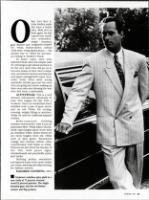
Cricketeer redefines glen plaid in a
new cloth of 75 percent worsted
wool/2 5 percent polyster. The single-
breasted gray suit has two-button
closure and flap pockets.
SPRING '89 69