
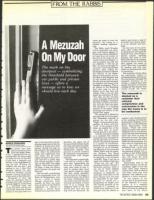

'FROM THE RABBIS
A Mezuzah
n My Door
The mark on the
doorpost — symbolizing
the threshold between
our public and private
lives — offers a
message as to how we
should live each day.
C-3
CO
HAROLD SCHULWEIS
Special to The Jewish News
T
he streets were dark
and the numbers on the
curb were faded. 'Tenta-
tively, I approached the un-
marked door. No name could
be made out but on the side
of the door a mezuzah was
affixed. I was emboldened to
ring the bell. Whether the
resident was the one I was
seeking or not, I knew that
whoever opened the door
would be a kinsman. In that
instant I sensed the potency
of the mark on the door-post.
Thousands of years ago
when our ancestors were in
bondage, they took a bunch of
hyssop, dipped it in the blood
of a sacrificial lamb, and
struck the lintel and the two
side posts (mezuzot) of their
homes. It was put there as a
sign to be honored by the de-
stroying angel sent to free the
children of Israel from their
captors. Seeing the sign on
the doorpost, the angel would
know where the persecuted
reside and would pass over
their home. But do God's
angels not know who is inno-
cent and who is guilty that
they should require a visible
sign on the door? The sages
explain, "Once destruction is
let loose it does not distin-
guish between the good and
the bad."
The mezuzah, a parchment
of two paragraphs from the
Book of Deuteronomy writ-
ten by a scribe in square
Hebrew characters, tradi-
tionally 22 lines, (as many
lines as letters of the Hebrew
alphabet), is affixed to
dedicate a Jewish home.
Placed in the top third of the
doorpost, the upper end of
the case tilted towards inside
the home, the lower end point-
ing outward, the mezuzah is
deliberately slanted. Few
gestures in Jewish tradition
go unnoticed, uncommented,
unassociated with deeper
meaning.
The mezuzah is raised high,
I was told as a child, so that
poor men, approaching the
home for a handout, would
raise their head to kiss it.
And in raising their head,
their spirits would be raised
and they would remember
that the God of the beggar is
the God of those who dwell in
the home. Understand, that
your God is his God. One law,
one God, one Father in whom
each of us is imaged. One
shepherd feeds us all. The
Jewish poor man must not
beg with eyes downcast. He
raises his head to kiss the
mezuzah. He comes as a
brother seeking righteous-
ness.
The Bible itself (Exodus
21:5-6) associates the door-
post with human dignity. If
the servant who is entitled to
be freed from his master at
the end of six years of ser-
vitude comes and declares, "I
love my master, my wife, and
my children; I will not go
free," he must be brought to
the court. And if the servant
persists upon selling his
birthright in order to achieve
the security of his depen-
dence on the master, he is to
be taken to the doorpost and
his ear marked with an awl.
For the servant has betrayed
his freedom and chosen to be
branded as property. This is
an offense to the liberating
God who took us out of
Egypt to be free men and
women. This is the ear that
heard the utterance of God,
"For they are My servants
whom I brought forth out of
the land of Egypt" (Leviticus
25). They are God's servants,
not servants unto servants.
The doorpost is a standing
symbol of the place where
loosening the fetters of the
bound first began.
The mezuzah is affixed to
the right side of the doorpost.
The Chanukah menorah is
placed on the left side.
"Right" is the symbol of corn-
passion, of mercy and love.
"Left" is the symbol of law.
Both are needed but of the
two sides that of mercy
should prevail in the home.
And the mezuzah is slanted
as a reminder that rational
compromise and concession is
the way the home is to be con-
ducted. The slanted mezuzah
is a symbol of conciliation,
derived from a compromise
wrought out of the contend-
ing opinions of two renowned
rabbis, Rashi and his grand-
son, Rabbenu Tam. Rashi
held that the mezuzah should
be attached to the doorpost
'vertically. Does it not say to
teach your children God's love
"When you rise up?" His
grandson however favored a
horizontal position. Does it
not say to teach children
"And when ye lie down?"
Scripture is frequently on
both sides. What then is to be
done? Should each one hold
on obdurately to his inter-
pretation or should not a
compromise be sought out?
The slanted position of the
mezuzah is a symbolic re-
minder that obduracy is not
strength, that the wisdom to
bend is not always a sign of
surrender but a power great-
ly to be admired and emu-
lated.
On the back of the parch-
ment, often visible through
an opening near the top of the
mezuzah case, three Hebrew
letters appear, spelling
Shaddai, the name of God.
Some take this as an acronym
for Shomer Daltot Yisrael, He
who guards the doors of
Israel. The home is guarded
by wisdom and love that
yields an interpersonal ethic
of concession.
But symbols, rituals, ideas
are notoriously subject to
misinterpretation and misuse.
So some pietists thought the
mezuzah functions as an
amulet, a magical form that
guards the doors of Israel by
warding off the demons that
would invade the home.
The mezuzah is
slanted as a
reminder that
rational
compromise and
concession is the
way the home is to
be conducted.
Against such disfigurement
of the meaning of mezuzah,
Maimonides inveighed. In his
Book of Love in the Mishnah
Torah, Maimonides wrote
sharply, "Those who write
names of angels, holy names,
a Biblical text or inscriptions
within the mezuzah are among
those who have no share in
the world to come. For these
foolish people not only fail to
fulfill the commandment, but
they treat an important pre-
cept — the unity, love and
worship of God — as if it were
an amulet to promote their
own personal interest. For ac-
cording to their foolish minds
the mezuzah is something
that will secure for them
advantages in the vanities of
the world."
Maimonides lived in the
eleventh century but his ad-
monitions apply to our day
when Jews hang mezuzot
around their neck as charms
and when some even trace
personal and collective tra-
gedies to a faulty mezuzah.
At the bottom of the
obverse side of the parchment
in the mezuzah is a cryp-
togram. It is a sentence
declaring the oneness of God.
But it is written by taking the
next letter of the letters
THE DETROIT JEWISH NEWS
53