

SPORTS
Numbers Game
Girls' sports are more popular than ever. Is it important to
have them coached by women?
MIKE ROSENBAUM
Sports Writer
p
articipation and interest in
girls' high school athletics
in Michigan have risen steadi-
ly in the past dozen years. In the
1976-77 school year there were 3,143
girls' varsity teams, according to
figures from the Michigan High
School Athletic Association. Last
school year there were 4,051 teams.
Although more girls are par-
ticipating in sports, fewer women are
coaching. There were 1,846 women
varsity coaches in 1976-77, the
earliest year that MHSAA statistics
are available. Women represented
57.5 percent of the total number of
coaches in varsity girls' sports. Last
year there were 1,185 women
coaching girls' sports, 29.3 percent of
the total.
Midge Mills, the 11-year veteran
volleyball coach at Birmingham
Seaholm High School, believes "there
are a lot of young women coming out
of college programs now that are
equipped with all the technical
volleyball knowledge you could ever
want in a coach. Of course what they
have to learn are coaching skills. But
I think there's a bigger pool now of
prospective coaches."
But Mills believes that women to-
day have fewer opportunities to coach
because more women work full-time.
Most coaches must either be teachers
or part-time workers in order to have
time for coaching because teams
generally practice immediately before
or after school. "A lot of these kids
(women athletes) come out, they've
played college ball for four years, but
their major is chemistry or English or
computer science," says Mills. "And
they've got nine-to-five jobs, which
really takes them out of the coaching
ranks."
Ronna Greenberg, who recently
completed her first year as basketball
coach at West Bloomfield High
School, says other factors keep women
from coaching. In addition to their ex-
panding role in the workforce, they
also face old-fashioned problems of
gender-role stereotypes. Women, even
working women, are still regarded in
most families as the primary
homemaker. "They're married; they
want to have their family and they
want to be with their family," says
Greenberg. "Coaching is a tough,
tough thing to do because if you're go-
ing to be good you're going to be spen-
50
FRIDAY, DECEMBER 9, 1988
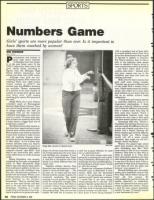
Midge Mills instructs her Seaholm team.
ding a lot of time away from home, a
lot of time preparing with your team
and building your program. If your
mate doesn't understand that, forget
it. And face it, the female role in the
family is so much different than the
male's role."
Seaholm athletic director Dick
Rosenthal says participation in girls'
sports is "at an all-time high . . . You
go back 10, 15 years and you have
literally half the number of sports. It's
constantly escalating. The media
coverage is much greater. The oppor-
tunity for recognition is bigger than
it ever has been before: But there is
a need for women to stay and get in-
volved in organized athletics after
their playing days. They serve as role
models. We need 'em as coaches; we
Glenn Triest
need 'ern as game officials; we need
`ern as administrators."
If a man and a woman were com-
peting for a coaching job with a girls'
team at Seaholm, Rosenthal says, "I
would take the more qualified person.
If everything is almost equal, I would
go with the woman."
Despite the willingness of athletic
directors such as Rosenthal to hire
women, Mills says the downward
trend in the percentage of women
coaches in girls' sports may continue.
"I would like to see more young
women getting into it," she says. "It's
going to depend a great deal on what
happens in our teaching profession
and what kind of changes and what
kind of turnover we have there . . . I
don't know if we're hiring teachers
with a secondary look at their abili-
ty to coach athletic teams. First, we've
got to hire them because they're good
in Spanish or algebra or whatever.
But they're going to have to take a
look at the expertise these people
have in athletics if they're going to
want coaches from within the system
— and that's where most of your
coaches come from — because more
and more, women now are in the
workforce and more and more are
working full-time."
Mills cites two main reasons that
girls need some women coaches.
"Number one, you get a different kind
of role model from a woman than a
man. I think women need role models,
people who either are or have been
good athletes, so you know that you
can be an athlete without being
unfeminine .. .
"I think men and women operate
on somewhat different levels in in-
trapersonal relationships. I think
they get a little bit different outlook
and a little bit different relationship
from a woman coach than they do
from most men coaches. That's a
generalization because some men
coaches are very close to their girls
and some women coaches may not be."
Greenberg adds that "there's a
friendship that develops between you
and your coach. It's different when it's
a male and a female, and when it's a
female and a female. Because dif-
ferent emotions get involved, different
things bother you. Where things
would roll off a male coach's
shoulders, they might not roll off a
female coach's shoulders."
Women who played high school
sports have another advantage over
men, Greenberg says. Men "don't
know what it's like to be in women's
athletics. They have no idea what it
takes to succeed in it. They don't
know what exists elsewhere and what
other female programs are doing. Not
to say that I do, but at least I have a
good idea of what kind of competition
is out there all over the place, just
because I was exposed to it."
Howard Golding was a successful
varsity girls' basketball coach at Oak
Park High School before taking the
boys' job this season. He
acknowledges the need for female role
models, especially in basketball,
where 19.4 percent of last year's girls'
varsity coaches were women. "There's
a need for more women basketball
coaches," he says. "It basically started
to get dominated by men."