

I EDUCATION
DETROIT'S
HIGHEST
RATES
12 MONTH CERTIFICATE OF DEPOSIT
8.200%
8A56%
8.300%
8.562%
Effective Annual Yield*
Minimum Deposit of $500
Effective Annual Yield*
Minimum Deposit of $75,000
•Compounded Quarterly
Rates to change without notice
This is a fixed rate account that is
insured to $100,000 by the Federal
Savings and. Loan. Insurance Cor-
poration (FSLIC). Substantial Interest
Penalty for early withdrawal from
certificate accounts.
FIRST
SECURITY
BANK FSB
MAIN OFFICE
1760 Telegraph Rd.
(Just South of Orchard Lake)
I OUR I MOUSING
OPPORTUNITY
48
PHONE 338.7700
3527700
HOURS:
MON.-THURS.
9:30-4:30
FRI.
9:30-6:00
FRIDAY, DECEMBER 9, 1988
MEMBER
FSLIC
Federal Savings & Loan Insurance Corp.
Your Savings Insured to $100.000
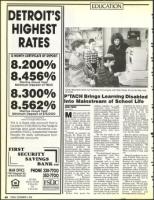
Teacher Maria Sanko directs Yudi Hochheiser at the computer, while Yanky Perczyk, left, and Itzy Zeiler study
the screen.
P'TACH Brings Learning Disabled
Into Mainstream of School Life
HEIDI PRESS
News Editor
M
oshe can't read. He
can do math, parti-
cipate in science, ex-
cel at sports, is artistic and
goes to regular classes just
like his peers. But when it
comes to reading, Moshe
needs a little extra help.
That's where P'TACH comes
in.
P'TACH, an acronym for
Parents for Torah for All
Children, is a program based
at the Yeshivath Beth
Yehudah and Sally Allan
Alexander Beth Jacob School
for Girls which helps learning
disabled children be
mainstreamed into regular
school activities. Rather than
focusing on the child's
weaknesses, the program
seeks to build self-esteem by
working on his/her strengths.
Founded in 1979 by
members of the Orthodox
community, P'TACH aims to
give "every Jewish child, no
matter what their affiliation,
the Jewish education they're
entitled to by their bir-
thright," P'TACH board
chairman Michael
Hochheiser said. Hochheiser,
who has two children in the
program, will be the honoree
at the organization's annual
fund-raising dinner Jan. 8 at
Congregation Dovid Ben
Nuchim.
Rather than group the
children together in a self-
contained class, P'TACH
seeks to mainstream them as
much as possible. They attend
regular classes, except in
areas where they need special
attention. When the class
meets in which they need ex-
tra help, the P'TACH children
go to a resource center where
a teacher gives them projects
and activities to strengthern
areas where they have
difficulty.
"We hit the child on all
fronts — visual, auditory and
manipulative," explained
Debbie Rothbart, a teacher,
psychologist and coordinator
of the girls' program. "We
focus on building strengths,
compensating for
weaknesses."
"The child doesn't miss out
on anything," said Tzvi
Burstyn, president of
P'TACH. "The school
cooperated with us in that
sense." Burstyn explained
that while all the other
children are in English class,
P'TACH students will be in
their English class. When the
other students study math,
students in the P'TACH
resource center study math.
According to Dr. Rothbart,
the children coming to the
resource center often have a
history of failure. The teacher
will focus on building the
child's self esteem, showing
what he/she can do, and work-
ing with the child until he
.
completes the task or activi-
ty. To make the work more at-
tractive to the child, the
teacher will look for the
child's area of interest —
sports, music, art, history —
gear program accordingly.
At the same time, P'TACH
promotes the resource center
as a privileged area rather
than a place for children with
problems The non-P'TACH
students are regularly invited
in to see the room.
But the special assistance
P'TACH provides does not end
with the day's-end school bell.
Parents are encouraged to
continue the process at home.
According to Rothbart, "We
work with the home in a sup-
portive, non-intrusive way.
We're available if they need
us."
About 15 students are serv-
ed by P'TACH. There are two
classrooms, but according to
Burstyn the need is great
enough for more. "We're look-
ing to expand, but we're
strangled by finances,"
Hochheiser added. P'TACH is
funded by the annual dinner
which provides 50 percent of
the budget, a raffle, a public
campaign each fall and by
private solicitations.
"We're at a critical point,"
Rothbart said. "We see gaps
in the kids that we service."
She said programs are need-
ed for the emotionally im-
paired, physically and
developmentally disabled.