

is valuable in our lives? And
what can be gained without
suffering? Do we want to love
and be loved?
He came to me, this man,
with his doubts and asked in
all seriousness, "How do I
know if I love her?" I answer,
"Are you willing to sacrifice
for her sake, to suffer with
her? If you answer 'yes: it is
a sign of love, but if you
answer 'no,' it means that
here there is no love." To love
and be loved requires com-
patibility and compassion,
two etymologically related
terms derived from the latin
Corn and pati, "to bear, to suf-
fer." Whoever loves a spouse,
a child, a parent, a friend
opens himself up to wounds.
Vulnerability is the price love
pays for its wonders. To love
and be loved by a child — is
there ever a moment that we
stop worrying about our
children as long as we live? To
love and be loved by parents,
those whose name we cry out
in the black night when we
are feverish and alone,
parents who someday will cry
out our name reversing their
parental roles with us, does it
not demand responsiveness,
suffering, and reciprocity? No
one can hurt us more than
those we love.
And so with friendship.
Can we have a friend or be a
friend without offering some
sacrifice of self? Where is
friendship more truly tested
than when deprivation and
sacrifice is called for? Who
will hear the confession of our
errors and not condemn; who
will contain your fears, who
will add their blood to our
own? Is there anything we
want, anything that brings us
joy that is immune to strug-
gle and pain?
And so with creativity. Can
we write an essay, compose a
song, paint a picture, play an
instrument, run a race with-
out pain?
Hedonism misrepresents
real living. Against the illu-
sion of hedonism, Judaism
presents us with an unflinch-
ing Reality Principle. Cast
out of the Garden of Eden in-
to the real world, Eve is told
by God the principle of life:
"With pain and travail shalt
thou bring forth children." No
birth without sacrifice. In
your blood, Eve, you give life
to the world. And to Adam,
God spoke reality, "In the
sweat of thy face shalt you
eat bread till thou return in-
to the ground, for out of the
earth wast thou taken; for
dust art thou and unto dust
shalt thou return."
The myth opens the inno-
cent eyes of Adam and Eve to
the real world, east of Eden.
Pain is the companion of
birth. Pain is the companion
of growth. The whole of life is
nothing but the process of
giving birth to oneself. rIb live
and to love, to create and to
work one must be willing to
suffer. One must be willing to
rip thorns and thistles from
the earth's growth and
wrestle with God's angels and
rise up limping lame. To give
birth to another or to give
birth to your own self is to en-
dure anguish. Life is filled
with births and deaths, with
attachments and separations.
So Hedonism couples two
ideas — the pursuit of
pleasure and the avoidance of
pain — that turn out to be
contradictory. Judaic wisdom
knows that spiritual, cultural,
aesthetic, creative pleasures
cannot be achieved without
pain.
When hedonism is caught
in the lie, it holds out a
heavier dose of enticements.
If the pleasures we seek are
too painful to accomplish, if
it requires too great an effort
to master a talent or to
transform the perverseness of
society, if the desire of our
hearts is too high or too
heavy to achieve, then drop
them for pleasures that come
without pain. If love requires
commitment, if struggling
against blood, sweat, and
tears, then let go of the ideals.
Relax, play it cool, don't let
things bug you. 'Mice the
short cut, grab hold of easy,
quick, immediate sensations.
Eat and drink, suck the juices
of easy joy. Feed the body.
There is pleasure enough in
good food, good wine, good
sex. If the self aspires to
higher things, redefine your
self.
From infancy we are raised
to fear pain, to instantly stop
the headache. And we have
found the cure, the techno-
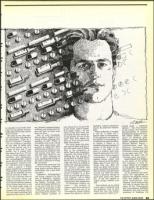
logical panacea. Open up
sacred chest — medicine
cabinet — the Aron Kodesh
of our homes, and behold a
pharmacopoeia of potions
and pills promising salvation.
S20 billion dollars a year
spent on sleeping pills,
stomach settlers, headache
tablets, analgesics. Dexamils,
Halcion, Restoril, Valium —
amphetamines and bar-
biturates, stimulants and
sedatives: "Cause us 0 Lord
to lie down in peace and raise
us up again unto life." Thy
miracles are daily with us
"evening, morn, and noon:'
Lenin claimed that Religion
is the opiate of the people.
The inversion is more ac-
curate. Opiate is the religion
of the people. Our material-
istic faith is in "Better living
through chemistry."
As we pressure the phar-
macist for soporiphics, we
pressure our religious institu-
tions and leaders to write
quick prescriptions. easy
answers, ritual routines that
will help us escape from the
pains of life. Prescriptions
and proscriptions faithfully
followed by rote will avoid the
exertions of thinking, the
THE DETROIT JEWISH NEWS
25