

PEOPLE
URBAIN'S
HORSEMAN
DAVID HOLZEL
Staff Writer
EM ordecai Richler believes
he will never be anything
but a Canadian-Jewish
author.
Novelists, he says,
have to know the most banal things
to bring their works to life. "Like the
price of a haircut when you were 12
years old. Where you went to fix a car.
Who the baseball players were!'
Richler knows the answers to
these questions for anyone who grew
up in the 1940s on St. Urbain Street
in Montreal's Jewish ghetto. Starting
from any other source would get him
in trouble, he says.
So his protagonists, like Duddy
Kravitz and Joshua Shapiro, grow up
poor in Montreal. And Joshua, like
Richler, spent his early adulthood in
London, married a non-Jew and
returned to Montreal after a prolong-
ed absence.
Richler was in Detroit recently to
speak at a retrospective of his work,
sponsored by the Birmingham
Temple.
The Apprenticeship of Duddy
Kravitz and Joshua Then And Now
are two of Richler's eight novels. It is
a body of work that also includes
titles like Cocksure and St. Urbain's
Horseman, which Richler calls his
most autobiographical work. Not sur-
prisingly, its main character is a Mon-
treal Jew who moves to England and
marries a non-Jew.
Richler is completing his ninth
novel about which he will say nothing
except its title, Solomon Gursky Was
Here. He has been working on it for
six years.
While he says that writing is the
only thing he ever wanted to do,
Richler once told the New York Times,
"I've been resisting writing novels all
my life. I mean, hell, you go up into
that room with your typewriter and
when you come out again you're three
years older?'
Now 55, Richler wonders again
where all the time has gone.
His physical appearance can best
be described as rumpled. Strings of
greying hair hang from his head, too
stubborn to stay pushed back in place.
His bifocals, perched on the end of his
nose, appear to defy gravity and
refuse to fall off.
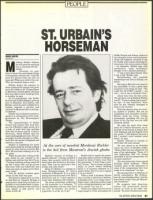
At the core of novelist Mordecai Richler
is the kid from Montreal's Jewish ghetto
Richler's manner of writing is
equally informal. "I always worked at
home. I get up early, work for two-or
three hours and an hour in the after-
noon. Then I go out and have a few
drinks and come home!'
Home for Richler is a cottage on
Lake Memphremagog, 90 miles
southeast of Montreal. It is a quiet
setting that lets him work with little
distraction and so "I don't spend so
much time drinking with friends!'
He shuns technology, preferring
an old typewriter to a computer. "I
murder portables and you can't find
one now," he laments. "An electric
typewriter is as far as I'll go."
Richler has no system for preser-
ving ideas, jokes and bits of dialogue
should he think of them away from
the typewriter. "I don't keep a jour-
nal," he says. "You're always working,
really, so you're always thinking
about it. It becomes obsessive as a
matter of fact. But I try not to impose
it on my family!'
When a book is finished, Richler
says it is both a relief and a letdown.
A finished work "is no longer yours!'
Older works, reflecting another stage
in his writing development, are "pain-
ful to reread. I try not to!'
Richler has dipped into his oeuvre
long enough to write screenplays for
Duddy Kravitz and Joshua. Joshua is
the successful writer and broadcaster
whose life suddenly unravels at age
40. Duddy is the manic, scheming en-
trepreneur who craves a piece of land
— an obsession, Richler says with
amusement, some mistakenly
thought to be a Zionist statement.
"I was a hot Labor Zionist when
I was a kid;' Richler says.
Nevertheless, his youthful
wanderings took him to Europe, not
Israel.
He lived in Paris for two years in
the mid-1950s. It was a great time
and place to be young, he says. "You
could live off of $80 a month — not
well — but it was a wonderful time."
About that time his first novel,
The Acrobats, was published. Richler
was 23. "It was a young man's novel;'
he says. "It was humorless!' Since
then he has "cleverly managed to
keep it out of print?'
With the advance from the novel,
he settled in London. Not yet an
established and successful novelist,
Richler made his living writing
screenplays, including the one for
Room at the Top that won the 1959
Academy Award.
He calls his novel from those
years, St. Urbain's Horseman, an ex-
patriate novel because it doesn't deal
with England and the English from
the inside. "I left England because I
felt I couldn't write another novel
there," he says.
Richler returned to Canada in
1972 after 20 years abroad.
He was raised in an Orthodox
home, the scion of Chasidic rabbis.
"Some of that was very attractive:' he
says of his upbringing. "Some of it
was suffocating. But I've always
cherished it for its romanticism, for
its good qualities!'
His characters also evince mixed
feelings about Judaism. "What
troubles some of the characters is
some of the compromises that were
made to be American," he says.
His personal life is a reflection of
Jewish assimilation. His children,
born of a non-Jewish mother, "get the
best of both worlds. They get Passover
and Christmas?'
He suggests that American
culture has assimilated Jewish
culture as much as the other way
around. "So much of American humor
THE DETROIT JEWISH NEWS
97