

illif hen Ofek-1, Israel's first
satellite, burns itself out
later this month, the big
question will remain
essentially unanswered:
What was the real purpose of Israel's
entry into the exclusive space club?
Only seven other countries — the
United States, the Soviet Union, Bri-
tain, France, China, Japan and India
— have so far demonstrated the desire
and the ability to launch their own
satellites. One reason for the these
ventures has been scientific; another,
unquestionably, has been military.
Does Ofek-1, a 330-pound satellite
launched into a low, elliptical orbit
with its 6.6-pound payload last
month, mean that Israel now has a
spy in space, an orbiting snooper that
is capable of sending home vital
strategic information about the Arab
world?
Israeli officials have denied that
Ofek-1 ("Horizon-1" in English) car-
ries military implications or inten-
tions. Prime Minister Yitzhak
Shamir expressed the bland hope that
the satellite would "bring benefits in
many fields," while Foreign Minister
Shimon Peres insisted that "this is
not a weapon, this is technology."
There were, however, hints that
Israel was hoping for something more
than a stream of unvarnished infor-
mation on space technology and
scientific data from the solar collec-
tors on Ofek-1.
According to Professor Yuval
Ne'eman, head of Israel's national
space agency, the principal purpose of
the satellite was to enhance Israel's
technological know-how, but he add-
ed: "There is military potential in all
this activity."
That did not detract from the
scientific accomplishment of having
put a satellite into space. The Ofek-1
project demanded that "millions of
11
t
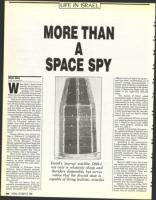
Israel's 'pop-up' satellite, Ofek-1,
not only is relatively cheap and
therefore disposable, but serves
notice that the Jewish state is
capable of firing ballistic missiles
different parts all had to be tip-top —
and they were," said Ne'eman, one of
Israel's leading astro-physicists, a
former head of military intelligence,
former science minister in the govern-
ment of Menachem Begin and now
leader of the right-wing Techiyah
Party.
The success of Ofek-1 added
tremendous luster to Israel's reputa-
tion for scientific and technological
achievement in many fields, a point
underscored by the fact that almost
all the systems were home-made at
the Israel Aircraft Industries, which
is still recovering from the cancella-
tion of the Lavi jet fighter project
earlier this year.
Arab countries, Ne'eman pointed
out, might be able to buy technology,
but it would be many years before
they could produce anything like
their own Ofek-1.
Indeed, it is precisely this point—
the rapid acquisition of sophisticated
missile weapons by Israel's enemies,
mainly from the Soviet Union and
China—that has led to widespread
speculation about Ofek-1.
According to the authoritative
London-based Jane's Defence Weekly,
Israeli military officials have pri-
vately conceded that Ofek-1 carried a
payload that went beyond mundane
scientific equipment. The real pur-
pose of the mission, according to the
journal, was to test surveillance
equipment.
However, Ofek-1 has a life of just
one month and there are no plans to
put a replacement into orbit when it
burns itself out later this month, so
is this theory credible? There are
grounds for believing that it is.
First, Israel is understood to be
dissatisfied with both the quality and
quantity of satellite intelligence it
receives from the United States.
Indeed, at the time of the 1973
Yom Kippur War, the United States
is reported to have stopped supplying
Israel with all satellite intelligence