

The Mod Couple
Continued from preceding page
being an artist and living a conventional
life. "You have the creative drive that keeps
you a little on the edge. Yet you see the
value in the traditional religion and you see
people who have no beliefs, no faith — you
don't want the kind of life they're leading."
three to six months of outlining and plot-
ting. "After I wrote the first book," he
remembers, "I said to myself, 'This writing
is a great gig.' I love being home, I love the
freedom of it." And he adds slyly, "It's
much better than honest labor."
Indoors, the Kellerman house manages
to feel both elegant and lived-in, with orien-
tal rugs, stained glass windows, tromp
d'oeil paintings by Jonathan on the wall
and comfortable old sofas. Two shelves
display at waist height multiple copies of
Kellerman novels, one shelf for hardbound,
the other for paperback editions, like a
bookstore.
oday there is a lot of activity going on
at the Kellermans, most of it unwanted.
A lengthy remodeling, which has added on
a two-level bedroom that will double as a
writing studio for Faye, is not quite fin-
ished. Workmen hammer, haul, call to one
another, burst in with questions. The house
alarm shrills as an electrician checks the
circuits. The phone rings. Shut into a back
room, the family dogs, two Papillons, res-
pond with a frenzy of barking every time
someone goes in or out of the house.
Jonathan and Faye, sitting together on
the living room couch, manage to rise
above their irritation at the commotion.
"It's not a mellow home anyway," says
Jonathan. "There's always an intense
amount of activity going on."
There must be. Jonathan is an accom-
plished amateur painter and guitarist, and
Faye is a bass player, fencer and guitar-
maker. A drum set, belonging to their
oldest child, 10-year old Jesse, is per-
manently set up in the living room,
waiting. The family often plays music
together.
Jesse and his sister Rachel, 7, are at their
Orthodox day school this morning. Jesse
in particular, says his father, is a precocious
student and voracious reader. • Does
Jonathan allow his son to read his novels,
with their violence and strong sexual imag-
ery? "Jesse is free to read whatever he
wants," the author states flatly. "We don't
censor our children. We have a home full
of books and ideas and they're free to
choose what they want. But," he adds,
"kids aren't interested in my books. Jesse
picks my novels up sometimes and says,
`Please don't get insulted, Dad, but they're
kind of boring.' "
Was Faye jealous of her husband's sud-
den and extraordinary success? "Maybe
initially," she responds thoughtfully. "But
the feeling was quelled by having seen him
struggle for so many years — and then the
first thing I write gets published. Maybe
he should be jealous of me. I love Jon's
writing," she continues. "If there's
jealousy, it's when I read his work and say,
`Boy, this is beautiful.' "
The Kellermans are committed to Ortho-
dox Judaism and engaged in Jewish com-
90
FRIDAY, OCTOBER 14, 1988
Photo By Judith Ma rgolis
T
manage the split between religious
and secular, the Kellermans recently
bought a house on the beach in Malibu, a
wealthy community northwest of Los An-
geles. "We spend two weekends a month out
there to keep ourselves sane," Jonathan
says wryly, "and two weekends a month in
town to keep the kids Jewish."
While her parents talk, the youngest
Kellerman, liana, 3, who has her mother's
naturally curly hair albeit in a lighter
shade, wanders in and climbs over
Jonathan to claim Faye's lap. "Because Jon
is home now," says Faye, spooning coffee
yogurt into her daughter, "he gets treated
by the kids with the contempt usually re-
served for mothers." Jonathan, laughing,
doesn't seem to mind one bit. "Rachel," he
recounts, "once told me, 'Daddy, you used
to be a doctor and come home late — now
you're home and I can bug you.' "
The Kellermans married young — she
was 19, a junior in college, he was 22.
Jonathan calls it "almost love at first
sight." "We have a great relationship," he
boasts. "It's true love, with a lot of passion
after 15 years of marriage."
In order to assure themselves of private
time together, the Kellermans have break-
fast or lunch out every day, without their
kids. "We really like each other," explains
Faye "We're happy together. We both work
real hard and we have a good life."
Although both have written novels
about Jewish life, neither has yet managed
to articulate a vision of the special cir-
cumstance of living as Jews in the modern
world. L.A. Times book reviewer Jonathan
Kirsch, for example, found Faye's Sacred
and Profane "curiously inarticulate" about
Judaism and its author "unwilling to con-
front" the issue of intermarriage, which is
integral to the novel.
Similarly, though Jonathan's The Butch-
er's Theater, an exciting and expansive
book of more than 600 pages, is filled with
the texture of life in Israel and with a
plethora of details about the history and
culture of both Arabs and Jews, it ends up
being mainly about its intricate storyline
and rarely about being Jewish.
This is a hazard of the mystery genre,
perhaps. But the Kellermans are so well
situated to accomplish something special
in the Jewish novel, that their fans must
be forgiven the hope that -they will ulti-
mately accomplish the synthesis.
In the meantime, Jonathan and Faye
Kellerman, each turning out a successful
novel a year, are working hard and having
fun.
T II
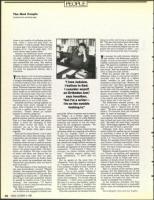
"I love Judaism.
I believe in God.
I consider myself
an Orthodox Jew;
says Jonathan,
"but I'm a writer
I'm on the outside
looking in."
munal life. When Jonathan was to receive
his "Edgar" in a Friday night award
ceremony, for example, he made Shabbat
with Faye in their hotel room, walked to the
ceremony and refused to use the micro-
phone for his acceptance remarks. "He
shouted instead," Faye recalls.
More recently, Jonathan joined several
Orthodox rabbis in a meeting with editors
of the Los Angeles Times to protest
"biased" coverage of the Palestinian upris-
ing. Several weeks later, he participated in
a second private meeting with Paul Con-
rad, whose anti-Israel political cartoons in
the Los Angeles Times have outraged
virtually all segments of the local Jewish
community. "I told Conrad, 'I think your
cartoons, are classic Catholic anti-Semi-
tism,' " Jonathan reports, adding with
some satisfaction, "I don't pull my
punches."
But he speaks at the same time of
"alienation" from the religious communi-
ty. "I'm part of it, but I'm not part of it.
I love Judaism, I believe in God, I consider
myself an Orthodox Jew, but I'm a
writer — I'm on the outside looking in.
Any orthodox religious group — Christian,
Muslim, Jewish — is by its nature conser-
vative and bourgeois. I'm the left wing of
Orthodoxy — I don't wear a yarmulke all
the time. I'm more a free-thinker, I guess.
If I didn't have children, I wouldn't live
here. I don't personally feel I need the com-
munity, but for my children it's essential."
Faye also expresses the tension between
David Margolis writes from Los Angeles.