

E
ach of the Kellermans came to novel
writing very differently.
"I was an aspiring writer even before I
got my doctorate," recalls Jonathan. "In
fact, I had been writing since I was 8 or
9 years old. I was a precocious kid."
At the precocious age of 24, he earned
his Ph.D. from UCLA, where he was also
a cartoonist and columnist for the campus
Daily Bruin. "Every year I turned out a
bad novel," he remembers, "but I had
nothing to say. Later, as a psychologist, I
did very intense work in medical psychi-
Photo By Craig Terkowitz
L
os Angeles — A few years ago,
Jonathan and Faye Kellerman
were not much different from
many other upscale modern Or-
thodox couples on L.A.'s residen-
tial West Side. Jonathan, a stocky, ner-
vously talkative man of 38, was a suc-
cessful family psychologist. Faye, 35, a
slender and energetic woman who had
completed dental school but never prac-
ticed, stayed home with the three Keller-
man children. Like many literate people,
Jonathan had ambitions as a fiction writer
that his friends — after he had written nine
unpublished novels in as many years —
liked to twit him about. "I was a failed
novelist with a good day job," he says now
with a laugh.
Kellerman can afford to laugh: He
recently closed his psychology practice in
favor of a new "day job" writing best-
selling mystery thrillers. In an abrupt turn
of fortune, he has become, he acknowledges
without naming figures, "one of the better-
paid writers in America." He and Faye, a
mystery novelist in her own right, have
even become minor celebrities, with a
write—up in People Magazine to prove it.
The bridge to success for Jonathan was
crime-solving psychologist Alex Delaware,
the hero of Jonathan's first published
novel, When the Bough Breaks, in 1985.
Bough, which has since been made into a
TV movie, won the Edgar Allan Poe Award
and the Anthony Boucher Award fer best
first mystery of the year and catapulted
Kellerman to the front rank of mystery
writers. Delaware and his fictional friend,
homosexual police detective Milo, were also
featured in Kellerman's next two novels,
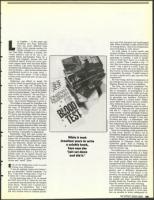
Blood Test and Over the Edge. The latter
has become a bestseller in paperback.
Meanwhile, Faye had also turned her
hand to writing. Whereas Jonathan had a
drawer full of rejection slips, Faye's first
written novel won both a publisher's heart
and the Macavity Award for best first
mystery novel. The Ritual Bath mixes
murder, religion and a chaste romance be-
tween a young Orthodox widow and a bur-
ly police detective who is a Jew with no
Jewish roots. In its sequel, Sacred and
Profane, the romance blossoms while the
detective solves a crime involving pros-
titutes and "snuff" films.
While it took
Jonathan years to write
a salable book,
Faye says she
"just sat down
and did it."
atry and with diseased and handicapped
kids. When I decided to take another stab
at writing fiction, I had a lot of experience
and something to write about."
An avid reader of crime novels and
mystery thrillers, Jonathan says he noticed
that "a lot of these kind of books are about
pathology in families. I said to myself,
`This is stuff that I know.' so I made the
hero a shrink. Then I needed a cop — I
don't like the amateur-showing-up-the-cops
motif — but I gave it a twist: a gay cop,
a very macho guy who just does his job.
But I never sat down and decided to write
a bestseller," he insists. "It didn't seem to
me that a shrink and a gay cop were that
commercial."
He was wrong, and the consequence of
his mistake was last year's contract with
Bantam Books for two more thrillers.
The first, the recently published The
Butcher's Theater, was a change of pace.
Set in Jerusalem, its protagonist is an
Israeli homicide cop who stalks and cap-
tures the psychotic perpetrator of a series
of gruesome sex murders; Publisher's
Weekly called it a "major novel." Keller-
man's fifth book, Silent Partner, another
Alex Delaware novel, is due next year.
While it took Jonathan years to write a
salable book, Faye says she "just sat down
and did it" — that is, taught herself to
write a novel. "I had an extremely vivid im-
agination, which I had always discouraged
in myself because I thought it was very
frivolous and silly — a distraction." She
gives a little shrug, as if that will explain
how distraction may be disciplined into a
career. The Kellermans are, as Jonathan
says, "very organized, disciplined people."
Faye, too, is working under contract now.
A long novel, Quality of Mercy, set in
Elizabethan England and featuring, in her
words, "intrigue and high adventure, with
a Jewish theme," is finished and set for
publication in February. Back at her
typewriter again, Faye is working on
another thriller about the Orthodox widow
and the secular cop.
The Kellermans live, as they did before
literary success touched them, in a large
corner house in one of L.A:s most pleasant
Jewish neighborhoods. The backyard, com-
pletely hidden from the street, contains
two small ponds filled with expensive
Japanese koi fish (a hobby of Jonathan's),
as well as a swimming pool and plenty of
lawn. A lone palm tree rises above a white
gazebo and a children's playground.
Around the corner of the house, in the
driveway, sits the Kellermans' Jaguar, with
the designer license plate WRITRDOC;
the garage has been remodeled into a
writing studio for Jonathan, who works
there for several hours each morning.
He composes perhaps six pages of first-
draft material a day, an impressive work
load. Working this quickly, a novel takes
him six months to write, subsequent to
THE DETROIT JEWISH NEWS
89