

Jewish Groups Take Sides
On The Abortion Question
MIKE ROSENBAUM
T
Special to The Jewish News
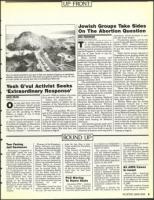
Taba, the disputed beachfront area south of Eilat, was awarded to Egypt by an international
arbitration panel earlier this month. While Israel has agreed to abide by the ruling, the Likud
and Labor parties are accusing each other of contributing to Taba's loss.
Yesh G'vul Activist Seeks
'Extraordinary Response'
DAVID HOLZEL
Staff Writer
ne year ago, there were only
a half-dozen Israeli groups
dedicated to withdrawl from
the administered territories. Now
there are 60, according to Peretz
Kidron, a leader of one of those
groups, Yesh G'vul.
The reason for the mushrooming
of Israel's "peace movement" is the
10-month-old intifada, or Palestinian
uprising, he said. Yesh G'vul — mean-
ing both "There is a Limit" and
"There is a Border" — was formed in
the early 1980s by soldiers who refus-
ed to serve in the Lebanon War.
Today, the organization en-
courages Israelis to oppose the oc-
cupation of the Palestinians in the
territories by refusing to serve in the
territories.
"We are not pacifists. We are in
and of the military," Kidron said of
Yesh G'vul members and supporters.
Kidron was in Detroit this week
as part of a nationwide tour to raise
money for Yesh G'vul's support fund.
The fund aids the families of those
who have gone to jail for their refusal
to follow orders. His visit here was
Continued on Page 22
.
i
he volatile abortion issue is
on the Michigan ballot next
month, and Jewish groups are
taking an almost-unanimous position
against Proposal A, which would end
the use of state funds to pay for
Medicaid abortions.
Many Jewish secular and
religious groups are against the pro-
posed ban. No group has voiced com-
plete support for it. While the Or-
thodox view is still anti-abortion, the
Detroit Council of Orthodox Rabbis
calls the proposed law too vague for
it to support. Some individual Or-
thodox rabbis do support it. There are,
undoubtedly, a variety of opinions
among individual Jews.
One confusing aspect of the ballot
issue is what exactly a yes or no vote
means. Those who oppose the use of
Medicaid funds for abortions must
vote yes. Those who believe that
Medicaid funds should be available
for abortions should vote no.
The issue of funding Medicaid
abortions has reached the desk of
Governor James Blanchard and his
predecessor, Governor William
Milliken, many times since federal
funds for Medicaid abortions were cut
off about 10 years ago. by the Hyde
Ammendment. Both Republican
Milliken and Democrat Blanchard
vetoed every bill which would have
ended state funding for Medicaid
abortions.
Anti-abortion groups used a peti-
tion drive to pass Public Act 59. It pro-
hibits the use of tax funds to pay for
I abortions of persons receiving public
assistance, unless necessary to save
the life of the mother.
Pro-abortion groups, led by the
newly-formed People's Campaign for
Choice (PCC), counter-petitioned.
They used the referendum procedure
to put the issue on the November
ballot.
Major Jewish groups opposed to
Proposition A are working under the
umbrella of the PCC. They include
the American Jewish Congress, the
National Council of Jewish Women
and the Jewish Community Council.
The Religious Coalition for Abortion
Rights, a multi-religious group, is also
part of the PCC. It includes the
NCJW, the Union of American
Hebrew Congregations, the Central
Conference of American Rabbis, the
National Federation of Temple
Sisterhoods, the United Synagogues
of America, the Reconstructionists,
Na'amat and B'nai B'rith Women.
Those who favor Medicaid fun-
ding for abortions say the vote is not
a referendum on the abortion issue.
Rather, they see the possibility that
poor women will economically lose
their legal right to an abortion.
Miriam Schey says the Jewish
Community Council has a well-
established "pro choice" position on
abortion. "In recent years," she adds,
`_`we've taken a position in favor of con-
tinued Medicaid funding. The issue as
we see it in this particular ballot
question is not even a pro-choice or
not pro-choice, but basically a fairness
issue, in that, for women who have the
means to be able to afford to make the
choice, that choice is already
available and has been since 1973,
Continued on Page 20
ROUND UP
Two Facing
Jail Sentence
Sentencing is expected in
six-to-eight weeks for two
Oak Park men who plead
guilty to harassing an at-
torney for Sinai Hospital in
violation of court orders. The
two face up to five years in
prison and a $250,000 fine.
David Nerenberg and David
Cohen will be sentenced after
an investigation by the
Federal District court proba-
tion department. The two
men admitted that they
rammed the door of the
garage at the Bloomfield
Hills home of attorney I.W.
Winsten on several occasions,
slashed his car tires and
threw a rock through a
window.
Winsten, of the Honigman,
Miller, Schwartz and Cohn
law firm, was defending Sinai
Hospital in a law suit brought
by Nerenberg in 1986.
Nerenberg taught at • Akiva
Day School during the
teachers strike in 1984-1985.
After he was not retained by
Akiva, he purchased Lincoln
Kosher Meats in Lincoln
Center. The following sum-
mer he accused Sinai, the
Council of Orthodox Rabbis
and the Kollel Institute of
conspiring to deny him a con-
tract to sell kosher meat to
the hospital, claiming he was
being discriminated against
because he was a
Lubavitcher.
Nerenberg closed his shop
several months after filing
the suit. He had owned the
store for less than a year.
Cohen worked for Nerenberg
in the store.
The Council of Orthodox
Rabbis paid Nerenberg
$5,000 to settle the case, and
the Kollel paid a $1,000 set-
tlement. But a federal judge
dismissed Nerenberg's $1
million suit against Sinai.
Nerenberg used the title of
rabbi, but court records show-
ed that he could not provide
proof that he had been
ordained.
PLO Moving
To Name State
Jerusalem (JTA) — Leaders
of the various Palestine
Liberation Organization fac-
tions have agreed unanimous-
ly to declare an independent
Palestinian state, according to
reports in Israel.
The decision was adopted
over the weekend during a
three-day meeting of the PLO
leadership in Tunis. It was
reported by Salah Khalaf, a
senior PLO official popularly
known as Abu Iyad.
The unified command of the
Palestinian uprising in the
administered territories
issued a statement Sunday
urging the Palestine National
Council to declare an in-
dependent state. "Communi-
que No. 27" suggested that
such a state be put under in-
ternational auspices for the
present.
According to Khalaf, the
PNC will convene to act on
the matter before the Israeli
elections on Nov. 1.
Close aides to Yassir Arafat
have endorsed the idea, but
the PLO chairman himself
has appeared unwilling to
make such a move without
achieving a consensus among
the terrorist organization's
rival factions.
65 AIDS Cases
In Israel
Geneva (JTA) — Israel has
confirmed 65 cases of AIDS,
according to the latest survey
of the spread of the disease
through the first six months
of 1988.
The total number of cases
worldwide at the end of that
period was put at 119,818.
THE DETROIT JEWISH NEWS
5