

INSIGHT
Ashkenazic movement.
And in the United States, rare is the
adult, Semitic-looking male inhabitant of
a major city who has strolled by a Chabad
Mitzvah Mobile and not been stopped by
one of its fedoraed, tzitzis-wearing crew
with the stock come-on line, "Are you
Jewish?" followed by an invitation to come
inside the van to fulfill the mitzvah of put-
ting on tfillin (phylacteries).
Lubavitcher's front office won't talk
numbers, but its baal tshuva campaign can
easily be counted a success, as a casual en-
counter with generous numbers of ex-pork
eaters and Shabbos violators among the
Crown Heights rank and file persuasively
demonstrates.
This significant-scale return to Chasidic
roots is an important sidebar in what may
be the Big Story in contemporary Juda-
ism, aside from the intermarriage
phenomenon itself; namely the wholesale
embrace of the Orthodox life by former
counterculturalists and jaded fast-track
young professionals.
Not surprisingly, while Chabad brushes
up against inevitable resistance from other
Chasidic quarters in their pursuit of
progress, they have recently found other
groups working their side of the street.
The Belz Chasidim, for example, main-
tain their Sinai Heritage Center, with a full
batter of courses and lectures, on the 68th
floor of the Empire State Building.
Outwardly, the Belz' baal tshuva induce-
ment program may not seem that different
from Lubavitcher's, although Belz officials
claim that Lubavitcher's idea of a good
Jew is too narrowly a good Lubavitcher
Jew. "We're not interested in making
Belzer Chasidim," says Sinai Center direc-
tor Leibel Rosen. "We're interested in mak-
ing Jews."
Even more radically, Breslov assumes a
posture of a kind of alert passivity, believ-
ing baalei tshuva will seek their path with
virtually no outreach at all. And they do,
drawn by Breslov's reputation for a unique,
spiritually complex inwardness.
"If a piece of trey fe (unkosher food) falls
into a pot of soup by accident, the piece is
considered kosher if the ratio of kosher-to-
treyfe is 60 to 1," says Breslov World
Center director Rabbi Nasan Maimon. "We
believe a Jew should 'fall in' in the same
way. The members come to you."
Impulse Toward Unity
Kol Yisroel haverim — All Israel are
comrades." This all-embracing impulse
toward Jewish unity, inwardly as well as
outwardly directed, serves as a powerful
counterforce to the differences, at times
violently schismatic, that divide the
Chasidic community. And the underlying
kinship is reinforced by some very mun-
dane practices.
Private bus services link Chasidic
neighborhoods within Brooklyn, and be-
tween Brooklyn and suburban outposts
.
166
FRIDAY, SEPTEMBER 9, 1988
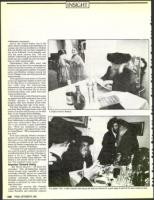
A Chasid at home in Brooklyn.
At a rebbe's "tish," or table, Chasidim often discuss the Torah and Talmud with a good supply of spirits (of the liquid variety) on hand.