

11111eint
Star
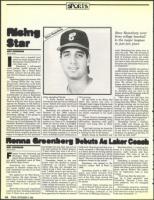
Steve Rosenberg went
from college baseball
to the major leagues
in just two years
MIKE ROSENBAUM
Sports Writer
11 f there were a baseball level
above the major leagues, Steve
Rosenberg would probably ar-
rive there soon.
Rosenberg, a left-handed
relief pitcher, moved through the
minor leagues like a Nolan Ryan
fastball, rising to the top after play-
ing with five teams in parts of three
seasons.
Rosenberg began this season with
the Chicago White Sox' top minor
league team, Vancouver, in the AAA
Pacific Coast League. Rosenberg was
2-0 in 20 games, with a 3.33 ERA and
17 strikeouts in 24 1/3 innings.
After pitching in both games of a
doubleheader on June 3, Rosenberg
was called up to the majors. He join-
ed the White Sox the next day in
Texas at 5:30 p.m. for a 6 p.m. game
against the Rangers. In the third in-
ning, Rosenberg made his debut, with
the bases loaded and one out.
Rosenberg pitched out of the jam. "I
was excited, a little tired;' says
Rosenberg, adding, "I was going on
pure adrenaline alone?'
Rosenberg was born in New York
but grew up in Coral Springs, Fla. He
attended Broward Community Col-
lege for two years and the University
of Florida for two more, through 1986.
While he shared the typical American
boyhood dream of sports stardom, he
began to recognize his full potential
while attending Florida.
"I kinda started realizing it
towards the last part of my collegiate
career. Talked with some scouts and
my coaches and realized the talent
that I had?'
Rosenberg was selected by the
Yankees in the 1986 summer
amateur draft. He signed and pitch-
ed briefly for the Yankees' Rookie
League team in Oneonta, N.Y. He
moved on to Class A Ft. Lauderdale
where he was 6-1 with a 2.12 ERA.
Last year, Rosenberg began at
Class AA Albany, where he was 4-4
with a 2.25 ERA. He was promoted to
AAA Columbus, posting a 4-1 record
with a 4.08 ERA and 51 strikeouts in
75 1/3 innings.
He was dealt to the White Sox
before this season and went to
Chicago's major league training camp
before being assigned to Vancouver.
Rosenberg, who displays no sign of
a rookie's awe of the major leagues, is
not totally surprised at his quick
success.
"I knew I had an advantage com-
ing into professional baseball, being
left-handed, throwing with good
velocity and being able to throw
strikes.
"I just kept moving up along the
way, taking it day-by-day, never real-
ly looking too far in the future!"
Despite being on baseball's fast
track, Rosenberg has taken time to
enjoy the ride. "My wife (Christine)
and I think about it every day. It's the
kind of business where you really
can't look too far into the future, but
you have to stop and smell the roses
along the way and realize what you've
accomplished!'
Rosenberg initially was used as a
middle-inning reliever, usually coin-
ing in to face one or two left-handed
batters, then turning the game over
to another bullpen ace. Eventually, he
was used in tighter, late-game situa-
tions. He earned his first major
league save last month, prior to his
initial appearance at Tiger Stadium.
Through Sept. 1, Rosenberg had
no decisions and one save in 26
games, pitching 42% innings with 24
strikeouts and a 4.01 ERA.
"He's done real well since he's
been up here," says White Sox pit-
ching coach Dyar Miller. "We had him
in spring training, saw he had good
stuff. Just a matter of getting a few
innings in. He's still young, inex-
perienced, but he looks like a bulldog-
type pitcher. He's done a great job for
us here. He's got four pitches that he
throws for strikes. Good competitor. I
think he's gonna be a good one!'
Rosenberg throws a fastball,
curve, slider and change up. His
fastball is his money pitch, which he
throws in key moments. "If I'm gon-
na get beat in a late-inning game
situation, if a game's on the line, I'll
go with my best stuff?'
Plosursis Illimonkerg Debuts L'o Laker Coast
MIKE ROSENBAUM
Sports Writer
F
ormer Livonia Ladywood and
Michigan State basketball
player Ronna Greenberg is the
new girls' basketball coach at West
Bloomfield High School.
Greenberg has coaching ex-
perience in summer camps and in
AAU basketball, but this is her first
high school job.
She applied for the West Bloom-
field vacancy, she says, because "I
really like to work with kids. I think
it's really important, especially for
young women, to have a good role
model."
Most high school girls' basketball
coaches are men. Greenberg feels that
most of them have good basketball
50 FRIDAY, SEPTEMBER 9, 1988
knowledge but says they may not be
the best mentors for female players.
"I don't think they have a lot of ex-
perience preparing young women to
be the best they can be, to show them
what's around out there!"
Greenberg looked to her own
future when she decided to attend
Ladywood, an all-girl, Catholic
school. She says she attended the
school to get a first rate education,
and "I didn't want to get lost in the
dust from all the other sports:' Name-
ly, boys' sports. She felt that girl
athletes in public schools rarely got
the notoriety due to them, publicity
which is usually necessary to get a
major college scholarship. Greenberg,
an All-American at Ladywood, did get
a scholarship to Michigan State.
Although her parents did not at
first appreciate her decision to attend
Ladywood, Greenberg says they even-
tually accepted it. She says that she
is a better person for having attend-
ed Ladywood "because I got a better
outlook of our faith and what it's all
about?' She was not forced to take any
religious classes at the school.
Greenberg was named to the
Catholic League Hall of Fame in
1986.
Greenberg played at MSU as a
guard and small forward from
1983-86. In 70 games she hit 44.2 per-
cent of her floor shots, scoring 188
points while adding 95 rebounds and
44 assists.
Greenberg began attending law
school at Detroit College of Law, but
is taking a term off to coach and to
earn a teaching credential at the
University of Michigan-Dearborn.
West Bloomfield, 1-1 entering this
week, is a young team, with three
seniors, eight juniors and four
sophomores. The team is led by
sophomore point guard Amira
Danforth.
Greenberg is pleased with her
team's hard-working attitude. Unfor-
tunately, they lack experience, which
likely cost them a win in their second
game, against Milford. The Lakers
lost an eight-point lead in that
contest.
"I just hope that the kids will .. .
play up to their potential" says
Greenberg. "Because I know they
have potential, but it's untapped
potential."
Greenberg's long-term coaching
plans are indefinite, but she says she
will continue to coach "as long as the
kids stay interested!'
❑
J