
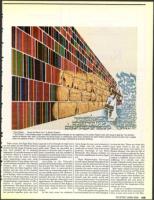
"T'Ka B`Shofar ... Sound the Ram's Horn" by Michel Schwartz.
"T'Ka B'Shofar" is the timeless prayer for freedom, beseeching the Almighty for the ingathering of the Jewish People to Zion amid songs of great joy. This rendition
depicts the Western Wall, heart of Jerusalem and eternal prayer, in contemporary colors which symbolize the Jewish People scattered around the world, and in realistic
tones, the residents of Israel — all part of the same nation and heritage. Contributed by American Greetings.
Taken alone, the High Holy Days
are one-sided, but the Torah seeks to
present the full range of human emo-
tion, from ecstatic joy to deepest
depression. It includes success as well
as failure. There is a time for ambi-
tion and a time for sense of limit.
Some experiences come only with
unselfconscious living, others only out
of self-criticism and guilt. The Yamim
Noraim, then, are a "distortion"
unless they are taken together with
Sukkot and the rest of the Jewish
tradition. In the sometimes delirious
joy of Sukkot, with its celebration of
harvest, of life-giving water, of goods
and of the produce of the field, are the
complementary experiences of affir-
mation of human pleasure and
achievement. The days of Sukkot are
the response to the denial and self-
criticism of the High Holy Days. The
two periods together give one the
capacity to live through triumph and
tragedy, yet knowing that this, too,
shall pass. When no one-sided ex-
perience is ultimate, then the partici-
pant's immersion and the outsider's
perspective can be fused. Life in all its
bewildering and uncontrollable varie-
ty becomes possible.
According to the Talmudic
analysis of the trial theme, on the first
day of court, New Year's Day, verdicts
are handed down in open-and-shut
cases; that is, concerning people who
are one-sidedly good or bad. (However,
when applying the trial model, many
interpret the rest of the ten days as
the time for appeals, rehearings, and
applications for clemency.) The peak
of intensity is reached on Yom Kippur,
when those whose records are mixed
(like most people) receive their
verdict.
In the trial, every act suddenly
looms large, for every act is known to
the Judge, and the whole verdict
could turn on a hair. One of the most
profound teachings of the Rosh
Hashanah—Yom Kippur holidays is
the cosmic significance of every single
act.
Says Maimonides: Everyone
should regard himself throughout the
years as exactly balanced between ac-
quittal and guilt. So, too, he should
consider the entire world as equally
balanced between acquittal and guilt.
If he commits one additional sin, he
tilts down the scale of guilt against
himself and the entire world and
causes its destruction. If he performs
one good deed, he swings himself and
the whole world into the scale of merit
and causes salvation and deliverance
to himself and his fellow men.
This truth applies throughout life,
but most people are too self-indulgent
to face the fact. There are those who
earn their world in one act. The
Talmud tells many such tales: of a
Roman Senator who gave his life to
annul an evil decree against the Jews;
of a Roman executioner who died to
release a rabbinic martyr from his
suffering; of a Jewish man who
bought a Jewish woman from captivi-
ty and prostitution and, having her in
his control, voluntarily released her.
How many wasted lives have been
redeemed by one heroic act? The most
moving scene in Dickens' A Tale of
Two Cities occurs when Sydney Car-
ton pulls together an aimless and
even squandered life and gives it
transcendent significance by martyr-
ing himself for the happiness of the
woman he loves.
In life as in tradition of literature,
individual acts do have enormous ef-
fects. A man once came to visit Mar-
THE DETROIT JEWISH NEWS
109
Scanned image of the page. Keyboard directions: use + to zoom in, - to zoom out, arrow keys to pan inside the viewer.
September 09, 1988 - Image 150
- Resource type:
- Text
- Publication:
- The Detroit Jewish News, 1988-09-09
Disclaimer: Computer generated plain text may have errors. Read more about this.