
See Our 18-Foot, 1500 Gallon
Salt Water Acquarium
COUPON
ENTERTAINMENT
Ca rry-Out Serviar-b.
Available
HAPPY NEW YEAR TO ALL!
HUNAN PALACE
Oriental Cuisine- and Cocktail Lounge
Szechuan, Hunan, Mandarin and Cantonese Dishes
1
0°./ 0 OFF
With This Coupon
Mu in or Carry-Out
Open 7 Days — Mon.-Thurs. 11:30-10:30, Fri. & Sat. 11:30-11:30, Sun. 12-10
38259 W. 10 MILE RD. & HAGGERTY • Farm. Hills
NEXT TO HOLIDAY INN Near Gd. River
473-3939
JN
A Very Happy and Healthy
New Year To All Our
Customers and Friends
DAVE'S DELI
681-3537
3258 Orchard Lake Rd.
LEO MERTZ'S KOSHER
CAFE KATON
547-3581
23055 COOLIDGE • Oak Park
Wishes Everyone
A Good Year
Of Much Health,
Happiness and
Prosperity
BREAK THE FAST WITH A MERTZ
DAIRY TRAY
ORDER YOUR KOSHER CHEESECAKE NOW
Under The Supervision of the Council of Orthodox Rabbis
•
_„,0 II
-lii-4
AN 41, •
I di t-r ._ 111 0111 ;
ti
4
I: . I ill
'
.11'- 4aiii. 41-
I*
Jack and Gary Cochran
and The Staff Of
10
• °
au Jacks
Food & Spirits
Wish Their
Friends and Customers
A Healthy and Happy
New Year
4108 W. Maple
• Birmingham, MI • 1 block W. of Telegraph • 626-2630
•
Laughs
Continued from preceding page
in Omaha, Neb. Appearing
with Garrett will be Brandy
Gold, former Detroit come-
dian Thom Sharp and the
former governor in TV's
"Benson," James Noble.
For the future, Garrett
would like to move into the
film area, see "First Impres-
sions" turn into a huge suc-
cess, do some more writing
(he scripted one of the
episodes for his new series)
and keep doing stand-up.
"I always want to do stand-
up comedy because it's my
first love and my anchor. And
once you start doing it you
just can't seem to stop. I love
that live, instantaneous reac-
tion from my audience," he
explained.
Garrett writes all his own
material which centers on
everyday situations, from the
trouble he runs into because
of his height, to living in a
family with a long line of
divorces, to odd jobs he's held
while trying to earn a living,
to relationships and being
single in the '80s.
"My material is all G-
rated," he says. "I'm very
clean. I was always determin-
ed to stay clean and I think
that's helped in getting the
work. I love a nasty, dirty joke
as well as anybody, but work-
ing that way limits you. Once
you start that way you have
to remain that way."
Much of the basis of his joke
telling revolves around his
early beginnings and his
roots. Example: "My mom is
5'4" and the woman is still in
traction from my birth. Com-
ing home that day from the
hospital, I drove."
Of course he's just kidding,
but is quick to add that he
was raised by funny people. "I
think most Jews have a great
sense of humor. And, after
growing tip in the kind of
family I did — even with all
the meshugas of the divorces
and moving and all that — we
still remained close. My
parents never frowned on my
going into show business.
They were never negative but
always supportive. And I
couldn't have done it without
their support because they
mean so much to me."
Garrett added that he
believes it's the family unit
that puts Jews into comedy.
"A lot of peple say it's from
the years of suffering but I
wouldn't know about that —
except the fact that I have
four parents, three in escrow.
After growing up the way I
did, Jewish comedy's kind of
redundant."
Garrett's sense of humor
seems to pervade everything
he does. In fact, he's one of the
few comedians in the business
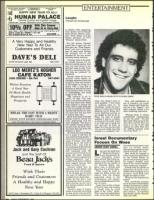
Garrett looks at everyday life for his comedy material.
today who doesn't seem to
mind hecklers. "I love when
an audience joins in," he
volunteers. "Look, the way I
figure it is when you're doing
stand-up you're doing emo-
tional skydiving anyway, so
you might as well go for it.
There are ways to handle
hecklers. I look at a heckler
as someone who really wants
to do what you're doing but
just can't get up there on
stage. So if you see him that
way you can really turn him
around in a wonderful way."
Now, well established as
one of comedy's top young
stars, Garrett still found be-
ing one of its "biggest" and
most versatile talents a too
often humbling experience.
"Buying shoes is always
unbelievably embarrassing
for me," he noted. "You feel
like a jerk when you go to the
shoe store and the shoe you
need is on top of the cash
register as a joke. Here they
are raffling business cards
out of the heel!"
❑
Israel Documentary
Focues On Woes
ANDREW SILOW CARROLL
L
ate into the third hour
of "Shattered Dreams,"
a new documentary by
Victor Schonfeld, Israeli
peace activist Yael Lotan im-
agines a tour of modern Israel
conducted for the benefit of
her deceased father, who
spent time in British jails
dreaming of a Jewish state.
There would be much to
make her father proud, she
admits, from the densely
populated cities to the
technological and agricul-
tural accomplishments of the
last 40 years.
Lotan then recites a litany
of Israel's woes, and wonders
to herself what he would
make of the "other" Israel.
What would a founding father
make of the fact that Israel
has never known peace, rules
over 1.5 million Arabs,
discriminates against its non-
Jewish minority, she asks.
How would he respond to
Israel's economic dependence
on the United States, its
pariah status among nations,
its support through arms
sales of the world's darkest,
most reactionary regimes?
If faced with the specter of
Kahaneism, of racism, or of a
welfare state reneging on its
promises, would faher have
fought the fight he did?
Would he have dreamed the
dream?
That unthikable question
lies at the heart of Schonfeld's
massive documentary, subtitl-
ed "Picking Up the Pieces,"
which was filmed during a
post-Lebanon, pre-uprising
nine-month period between
1985 and 1986.
Scanned image of the page. Keyboard directions: use + to zoom in, - to zoom out, arrow keys to pan inside the viewer.
September 09, 1988 - Image 113
- Resource type:
- Text
- Publication:
- The Detroit Jewish News, 1988-09-09
Disclaimer: Computer generated plain text may have errors. Read more about this.