

4
BUSINESS
ERIC M. STARKMAN
Special to The Jewish News
NV' hen George Brody
was a young boy at-
tending a Brooklyn
Hebrew school, the
rabbi would award a
special prize to the student who
scored the highest grade on a weekly
test. But after Brody won the prize for
several consecutive weeks, the rabbi
cut Brody from the competition.
"That soured me a little bit?'
Brody recalled. "It was a cruel thing
to do to a sensitive kid."
The sensitive kid grew up to
become one of the country's toughest
and most respected bankruptcy
judges. In his 28 years on the bench
at U.S. Bankruptcy Court in the
Eastern District of Michigan
(Detroit), Brody ruled on a myriad of
high-profile bankruptcy cases, in-
cluding the near-collapse of Adat
Shalom Synagogue and the Diamond
Mortgage Corp. securities swindle.
His most recent case was Fred
Sanders Inc., the once-ailing confec-
tionery company.
One , of the functions of a
bankruptcy judge is to approve fee re-
quests by lawyers and other court-
appointed professionals involved in
bankruptcy cases. From the moment
he took his position on the bench,
Brody established a reputation as a
penny-pincher who was notorious for
slashing attorney fees. He once took
attorney fee requests to review on a
vacation. Jewish attorneys privately
referred to Brody as Der Schneider,
Yiddish for "the cutter."
"I was just doing my job?' said
Brody. "I could be generous with my
own money, but I didn't have the right
to be generous with creditors' money.
I had a legal and moral obligation to
limit compensation for court-
appointed professionals to reasonable
levels. But there were lawyers who
made excessive requests and deserved
to have their fees cut."
Brody, who retired last month,
also was credited with helping restore
credibility and respect for the
bankruptcy court in Detroit. Six years
ago, the court was scandalized when
a grand jury indicted Irving I. August
for a conspiracy to avoid appearing
before Brody. August, a once promi-
nent Jewish attorney, wanted to avoid
Brody because of the judge's long-
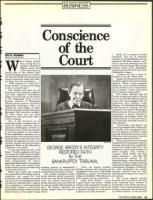
Conscience
of the
Court
GEORGE BRODY'S INTEGRITY
RESTORED FAITH
IN THE
BANKRUPTCY TRIBUNAL
standing practice of substantially
reducing attorney's fees. August was
convicted and sentenced to prison.
The incident prompted concern
within Detroit's Jewish community.
At the time, the Detroit bankruptcy
court was heavily dominated by
Jewish attorneys and many believed
the August scandal reflected badly on
them. Yet Brody's reputation for
honesty helped offset the negative
fallout.
"After the August scandal,
Brody's presence lent integrity and
credibility to the court," said Phillip
Shefferly, a partner with Schlussel,
Lifton in Southfield. "His influence in
that respect was very important."
Added David Ruskin, a bank-
ruptcy lawyer and trustee, "George
Brody set the standard for honesty, in-
tegrity and competency. And he was
constantly kicking us in the tush to
adhere to his high standards?'
Brody, 70, is steeped in Jewish
tradition. The son of Orthodox
parents, he attended Shabbat services
regularly. His father, Samuel, work-
ed in a garment sweatshop and was
active in his synagogue. His younger
brother, David, is the Washington
representative of B'nai B'rith's Anti-
Defamation League.
"Judaism has had a major in-
fluence on my life," Brody said.
Despite his strong Jewish identi-
ty, Brody said he never favored Jewish
lawyers. "When a lawyer appeared
before me, I never considered whether
he was Jewish or not. I treated them
all as lawyers. I never cared about
their religious backgrounds."
Still, Brody admitted that his
Jewish background made it difficult
to rule on the Adat Shalom case. In
June 1975, the synagogue filed for
protection from creditors under
Chapter 11 of the Federal Bankruptcy
Code because of a dispute with the
contractor who built its Farmington
Hills sanctuary. It was one of the first
synagogues to become involved in
bankruptcy proceedings. Brody felt
added pressure in this case because
he occasionally attended services at
Adat Shalom.
"Emotionally, Adat Shalom was
one of my toughest cases," Brody said.
"I decided in the synagogue's favor
but the decision was based on legal
grounds. Fortunately, the issue was so
clear there was no question what the
judgment should have been."
Jewish and other ethnic attorneys
dominated U.S. bankruptcy courts for
decades. The large firms avoided this
area of law because they felt it was
unseemly to pick at the carcass of a
dead company. That created a
vacuum, which Jewish and other
ethnic attorneys — who often felt
discriminated against by the
mainline firms — were allowed to fill.
However, in 1978, Congress radically
reformed the federal bankruptcy code
and opened a floodgate of bankrupt-
- cy cases. Bankruptcy law quickly
became lucrative and the blue-
blooded firms rushed in for a piece of
the action.
The Irving August scandal
erupted as the big Detroit law firms
were becoming more involved in
bankruptcy cases. Brody said the in-
cident "was an embarrassment to the
Jewish community and particularly
to Jewish lawyers." It was the most
THE DETROIT JEWISH NEWS
41