

EDITORIAL
Generation Gap
How often have the baby boomers heard the explanation: "You
who were born after the Depression, after World War II, after the
Holocaust, after the birth of Israel, after . . ., you just would not
understand."
George Mann, organizer of a "young" group for the Detroit
District, Zionist Organization of America, has a better explanation
for the striking differences of opinion between Jewish elders and
young adults over Israel's policies:
"The young people do not want to just guard (Israel) but to create
. . . They want Israel to grow, to move on. They don't want Israel to
always be on the defensive."
Mann was commenting on a survey of Jewish News readers con-
ducted in May in which the generation gap is clearly evident (see
Pages 5 and 16).
The difference of opinions over Israel would be frightening for
some. But local Zionist leaders who commented on the survey were
not dismayed by the results. They saw no disloyalty among the
younger generation.
Said Mann, "The younger people want to enhance the dream and
end the wars and the constant tension." It is the dream of the older
generation as well.
Fortunately, all genertions of Jews agree on the end result, even
though they may disagree on the appropriate tactics.
We are already tardy in planning for the "elder boom" of the corn-
ing decades. Only within the last few years, for instance, have in-
surance companies begun offering long-term health insurance. What
does exist is often limited and costly. And just last month, Congress
killed a bill to create the first federal coverage for home health care
for the chronically ill elderly.
As a nation, as a state, and as a city, we must begin to anticipate
the needs of the elderly as they comprise a greater and greater pro-
portion of our population.
For the Detroit Jewish community, the situation is no less dire
than for anyone else. The community has a growing elderly popula-
tion. Its first-class housing service — Jewish Home for Aged — is
suffering from a low Medicaid payment schedule authorized by the
state and federal governments. Both the Home and Federation Apart-
ments have waiting lists, and need more capacity to deal with a grow-
ing population. Although the Apartments will soon break ground
on a new building, the Home is contemplating cutbacks because of
its financial crisis.
It is hoped that the federal government quickly realizes the need
to cope with the imminent crisis of the aged in our nation. And that
the Jewish community's elder-oriented efforts serve as a model for
similar endeavors around the U.S.
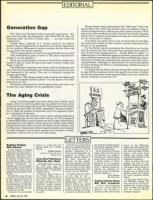
The Aging Crisis
Aging, something people have been doing since creation itself
began, seems more perilous these days. In another two years, about
12 percent of Americans will be over 65. This proportion will almost
double by the year 2030. By 2050, compared to America's popula-
tion in 1982, the number of Americans over 55 is expected to grow
by a whopping 113 percent.
The price for this increase in the nation's elderly population
will be staggering. By the turn of the century, the U.S. is expected
to devote $200 billion a year to health care for the aged. Federal hous-
ing programs for the elderly will dry up in the next few years. Public
transportation often does not reach the elderly in the suburbs. And
the 96 percent of Americans without long-term health care insurance
are often reduced to leaving their spouses with virtually no funds,
sometimes without even a roof over their heads.
INION11111111111111111111•111
LETTERS
Building Bridges
With Yavneh
As the director of Project
Renewal in Yavneh, Israel, I
appreciate very much the op-
portunity Detroiters have
given me to visit our sister ci-
ty, Detroit in May. I have
learned a great deal about the
Jewish community, its
organization and its people,
and, therefore, will be able to
contribute to bulding strong
bridges between Detroit and
Yavneh .. .
I would like to use this op-
portunity to remind you that
in the industrial section of
Yavneh, there is a potential
for development of high-tech
industry. I hope that our rela-
tionship will result in future
investments as well .. .
I wish all of us a successful
6
FRIDAY, JULY 22, 1988
future in achieving our
mutual goals for a better
Yavneh.
Yitzhak Shalom,
Director of Project Renewal,
Yavneh, Israel
Jews Must Reinforce
Ethnicity, Not 'Ideal'
Although I agree in princi-
ple with your July 15
editorial regarding "Mythical
Masquerade," a distinction
must be noted.
Presently, Jews living in
the United States are a
strong ethnic group proud, for
the most part, of their
heritage. And rightly so. If an
individual sought cosmetic
surgery to conceal or deny his
heritage and origin, whatever
that may be, that person is to
be pitied.
However, it is not just Jews
who are availiing themselves
of the marvels of cosmetic
changes. Americans as a
whole are changing their ap-
pearance to comply with
Madison Avenue images of
the "ideal" American ap-
pearance. In that respect,
Jews are probably succumb-
ing to this advertising concep-
tion as much as any other
American ethnic group. And
therein lies the falsehood.
No matter what our origin,
we are who we are —
Americans. We are a diverse
nation with a multitude of
backgrounds, each with a
distinct history now united
under a common flag. We as
a nation should be proud of
that fact. Instead, we attempt
to conceal our ethnicity under
the pretense of adjoining the
advertising industry's defini-
tion of our citizenship.
As an American of Jewish
origin, I feel we must retain
and reinforce our image of
ourselves as a strong ethnic
group within, and as part of,
a strong nation of ethnic
groups. It is in our common
interest to be our individual
selves — and that includes ac-
cepting our physical ap-
pearance as God, not Madison
Avenue, defines us.
Terry Gibbons
West Bloomfield
Cutting Library Hours
Will Hurt Academic
I find it most disturbing
that the United Hebrew
Schools has decided to
drastically reduce the weekly
hours of the Midrasha
Library from 32 to just 6. This
library, the most comprehen-
sive and up-to-date Jewish
library in the state, serves
scholar and layman alike
with the utmost devotion and
professional expertise.
Have we gone so far as to
forsake the title of "Am
HaSefer," People of the Book,
and instead allow monies to
be spent on other Jewish
causes, many of which could
function quite well without
the "extra" assistance alloted
them?
In the past several years,
the Midrasha already has
seen some of its services ter-
minated due to lack of fun-
ding. I wonder why the UHS
and the Jewish Welfare
Continued on Page 10