

PURELY COMMENTARY
Historical Perspectives
Continued from Page 2
outlined in the artcile. They include the
American Christian Palestine Commit-
tee, fundamentalists, as well as
elements among Catholics, the Blacks
and others.
The many individuals listed, pro
and con, include Daniel Poling, Pierre
van Paassen, Dorothy Thompson, John
Haynes Holmes, Reinhold Niebuhr and
others. With the exception of Dorothy
Thompson, who was a Zionist advocate
who later became an antagonist, this is
a list of strong supporters.
The most outspoken of them was
Reinhold Niehbuhr, whose pro-Jewish
role was uncompromising. He was a
former Detroiter who became a world
figure in theological circles. The
Niehbuhr activity is lengthy but com-
pels quoting as part of the record of
most devoted supporters of Zionism in
Christian records. As Voss-Rausch
state:
During Holmes' absence in
Palestine in 1929, he invited a
newcomer to New York City,
Reinhold Niebuhr, to serve as
guest preacher at Community
Church for six successive Sun-
days. Niebuhr had just arrived
at Union Theological Seminary
to join the faculty as the William
E. Dodge Professor of Applied
Christianity. He was already
committed to a Zionist ap-
proach to Palestine's ultimate
settlement and had spoken to
that effect in his former Detroit
parish. He had also written sym-
pathetically about the Jews in
his regular Saturday night col-
umn in the Detroit News. His
strictures against assimilation
appeared often in World Tomor-
row, the Christian Century, the
New Leader, and the Messenger
(Evangelical Synod), and he had
a special aversion to the ad-
monitions and pieties of those
who advocated "brotherhood"
in all-too-easy language, as in
the the newly founded National
Conference of Jews and Chris-
tians (as it was then called).
By the early 1930s, Reinhold
Niebuhr was fully aware of the
problems German Jewry faced
and, with such articles as "Ger-
many Must Be Told!" in a May
1933 issue of the Christian Cen-
tury, pointed to Palestine as a
refuge for Jews fleeing Hitler's
sadism. In an historic and stirr-
ing address in 1938, before a na-
tional convention of Hadassah,
the Women's Zionist Organiza-
tion, he deplored the moral
bankruptcy of the Munich set-
tlement of 1938 and its "Evil
Pact;" and then he turned to
Palestine and spoke of the time,
energy, and treasure invested in
the national homeland and the
necessity of not letting it fail.
Professor Niebuhr warned
repeatedly in the 1940s about
the inequities of the 1939 British
White Paper limiting immigra-
tion to Palestine and cutting it
off entirely in March 1944. His
membership in the American
Palestine Committee from the
early 1930s and his leadership in
44
FRIDAY, JULY 22, 1988
founding the Christian Council
on Palestine in 1942 reflected his
keen interest in that country's
Zionist beginnings .. .
Upon Niehbuhr's death, the editors
of the magazine Christianity and Crisis
adopted an anti-Zionist policy. Mrs.
Reinhold Niebuhr demanded that her
husband's name be erased from the list
of the magazine's founders. Mrs.
Niehbuhr remains to this day one of the
strongest supporters of Zionism.
It is very distressing to learn that
there still is too much opposition in con-
trast to the friends counted by Israel
and Zionism. The two authors of the
American Jewish Archives' study re-
main more optimistic. They concede to
some pessimism. As they declare in "An
Overview" to their article:
Perhaps the complex state of
affairs in the black community
today only reflects the historic
ambivalence that has domi-
nated Christendom as a whole.
The World Council of Churches
has often uttered expressions of
"effective international
guarantees" for the territorial
integrity and political in-
dependence of Israel and the
Arab nations, while repeatedly
criticizing Israeli policies and
calling for "an international
presence" over Jerusalem. With
so many Christian denomina-
tions fearful of losing their mis-
sionary agencies and institu-
tions in Arab lands, their
animosity toward the Jewish
state has steadily increased.
And forty years of Arab and
Christian propaganda have cer-
tainly taken their toll. In 1980,
the National Council of Chur-
ches of Christ in the U.S.A. en-
dorsed a pro-Arab commission
report which stipulated that the
Palestine Liberation Organiza-
tion, with Yassir Arafat as its
leader, was the accredited agen-
cy of the those opposed by
Israel. The Middle East agenda
of the seventeen-member com-
mission was so biased at its in-
ception that major Jewish
organizations, including the
American Jewish Committee,
the American Jewish Congress,
and the Anti-Defamation
League of B'nai B'rith, refused
to present testimony — the pro-
PLO findings were a foregone
conclusion.
The recent defeat of positive
statements on Israel in both the
199th General Assembly of the
3.1 million member
Presbyterian Church (USA) and
the 1.7 million member United
Church of Christ in June 1987
underscores the political ploys,
stereotypes and caricatures,
and fears of divisiveness over
Israel that plague even the best
of intentions in Jewish-
Christian relations .. .
This essay has underscored
the conclusion that Israel may
well count on a strong core of
Christian supporters in
America, but at the same time
the Jewish state must never ex-
pect justice from American
Christendom as a whole.
There are many lessons to be
learned from all the essays in the
magazine. The Christian attitudes
are especially important for a
knowledge of what is occurring in
ecumenism and Christian-Jewish
relations generally.
American Jewish History of the
American Jewish Historical Socie-
ty, and the American Jewish Ar-
chives of the movement by that
name, often enrich our knowledge
with studies just alluded to in the
latter. The administrators of
American Jewish Archives, Dr.
Abraham Peck and Dr. Jacob R.
Marcus, earn our gratitude for the
current discussion of the Zionist-
Israel experiences.
Daniel Tickton
Recollections
Continued from Page 2
mains a continuity with the Jason
Ticktons.
The special mutual interest with
Daniel was in the personalities he
depicted, the most notable being the
world leadership of Nahum Sokolow. It
was before he was elected to the world
presidency of the Zionist movement
that Sokolow spent nearly a week in
Detroit, addressing public functions,
conferring with Zionist leaders — Rab-
bi A.M. Hershman, Morris Zackheim,
Abraham Srere, Robert Marwil, as well
as with non-Zionist well-wishers. The
major dinner meeting was in the social
hall of the then Shaarey Zedek on
Willis and Brush.
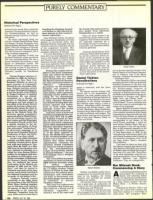
Nahum Sokolow
Sokolow was diabetic and he was ac-
companied on his many Zionist lecture
trips by his daughter, Dr. Celina
Sokolow, who provided the medical
guidance he needed.
During that week's visit I was with
him a great deal, at conferences, for
meals at the then Joseph's Restaurant
on Montcalm and Woodward.
It is important to note that the man
who arranged the details for the visits
by the Sokolows was Jacob Miller, who
Daniel Tickton
was at the time executive director of the
Detroit District of the Zionist Organiza-
tion of America, and of the Keren
Hayesod — Palestine Foundation Fund
— campaigns here.
Soon thereafter, Miller was named
managing director of the newly-formed
Palestine Insurance Co. His first visit
upon his arrival in Jerusalem was with
the British-named Governor of
Jerusalem Ronald Storrs. After a brief
exchange of English greetings, Gover-
nor Storrs, who was known to be not too
sympathetic to Zionism, said "Miller,
daber Ivrit, ata b'Eretz Israel" —
"Miller, speak Hebrew. You are in the
Land of Israel." It was a cordiality that
I read later when he acknowledged my
review of his biography.
Nahum Sokolow returned to Detroit
in 1929 to address the opening session
of the national convention of the Zionist
Organization of America held here that
year in the Cass Theater on Lafayette.
The recollections are about the most
distinguished in our history of the
world Zionist presidents. I could not
have known Theodor Herzl. But as a
mere youngster, I was, with my brother
Ben, at the memorial assembly in the
Groisse Shul — the Great Synagogue —
in Lida Byelorussia, in 1904, in the
week after the world leader's death. The
anti-Zionist Bundists rioted to break up
the memorial procedures. And I could
not have known Herzl's successor,
David Wolfson.
I did meet for about an hour with
the German scientist and scholar, Prof.
Otto Waburg (1859-1938) who succeed-
ed Wolfson and was World Zionist presi-
dent from 1911 until 1920. Then follow-
ed by close association with the suc-
ceeding presidents, Chaim Weizmann,
Nahum Sokolow and Nahum
Goldmann. They are unforgettable.
Bar Mitzvah Book:
Commencing A Diary
n interesting pubishing trend is
encouraging the compiling of
diaries and retaining family
records. An inducement in preparation
of a diary is provided for bnai mitzvah
in a large volume entitled "The Bar
Mitzva Book — A Written Remem-
brance."
Published by Stewart, Tabori and
Chang, the record book contains the
basic facts leading to a knowledge of
observances. The synagogue obser-
A