

COUPON
ENTERTAINMENT
I
POT IDOUPIRI
DINNER FOR 21
34637 GRAND RIVER
• White Fish • Chicken Alfredo • Sweet 2 Blks. E. of Drake Rd. • Farmington
& Sour Shrimp • Broiled Orange
478-8484
Roughy • Chicken Marsala • Chicken
Stir Fry • Veal Parmesan • Shrimp &
Chicken Creole • Seafood Fettucine •
Lasagna • Marinated Chix Breast
Ancient Treasures
Continued from preceding page
$1 2 c'on
ALL DINNERS ARE PREPARED "FRESH TO YOUR ORDER" AND INCLUDE: SOUP, SALAD OR COLE
SLAW, CHOICE OF POTATO, RICE OR PASTA & FRESH ROLLS AND BUTTER.
NO OTHER DISCOUNTS APPLY WITH THIS COUPON
.
110% OFF TOTAL FOOD BILL
Ermanno & Liz Lazzari
"I love the Linguine
Buconiera" .. .
Jack McCarthy,
Channel 7 "Friday Feast"
Family Dining
Italian & American Cuisine
eye
L
"1
Banquet Facilities
666-2570
6610 Highland Rd.
Waterford, MI
1
COUP ON
FAMILY ITALIAN DINING & PIZZA
4033 W. 12 MILE, 3 Blks. E. of Greenfield
548-3650
Berkley
PIZZA-RIBS-FISH
HOMEMADE GARLIC BREAD
ROUND PIZZA
SQUARE PIZZA
SMALL OR LARGE SMALL-MED-LARGE
ON FOOD PURCHASES
OF $6 OR MORE
sal OFF
DINING ROOM, CARRY-OUT
Expires July 31, 1988
• BANQUET ROOMS • BEER • WINE
• COMPLETE CARRY-OUT • COCKTAILS
THE BRASS POINTE
SPECIALS
I
C
o
0
-
11 45
BAR-B-Q CHICKEN FOR 2 $ 795
BAR-B-Q SLAB FOR 2.. $
DINE-IN OR CARRY-OUT
We Serve Eeer, Wine and Cocktails
JN
Expires 7-15-88
OPEN 7 DAYS A WEEK FROM 11 a.m.
476..1377
24234 Orchard Lake Rd. at 10 Mile
ROYAL EAGLE DINING IN
OLD WORLD ELEGANCE
Enjoy
European Cuisine Dinners
Sunday 4 p.m. to 8 p.m.
Wed. thru Sat. 5 p.m. to 10 p.m.
6-Course Gourmet
Table Service Brunch
Sunday 11 a.m. to 3 p.m.
$1295adults
$795
children
8 & under
THE ROYAL EAGLE
Blks. N. of Jefferson
1415 Parker, 1 Blk. East of Van Dyke & 2 1/2
In Historic Indian Village
Closed Mon. and Tues.
56
FRIDAY, JULY 8, 1988
331-8088
Reservations Suggested
be classified masterpieces of
ancient sculpture. Other
Chalcolithic objects on view
are the pottery vessels from
Gilat and the ossuaries
(burial chests) from Azor. The
most remarkable find from
this era is the Judean Desert
Treasure, the largest group of
ancient copper objects found
in the Near East.
There are more than 30
items from the Canaanite
period (3150-1200 B.C.E.),
which to the student of Torah
are of special interest. One of
the Torah's most powerful ad-
monitions to the Israelites is
not to be like the Canaanites,
not to worship their idols and
not to make masks for
worship.
The pagan practices of the
Canaanites are intimated by
the various cultic objects
which have been excavated
from that period. The items
were made from an im-
pressive variety of materials,
and are important from the
esthetic point of view because
of their very fine craftsman-
ship. There is the silver cup,
found as a tomb offering, and
several pottery vessels that
are classified as masterpieces
of Canaanite ceramic art.
Figurines of gold, and a
graceful "Snake jug" of pot-
tery, give us further insights
into Canaanite culture.
One of the finest
achievements of Canaanite
art are its ivory pieces, as
seen from the Lachih ivories
on display. Diminutive in size,
they have the sculptural
quality of rare masterpieces.
The development of a
Hebrew script during the
Israelite period (1200-586
B.C.E.) signals the start of a
new age. The group of inscrib-
ed seals on display is of par-
ticular interest during this
period. Another fascinating
item is the sixth century
B.C.E. ostracon (letter, writ-
ten on pottery) which is
regarded as the earliest
epigraphic reference to the
Temple in Jerusalem
Objects more expressive of
Judaic sensibilities become
more prominent in the Se-
cond Temple period, and dur-
ing the period of the Mishnah
and the Talmud (332
B.C.E.-640 C.E.). Among the
most important objects found
from this period, in
Jerusalem, is a large Hebrew
inscription which reads "to
the place of trumpeting." The
block of stone with this in-
scription was found in the ex-
cavations near the Temple
Mount in the Old City. The
Hebrew script is so clear that
anyone knowing the Hebrew
alphabet can recognize the
letters without any difficulty.
The custom of a priest pro-
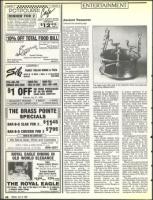
This copper crown dates back to the Chalcolithic Period, the second half
of the Fourth Millenium B.C.E.
claiming by trumpet blasts
from the Temple Mount the
approach of the Sabbath is
recorded both in Josephus'
"History of the Jewish War,"
and in the Mishnah.
The Siloam hoard is
another example of Israelite
objects discovered in the
Jerusalem area. It contains
12 silver coins, three of which
are Jewish shekels, and nine
are of Tyrian origin.
The latest coin in this col-
lection dates to the Year Two
of the Jewish war against
Rome, struck in 67 C.E. In
Mishnaic sources these coins
are called Jerusalemite
Silver. The Tyrian shekels
have the head of Heracles on
one side, and an eagle on the
other side.
The Jewish shekels have
replaced these symbols with
a Temple vessel (the Omer
cup) on one side, and a branch
with three pomegranates (a
symbol of purity) on the other.
The Hebrew inscriptions read
"Holy Jerusalem" and
"shekel of Israel."
Among the other items of
Jewish interest are a plaque
against the "evil eye," a
Jewish oil lamp, and a mosaic
pavement, or floor, from a
synagogue in Beth Shean.
Dating to the fifth century
C.E., the limestone plaque
contains four mirrors, intend-
ed to distract and ward off the
evil eye. It bears such typical
Jewish symbls as two
menorot, and its shrine-like
construction is com-
memorative of the Temple in
Jerusalem.
The Jewish oil lamp, from
about the same period, and
fashioned in bronze, is the on-
ly known specimen of its
kind. Although it follows Ro-
man artistic traditions, its Ju-
daic character is strongly pro-
nounced in the menorah-
shaped handle-guard and in
the lulav, etrog and shofar
which cling to its sides.
The remarkable mosaic
floor, from a synagogue in
Beth Shean, is made of stone
and glass pieces, in six colors
of different shades. It dates to
the Sixth Century C.E. This
floor was excavated in 1962.
Its central representation of a
shrine within a shrine is
flanked by two huge menorot,
accompanied by shofars and
incense shovels, which evoke
memories of the Temple in
Jerusalem.
The highlight of the exhibi-
tion are the two Dead Sea
Scrolls on display. These
scrolls are dated from the
First Century B.C.E. to the
First Century C.E. Before
these scrolls were discovered,
our earliest manuscripts of
the Bible dated from the 10th
Century C.E. It is for this
reason that the Dead Sea
Scrolls are of such immense
importance.
What is even more amazing
about the Dead Sea Scrolls is
that despite their being 1,000
years older than the existing
manuscripts of the Bible, they
differ only slightly from the
Hebrew books of the Bible in
use today.
The two scrolls on view are
the Habakkuk Commentary
and the Masada Psalms
Scroll. The former is the best
preserved of the commen-
taries, and contains a
religious composition which
interprets the biblical text.