

l_LIFE IN ISRAEL
"One day you were con-
sidered the intruder and there
were great efforts to keep
away the 'evil eye,' " Bar-Am
says. "The next day you
might find yourself standing
among some unapproachable
rabbis who all of a sudden are
photographable."
He pauses to reach for his
pipe. "It's a game, and you
have to know the rules. The
photographer has to remain
sane and sober and keep his
professional honesty and in-
tegrity."
Born in Berlin in 1930, Bar-
Am settled in Kibbutz Gesh-
er Haziv, where his hobbies
included hiking and archaeol-
ogy As a participant in digs
in the Judean desert in the
1950s, he borrowed a camera
from a fellow kibbutznik so
that he could record his
findings.
"Between being a lock-
smith, a guard and a youth
leader," he recalls, "I kept
clicking. People told me that
they recognized my photo-
Photos By Micha Bar-Am.
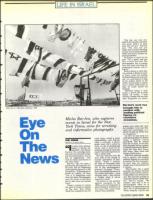
Wash day in a West Bank settlement, 1970.
Eye
On
The
News
Micha Bar-Am, who captures
events in Israel for the New
York Times, aims for arresting
and informative photographs
CARL SCHRAG
Special to the Jewish News
n many ways, photog-
raphy is almost im-
possible," says Micha
Bar-Am. It's a strange state-
ment for one of Israel's lead-
ing photojournalists, but he
has an explanation. "You
work in reality and fiction at
the same time."
Bar-Am, who has been a
professional photographer for
30 years, has an interesting
philosophical approach to his
occupation. "A photograph is
based on reality," he says,
"but it is something more
than the facts. Photography
must do justice to the facts,
but it also must go beyond
them."
Using a camera to convey
the news of Israel to readers
of The New York Times,
which has employed him for
many years, entails a great
responsibility, and Bar-Am
takes it seriously. A photo-
graph must tell a story as
much as the accompanying
words. And it must be in-
teresting enough to catch the
reader's eye and impel him to
take a closer look.
Bar-Am, who lives near Il
Aviv, tells of the change in
Israelis' perception of jour-
nalists. "Since I started,
all sides in Jerusalem have
learned how to make the best
use of the photographer's
presence," he notes. "Every-
body has learned the power of
the media and rules — even
religious ones — are twisted
or broken when it serves
someone's cause."
He points to the protests
against autopsies in the
1960s as the turning point in
ultra-Orthodox awareness of
the boost their cause could
receive from publicity.
Bar-Am's work has
brought him in
contact with
leading political
figures on
countless
occasions.
graphs even when they were
not credited. I was very flat-
tered and encouraged, so I
slowly turned my hobby into
an occupation:'
In-1957, he was hired as a
staff photographer by Bama-
hane, a popular Israeli
periodical, and he stayed
there for 10 years. In the past
three decades, he has covered
hundreds of stories for Barna-
hane, the New York Times,
and many other local and
foreign publications.
Bar-Am's work has brought
him in contact with leading
political figures on countless
occasions. For the most part,
he says, they are ordinary
People, even in the presence of
a camera.
"Ben-Gurion was a good
example. He always behaved
freely in front of the camera.
Golda (Meir) was always nat-
ural. But the best example is
Jerusalem Mayor Thddy Kol-
lek," Bar-Am laughs. "He
couldn't care less if he is
photographed when he is
sleeping. His spokesman even
has a set of photographs of
'Teddy sleeping. Anyone else
THE DETROIT JEWISH NEWS
41