

I PURELY COMMENTARY
Alien Registration
Continued from Page 2
Division recruited Spolansky to
help uncover disloyal activities
in Chicago (where he was the _
publisher of a pro-war and pro-
Kerensky Russian-language
newspaper) . . . After the war he
became a special agent of the
Bureau of Investigation of the
United States Justice Depart-
ment. In his capacity from 1919
to 1924 as head of the Chicago
district of the bureau's General
Intelligence Division, Spolansky
for the first time labored direct-
ly against the radical left,
gathering evidence to jail or
deport "anarchists, communists,
and other subversive elements."
With J. Edgar Hoover's GID,
Spolansky also learned that
communist was really an inter-
national conspiracy or-
chestrated by Moscow. In 1920
he took charge of the Palmer
Raid arrests in Chicago, and in
1922 led a raid against the secret
Communist party convention in
Bridgman, Michigan.
In the dramatis personae of this
distressing Michigan occurrence, its
author researcher Thomas Klug has in-
cluded the eminent Jewish personality
Fred Butzel. The genius of Fred Butzel
was in philanthropy, not in the law.
Michigan governors offered him
.judgeships, on recognition of his sense
of justice and ability to judge people. In
his essay in the current issue of the
"Michigan Historical Review" (publish-
ed by the Michigan Historical Society),
in the leading article entitled "Labor
Market Politics in Detroit: The Curious
Case of Me" `Spolansky Act' of 1931,
Klug recalls the Butzel role:
Nor did employers welcome
the state's interference in the
labor market, according to Fred
M. Butzel, a prominent liberal
attorney who represented some
unnamed Detroit manufac-
turers. His clients opposed the
law because many of their
highly skilled alien employees
planned to resign rather than
submit to registration and
fingerprinting.
In the press Butzel went on
to defend freedom of movement
and liberty of contract and
upheld the labor-market status
quo, suggesting that while "a
great deal can be said in favor
of a stable and settled popula-
tion, it may be just as desirable
to have a mobile force of labor
that can come and go as need-
ed" — certainly a bitter dose to
take for Depression-era
workers.
At this point it is necessary to ap-
pend to the Klug research my personal
involvement in the campaign to prevent
the enforcement of the strict alien
animosity in Michigan. I worked very
closely in that campaign with Theodore
Levin, Fred Butzel, Patrick O'Brien,
Maurice Sufar and numerous others,
especially the noted political and
judicial leader Frank Murphy. There
was a concerned activism against the
proposal we viewed as vicious. Frank
wn
connv
RA AV 07 1C01
Murphy showed deep concern. He was
the genuine liberal. He supported us in
the Zionist and other causes.
In our campaign against the alien
prejudices, Theodore Levin could have
judged it as his major pre-Judicial
achievement. He wrote the guidelines
for that effort and when Pat O'Brien
finally secured an injunction to prevent
the law's enactment the two authored
a brief which was published as an ex-
tensive brochure outlining that
legislative and judicial experience.
The understandable concerned in-
terest in the Michigan case reached na-
tional proportions. There was fear that
the Michigan proposal to register and
fingerprint aliens could encourage
similar action in many other states.
During the turbulent period of
discussions and appeals for the scrapp-
ing of the measure, there wasn't a day
that the Jewish Telegraphic Agency did
not call me from New York about the
progress of the opposition's action. The
injunction at last secured against the
measure by Pat O'Brien ended the
fears.
Thomas Klug earns recognition and
appreciation for his researched account
of a very important Michigan case. The
"Michigan Historical Review" is to be
commended for giving his essay pro-
minence as the leading article in its
current issue. Such historical facts must
not be ignored and must be retained in
the state's records. They must be made
known as means of preventing repeti-
tion of attempts at introducing prejudic-
ed legislation here or anywhere else.
Such an aim should be considered ac-
complished in the task of the Klug
essay.-
Deir Yassin
Continued from Page 2
followed. Midway, the Irgunists
ran out of ammunition, but went
on as best they could with the
weapons and equipment found
in the first houses to fall into
their hands. Most of the stone
buildings were defended hotly
and were captured only after
grenades were lobbed through
their windows. Some of the gar-
rison, as the battle neared its
close, attempted to escape in
women's dress. When approach-
ed, they opened fire. They were
discovered to be wearing Iraqi
military uniforms under the
disguise.
When the fighting ended, the
Irgun unit found that it had sus-
tained 41 casualties, four of
them fatal. In the captured
houses they were horror-
stricken to find that, side by side
with those of combatant Palesti-
nians and Iraqis, were the
bodies of women and children.
Either these luckless villagers
had trusted in the Arab soldiers
to beat off the attack or had
been prevented from leaving the
village with the others when the
opportunity was given before
the fighting began or perhaps
had been afraid to go. Whatever
the reason, they were the inno-
cent victims of a cruel war and
the responsibility for their
deaths rests squarely upon the
Arab soldiers whose duty it was
— under any rule of war — to
evacuate them the moment that
they turned Deir Yassin into a
fortress, long before the battle
for the village began. Total Arab
casualties, including soldiers
and civilians, were counted
after the fighting at 200.
The Irgun unit, with its
limited medical supplies, did
what it could to tend its own and
the village wounded, before tak-
ing them to hospitals in
Jerusalem.
This is the statement of
Junes Ahmad Assad, a promi-
nent inhabitant of Deir Yassin
who survived the battle:
"The Jews never intended to
hurt the population of the
village, but were forced to do so
after they met enemy fire from
the population which killed the
Irgun commander."
It was published in the Jor-
danian daily "Al Urdun" of
April 9, 1955. Its only inaccuracy
is in respect to the Irgun com-
mander: Assad undoubtedly
saw him fall in attack, but he
survived.
Faxon Legislature's
Salutarian Saluted
F
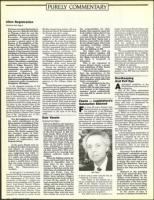
or some 29 years, Senator Jack
Faxon has been an emissary for
his colleagues in the Michigan
state legislature, at important com-
munal functions, reading citations to
eminent citizens. At the scores of impor-
tant functions at which he was the
spokesman for the state's lawmakers,
he expressed appreciation to fellow
citizens for their services to social ser-
vice movements, to educational causes,
Jack Faxon
to Israel and to other aims for the ad-
vancement of human needs.
Now Faxon is the selectee for a
return compliment. As the honoree for
1988 of the Detroit Council of the
Jewish National Fund, at the June an-
nual dinner, those he saluted through
the years will have the opportunity to
give him deserved recognition.
The JNF choice of an honoree is a
proper one because Senator Faxon had
come to the numerous events through
_ the years as a supporter who identified
personally with the many movements.
As a Zionist, as an advocate of basic
needs to raise the standard of living of
his fellow citizens, as one concerned
with the progress of cultural
movements with which he is identified,
he has earned the tribute to be accord-
ed him.
This is an appropriate time to note
the special interest he has in Yiddish.
He is the articulate Yiddishist. He
doesn't permit an opportunity to slip by
without expressing himself in the
Mame Loshen. There are anxieties, but
even they are his expressions of love for
the Yiddish he espouses.
With his sense of humor and his
Yiddish, he is certain to add another
quality to the JNF that has chosen to
honor him.
Soothsaying
AndEvil Eye
A
strological credibility in the
White House lends notoriety to
soothsaying.
One of the oldest phenomena
assigned to the aspect of predicting that
even rises to the realm of prophesying
is "the Evil Eye."
In the Jewish experience this has
become applicable to common expres-
sions, and even to salutations for
avoidance of evil and bad luck.
Therefore, in its common usage it
has emerged as a corrupted Yiddishism.
Ordinarily it sounds like "kin-ayn-
orah." When, as a matter of fact in its
correct form, prefaced with the Yiddish
"Kein," which means without, the
knowledgeable will always correct the
misusers, advising them that it should
be pronounced "Kein-Ayin-Horeh." It is
from the Hebrew "Bli Ayin Horah."
Therefore it could be interpreted as
the good wish, "You should be saved
from the Evil Eye."
A most fascinating explanation of
the "Ayin Raah" idea is in the "Jewish
Concepts" compiled by the late Dr.
Philip Birnbaum. For the most
authoritative definitions I often turn to
the writings of my mentor, the late Rab-
bi Birnbaum. Here is his most in-
teresting compilation of facts about the
Ayin Raah concept:
The terms "Ayin-Horeh" and
"Ayin-Raah" essentially denote
envy, jealously, grudge, greed, ill
will. In the Hebrew Bible, we are
told not to dine with a man who
is stingy (Ra Ayin) and not to
desire his delicacies. "Eat and
drink;' he says to you, but his
heart is not with you (Proverbs
23:6-7).
Opposed to tke, grudging
man is the generous man, (Tov
Ayin) (Proverbs 22:9). In the
"Ethics of the Fathers;' we are
told that a good eye (Ayin Tovah)
or generosity, is the best quali-
ty to which a man should cling;
and that an evil eye (Ayin Raah)
is the worst quality, which a
man should shun (Avoth 2:13-14).
In the course of time, it
became a widespread belief that