

I FRONTLINES
STREET WISE
With The Jewish News' Home Magazine
You can purchase copies of the Jewish
News' colorful, informative Home
magazine, beginning May 13, from these
convenient locations:
— SOUTHFIELD —
Capitol Rx
Twelve Mile & Northwestern
Seven-Eleven
Franklin Rd. South of Twelve Mile
Majestic Market
Lahser & Civic Center Dr.
Heritage Building
Northwestern & Evergreen
Phil 'IV Pharm.
Borders Book Store
Evergreen & Twelve Mile
SOuthfield & Thirteen Mile
Greenfield Rx
Efros Rx
Greenfield N. of Twelve Mile
Greenfield & Ten Mile
— W. BLOOMFIELD —
Efros Rx
Waldrake Rx
Orchard Lk. & Maple
Drake & Walnut Lake
Downing Rx
Walnut Lk. West of Inkster
— OAK PARK —
Seven-Eleven
Lincoln Rx
Lincoln E. of Greenfield
Coolidge & Lincoln
Bornstein Bookstore
Oak Park Book Center
Greenfield & Ten Mile
Nine Mile & Coolidge
— BIRMINGHAM —
Say on Rx
Metro News
Telegraph & Maple
Telegraph & Maple
— FARMINGTON HILLS —
Efros Rx
Seven-Eleven
Gd. River & Drake
Orchard Lake & Thirteen Mile
I Browse Bookstore
Warren Rx
Orchard Lk. & Northwestern
Middlebelt & Fourteen Mile
— ANN ARBOR —
Blue Front Newspapers Community News Center
701 Packard at State
330 E. Liberty
THE JEWISH NEWS
No ?AAA
14
FRIDAY, MAY 13, 1988
Hadassah Editor Tigay
Scans Globe For The Exotic
ELIZABETH KAPLAN
Staff Writer
T
he typical traveler sets
out on a trip for Paris.
He just can't wait for
some of that Perrier and a
croissant. He's carrying a big
bag filled with maps of the
metro and he's on his way to
have his portrait made at
Montparnasse.
And then there's Alan
Tigay.
Tigay, executive editor of
Hadassah Magazine and
editor of The Jewish Traveler
prefers, well, the more uncom-
mon route when gallivanting
the globe.
In Japan, where he lived for
three months, Tigay worked
as a folksinger. In Israel, he
studied Hebrew at an absorp-
tion center for Soviet im-
migrants, and in India, he
dined on the most expensive
meal in the city. It cost 50
cents.
The Detroit-born Tigay was
back home this week to ad-
dress the 42nd annual
meeting of the Women's Divi-
sion of the Jewish Welfare
Federation.
In an interview, Tigay
discussed some of his travels,
which have included Hong
Kong, Thailand, Mozambi-
que, South Africa, Lebanon
and Sri Lanka. It was Sri
Lanka that got Tigay started
in the first place.
He had planned on becom-
ing a demographer. Then he
entered the University of
Michigan and decided to ma-
jor in sociology. After his
graduation in 1969, Tigay
joined the Peace Corps.
Assigned to work on a
public health program in Sri
Lanka, Tigay said that
through this experience, he
"got a glimpse of what the
world is really like."
Tigay returned to the
United States and settled in
Chicago where he met his
wife, Lois.
Like Tigay, Lois was in-
terested in traveling. So the
two worked for 18 months,
saving half their entire earn-
ings' for the next 18 months,
when they set out for adven-
tures in Asia, Africa and the
Middle East.
The couple spent three
months in Kyoto, Japan,
where Tigay worked as a
folksinger in a new cafe with
a "Western-style motif."
One of his most interesting
experiences while in Japan
occurred on Pesach.
He and his wife were cer-
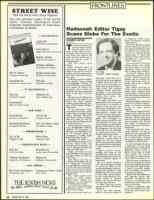
Alan Tigay:
Looking for a Jewish gondolier.
tain they would find just a
small group at the synagogue
in Kobe, where they were in-
vited for the first seder. In-
stead, they were greeted by a
large crowd that included
visiting South Africans,
members of the Pittsburgh
Symphony on tour and "every
Israeli from within 100
miles," Tigay said.
For Tigay, the seder was
memorable not only because
it took place in a country so
different from his own, but
because he witnessed a com-
mon tradition shared by all
participants, despite the
diversity in their nationality.
Last year, Tigay returned to
Japan. The synagogue in
Tokyo, where he and his wife
had attended services, was
half its former size. He said 50
percent of the land on which
the synagogue was built had
been sold, so as to establish
an endowment fund for the
Jewish community there.
And while the sale did
generate a great deal of
money for the fund, Tigay
said, it also meant sacrificing
the gardens by the synagogue
— and therefore much of its
charm.
Tigay's travels finally
brought him back to the
United States and to Colum-
bia University, from which he
holds a master's degree in
journalism.
He soon found positions
with Near East Report, where
he served as editor of the
weekly publication which ex-
amines U.S. policies in the
Middle East. He also worked
as New York correspondent
for the United Feature Syn-
dicate, where he covered
politics, the United Nations
and arts and business.
In 1980, Tigay was named
executive editor of Hadassah
Magazine.
Don't ask. He's already
heard it. A man, in charge of
a magazine which serves
what is essentially a women's
organization?
Hadassah Magazine, which
has the largest circulation of
any Jewish publication, does
not address only issues of in-
terest to the women's Zionist
organization. It "covers the
entirety of the Jewish world"
including arts, culture and
society, Tigay said.
It also provides a forum for
telling stories that might
otherwise have remained
unearthed. This is just the
sort of thing Tigay relishes.
"It doesn't happen often,
maybe once or twice a year,"
he said. "We find an entirely
unique and an entirely ex-
citing manuscript from so-
meone who is not a profes-
sional writer."
But before arriving on
Tigay's desk, these articles
must receive • approval from
another editor — and compete
with the literally hundreds of
other manuscripts that tome
in each year.
Not surprisingly, Tigay also
admits to a soft spot when it
comes to travel articles,
which he often writes
himself.
He recently visited Europe,
where he met with the small
Jewish community living in
Germany. Many of the Jews
there, he said, are transplants
from countries like Poland
who came to Germany to
escape their memories of the
Holocaust.
Tigay described the unset-
tling situation as one in
which survivors associate the
Nazi era only with the coun-
try of their birth, whereas
Germany can appear to them
as without a stain of evil.
In his meetings with Jews
in Germany, as in all travel
stories that run in Hadassah
Magazine, Tigay wants to
draw out the ways in which
Jews reflect the country
where they live and how they
have made an impact on it.
When he sent a reporter to
Venice, for example, he asked
her to find a Jewish gondolier.
In Switzerland, Tigay sought
a Jewish chocolate maker.
And in Chicago, he went for
the Jewish gangster.
Despite the vast differences
that separate Jewish com-
munities throughout the
world, it is, in the end, their
similarities which Tigay said
are most binding.
"There's something that
ties us all together," he said.
"And that's what I like to em-
phasize."