

CLOSE-UP
NV
11 1 111)1111E
BA BY LO
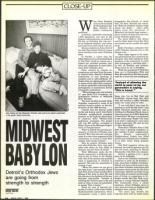
Alan, Sarina and Zev Steinmetz: Orthodox Jews want to be asked to participate
in the greater Jewish community.
Detroit's Orthodox Jews
are going from
strength to strength
DAVID HOLZEL
Staff Writer
24
FRIDAY. APRIL 1_1988
hen Sinai Hospital
announced the layoff
of 150 employees last
May, Detroit's Or-
thodox community
mobilized.
A petition, reportedly containing
1,000 signatures, was sent to the
hospital administration on behalf of
Eli Apt, an Orthodox Jew who serv-
ed as weekend chaplain, and whose
part-time hours were about to be cut.
Since an election in June, three of
the Oak Park School District's seven
board members have been Orthodox
Jews.
In October, a rumor that the
Jakks Restaurant on Greenfield Road
in Oak Park would be turned into a
topless bar provoked protests, peti-
tions and complaints to state politi-
cians from Orthodox Jews.
Once content to remain in-
conspicuous and aloof from the socie-
ty around them, Detroit's Orthodox
community is now growing in
numbers and in self-confidence. Or-
thodox Jews are taking public action
on issues which affect their communi-
ty and are gradually increasing their
participation in mainstream Jewish
community institutions.
"We're stronger now and we know
it," says Rabbi E.B. Freedman, ad-
ministrative director of Yeshivath
Beth Yehudah.
The most manifest example of the
Orthodox community's sense of its
political muscles centers on the con-
struction of the 1-696 freeway.
Concern that the freeway would
divide and destroy north Oak Park's
Orthodox neighborhood prompted
pressure on the highway department
to construct three 700-foot-wide
pedestrian overpasses. The project
will cost $20 million, according to
Robert Tiura of the Michigan Depart-
ment of Transportation.
What is behind the growing pro-
minence of Detroit's Orthodox com-
munity? Why does this new activism
come at a time when segments of the
community are trying to limit their
contact with secular society?
How do modern Orthodox Jews
and ultra-Orthodox Jews view each
other and where do they differ on
Zionism and the State of Israel?
Their differences aside, the Or-
thodox community is definitely get-
ting to feel at home in the Detroit
area. One of the reasons may parallel
what is happening in America in
general: The post-war generation is
coming of age.
"We're the closest we can get to
the baby boom," says recently elected
Oak Park school board member Ezra
Roberg of the Jews in their 30s and
40s who are in the forefront of the new
Orthodox high-profile. "Instead of
allowing the world to pass us by and
push us where it may, our generation
is saying 'This is home.' "
Home for most of Detroit's Or-
thodox is within a mile of the 10 Mile
Road-Greenfield intersection, which
encompasses nearly a dozen small
synagogues, the mikvah, or ritual
bath, the Beth Yehudah day school,
the Yeshivah Gedolah religious high
school, the Kollel — where adult
males study the intricacies of
Halachah, the Jewish legal system —
plus a number of shops that serve the
area's Orthodox population.
The Akiva Hebrew Day School
and the Beth Jacob School For Girls
are located not far outside this tight
circle.
Rabbi Freedman estimates that
1,000 Orthodox families live in the
Detroit area.
What might appear to be volun-
tary ghettoization has a practical ap-
plication: The short distances allow
members of the community to reach
their synagogues — and each other —
by foot on Shabbat and holidays,
when travel by car is forbidden.
While the movement of Orthodox
Jews out to Farmington Hills and
West Bloomfield has laid the ground-
work for at least two new synagogues,
"Instead of allowing the
world to pass us by, our
generation is saying,
'This is home.' "
those who live in Oak Park and
Southfield express hope that their
area will remain a viable Orthodox
center for many years to come.
"I was told that I was crazy for
wanting to build in Oak Park;' says
Rabbi Abraham Jacobovitz, who is
building his Machon Mbrah drop-in
learning center on 10 Mile Road east
of Greenfield."We have a commitment
to the community. People who come
to us want to experience a real warm
Jewish community. We can't do that
in West Bloomfield."
These days, Orthodox Jews in Oak
Park voice a growing confidence in
the viability of their neighborhood.
The Jewish community's
Neighborhood Project has lifted
morale and residents point confident-
ly to their area's rising property
values.
Oak Park's property values rose
between two and five percent over the
last two years, according to Ronald
Sztumerski, Oak Park city assessor.
Detroit is getting to be a great
place to be Orthodox.
And so the Orthodox community
continues to grow, by 20 families a
year, according to Rabbi Freedman.
Detroit now has a critical mass to sup-
port those Orthodox institutions and
businesses which enrich the life of the
community. Detroit's currently strong
white-collar job market and favorable
cost of living, in comparison to Or-
thodox centers like New York, is ap-
pealing to young Orthodox familes.
The community eruv, a ritual
enclosure, allows Orthodox Jews to
carry personal items on Shabbat and
enhances their quality of life.
"Ten years ago, besides the
bakeries, there were no outlet stores