

TRAVEL
If you are not wearing it . . . sell it!
You can't enjoy jewelry if it's sitting in your safe
deposit box. Sell it for immediate cash. We pur-
chase fine gems. Diamonds and Gold Jewelry.
A SERVICE TO PRIVATE
OWNERS BANKS & ESTATES
GEM/DIAMOND
SPECIALISTS
AWARDED CERTIFICATE BY GIA
IN GRADING & EVALUATION
a4
30400 Telegraph Rd.,
Suite 134
Birmingham 642-5575
Hours:
Daily 10:00-5:30
Thurs. 10:00-8:30
EST. 1919 Sat. 10:00-5:00
Fine Jewelers
`I can't get over my new
Invisible Fencing: "
W
ith one call to Invisible Fencing, you can
. teach your dog to stay within your prop-
erty boundaries, without unsightly fences.
University tested, vet approved, and your satis-
faction is guaranteed. It even costs less than
traditional fencing. Call today, and find out why
Over 50,000 dogs stand behind Invisible Fencing.°
111— INVISIBLE FENCING R
FOR A BROCHURE
& FREE ESTIMATE
82
of BIRMINGHAM, INC.
FRIDAY, MARCH 18, 1988
1 - 851 - 7154
IPIEDJ
GET REJUITS
Call The Jewish News
354-6060
Look for us
at the
Home Builders Show
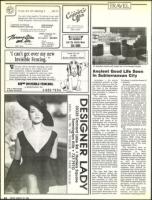
An excavated mansion with mosaic floor in the Herodian Quarter.
Ancient Good Life Seen
In Subterranean City
Jerualem — An entire
residential quarter in what
used to be known as the Up-
per City of Jerusalem, from
the time of the Herodian
Dynasty, is the newest attrac-
tion available to visitors in
Israel's capital.
The spacious mansions,
decorated with frescoes,
moulded stucco and colorful
mosaic floors, were opened to
the public last November for
the fist time since the
Romans put the torch to these
luxurious residences on Sept.
20, 70 C.E., thus completing
the destruction of Jerusalem.
The Herodian Quarter was
excavated by Prof. Naham
Avigad and scores of ar-
chaeologists and volunteers,
who dug their way through
more than 2,000 years of
debris.
Going below the modern
buildings, it is possible to
wander through the palatial
mansions that were built here
by wealthy Jerusalemites, on
the choicest real estate the
city had to offer. One can pic-
ture the creme de la creme of
the city gathering in the
sumptuous reception halls, or
the proprietors luxurating in
their various bathing in-
stallations. We marvel at the
decorations they bestowed on
their residences, and at the
furniture and utensils they
used for their banquets. How
all this survived succeeding
waves of destruction seems
miraculous.
The area had been the
Jewish Quarter within the
city walls since the Middle
Ages. When Israel's capital
was reunified in 1967, the
returning Israelis found the
quarter to be one big heap of
rubble. A company was set up
to rebuild the area, and at the
same time droves of ar-
chaeologists descended on the
quarter to research the past.
For them it was the chance of
a lifetime.
Builders and diggers work-
ed in a symbiotic way, aimed
at leaving the more impor-
tant finds exposed at street
level or visible under the new-
ly built houses. The incor-
poration of the Cardo street
from Byzantine and Crusader
times into the present street
plan, is a prime example of
imaginative planning and
design that has drawn world-
wide attention. Other ancient
remains punctuating the
rebuilt quarter include an
apse of the sixth century Nea
Church, built by the Emperor
Justinian, and fortifications
built by the Maccabean rulers
in the second century BCE
and by King Hezekiah in 701
BCE.
The latest complex of ex-
cavations to become accessi-
ble is a quarter of luxurious
residences built in the first
century BCE when King
Herod carried out extensive
buiding projects that made
Jerusalem one of the most
resplendent cities.
The mansions have an
amazing array of water in-
stallations in their
basements, all the more
remarkable considering the
shortage of water in the area.
Here one finds ritual baths,
as well as luxurious
bathrooms paved with ex-
quisite mosaics. This preoc-
cupation with Jewish re-
quirements for ritual purity,
combined with the presence
of more sybaritic bathrooms,
lead scholars to believe that
the mansions belonged to the
high priests of the Temple.
This belief is reinforced by the
proximity of the quarter to
the Temple precinct.
The reception hall walls
were first decorated with
frescoes, and later covered
with plaster imitating stones.