
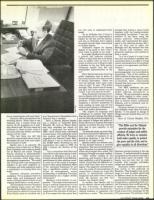

CD
how to communicate with each other." bi at Young Israel of Greenfield where
Tanzman offers management the Tanzman was a member.
following advice: "First, treat a new
Born in Detroit, Shlomo Sperka
employee like a human being and was a student at Yeshivath Beth
answer all the questions he is prob- Yehudah. He went to Wayne State
ably afraid to ask. Tell him where the and later attended law school at
bathroom is, where to park, when to night. "I graduated law school in
eat lunch and take breaks; and then 1960. I have always been interested
explain all the rules.
in social issues. I was looking for a full
"The last thing you tell him time position and David Tanzman
should be instructions about the job. suggested the National Labor Rela-
Remember, the last is the most impor- tions Board. I was an attorney with
tant because it lasts."
the NLRB before becoming an ad-
Sperka also is an educator. He ministrative law judge in 1969. In
teaches a class in labor law at Wayne 1983 I became the director of the
State University and a class in Jewish BER.
"It is a coincidence that Dave and
law at Wayne's law school. Though
heavily involved in administrative I should be in the same agency. Labor
work, he would like to be more involv- relations in Michigan is not a par-
ed in activities which foster labor- ticularly Jewish field. In the Midwest,
management cooperation. "We would practitioners in labor relations usual-
like to bring labor and management ly come out of the ranks of manage-
together to get more employee in- ment or labor union leadership. Most
volvement and help employees make of the unionized businesses do not
a contribution to running their own have a significant number of Jews
either in management, union
work!'
Tanzman advocates preventive membership, or leadership. The legal
mediation. "It is a program where we representation has a higher Jewish
assist labor and management and involvement:'
Sperka is a firm believer in com-
cause a dialogue between them on an
ongoing issue before a crisis occurs!' promise. "The single most important
The friendship between Tanzman thing in seeking compromise is to be
and Sperka began years ago when able to return respect for the other
Sperka's father, Rabbi Joshua Sperka, party as a person, and attempt to
at one time the rabbi at Congregation understand the interests of that par-
B'nai David, acted as volunteer rab- ty. If you respect the other party then
you will want to understand their
needs.
"As an Orthodox Jew, I bring to
my particular job in a legal agency a
respect for the law and the system,
and also an Orthodox Jew's respect
for people and the high value placed
on human dignity.
"Judaism's respect for human
dignity is my guide in how I feel I
must relate to people in my work!"
As a judge, Sperka had to develop
a patient and judicious attitude.
"When a legal issue has to be faced,
then no matter who's ox has to be
gored, you have to be willing to make
a decision to the law. Both parties
ultimately benefit from fair and
evenhanded administration of the
law?'
Often Sperka had cases involving
public employees such as police of-
ficers and teachers who were accused
of serious misconduct. "There are
very hot feelings when these cases
come to trial," he says. "The stakes
are high. They involve loss of money
and jobs, and entire careers can be
ruined. I try very hard to be fair!'
Years of talmudic training are evi-
dent as Sperka tells how he relies on
his Jewish background to help resolve
problems. "I think talmudic training
heightens a lawyer's sensitivity to
close reading of cases and all text
material and induces a willingness to
work with subtle distinctions.
"My respect for language and
willingness to analyze text stems
from my talmudic training. The Bible
and the Talmud provide principles for
the conduct of judges and public of-
ficials. We learn to examine both sides
equally, to protect the poor and the
rich, and to give equality in all
directions.
"In talmudic study, we study iden-
tical facts and look for differences. We
have a method of analysis in ap-
proaching decisions. I use this ap-
proach in my legal career?'
Sperka recalls one delicate case.
"It was delicate because it involved
clergymen. The case involved the fir-
ing of a teacher in a parochial school
where the principal was a priest. The
testimony brought out many conflicts.
"After careful reading of the
testimony, and because I gave very
high credibility to all of the people in-
volved, I found that the different ver-
sions could have been true to some
degree. The apparent contradictions
were the result of misconceptions of
certain facts. I always try to get the
parties to demonstrate personal
respect for each other when a case is
tried. My decision was that the
teacher was illegally fired!"
In another case, Sperka had to
decide whether interns and residents
at the University of Michigan
Hospital in Ann Arbor should be con-
sidered students, or employees who
could form a union. "The university
stressed that having a union would
interfere with the teacher-student
relationship," he explains. "I was very
sensitive to the issue, using the
classic yeshivah `rebbe-student'
model, and I appreciated the impor-
tance to the learning process. But I
felt my duty was to apply the
Michigan law. My decision was that
the interns and residents were
primarily employees and entitled to
form a union.
"In a lot of cases it is easy to see
that only one solution is possible. But
sometimes there is no right or wrong
answer and people have to reevaluate
to come to an agreement and find a
solution!'
Sperka says he is not pro-union or
pro-management, but pro-collective
bargaining. "One of the realities of
labor relations is that once a specific
dispute is resolved the parties must
re-establish their relationship
because they have to go on living and
working together?'
Two BER mediators are par-
ticipating in a Detroit high school
project offering alternatives to
violence. "We are interested in seeing
our skills applied to other areas,"
Sperka says. "Mediation is a growing
area in divorce courts, community
disputes, and in consumer and en-
vironment issues!'
Tanzman started his career by a
less orthodox route than his friend
Sperka. "I was placed in charge of
things and just worked them out," he
recalls.
Born in Corona Heights, N.Y.,
"The Bible and the Talmud
provide principles for the
conduct of judges and public
officials. We learn to examine
both sides equally, to protect
the poor and the rich, and to
give equality in all directions."
Tanzman started working at the age
of seven. "I walked behind the horses
and picked up the manure and sold it
for 25 cents a pail;' he recalls. "Our
family was not rich, but we were
wealthy with concepts, principles,
values and attitudes."
Tanzman's mother would not let
him travel to the yeshivah in'
Brooklyn. "She thought it was too far
away, so I went to public school and
to Hebrew school in the afternoon:'
For personal reasons, including ill
parents and the Depression, Tanzman
turned down a scholarship from Cor-
nell University that would have led to
a career in veterinary medicine. "I
had to go to work;' he says. "In 1936,
I took a test to be a messenger for the
U.S. government. Not getting a reply,