

AROUND TOWN
Thrifty
Thinking
Women's organizations'
thrift shops prove profitable
to the community service
projects they benefit
RUTHAN BRODSKY
Special to The Jewish News
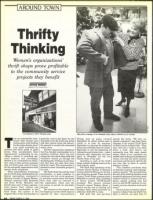
The entrance to ORT's Ferndale shop.
T
hey are remarkable enter-
prises! They furnish local
communities with clothing
for the entire family, furni-
ture, small household ap-
pliances and other goods at great
prices. They accommodate their
organizations' membership by pro-
viding a vehicle to contribute per-
sonal property and accordingly,
declare it as a charitable tax deduc-
tion. And, as their primary purpose,
they net fairly large sums of money
for the non-profit organizations that
operate these enterprises. ,
These extraordinary businesses
are the thrift shops established by the
Detroit metropolitan community's
National Council of Jewish Women,
Women's American ORT, Hadassah
and B'nai B'rith. Members and
friends from each of these organiza-
tions donate their clothes and
miscellaneous merchandise to the
thrift shops. One quarter of the
original value of the merchandise is
48
FRIDAY MARCH 11. 1988
generally used as the figure for the
charitable write off. In the case of furs
and other special items, the deducti-
ble amount is usually the estimated
resale value.
All four organizations emphasize
that the donated merchandise be in
excellent condition. Since this isn't
always the case, thrift shop staffs and
volunteers usually go through the
donated goods, weeding out merchan-
dise that does not meet their stan-
dards for resale. This merchandise is
donated to other charitable groups in
the area.
The thrift shops then sell the used
merchandise in good condition to
customers who live in the communi-
ty and other nearby cities. The funds ,
from these sales are returned to
the organization which uses the
net ncome to provide its charitable
services.
The summer is the slowest time
for shopping in all the thrift shops as
reported by their organizations.
Betty Bercu, manager of the Hadassah shop, helps a customer try on a jacket.
Things pick up again around
September for school clothes and a
month or so later for everyone.
September is a big time for children's
shoes and outfitting them for school.
September is also the beginning of
looking for good winter buys — coats,
business suits. September and then
again in November are the two
busiest times of the year.
According to each of the thrift
shops, women's clothing items are the
most popular goods.
The thrift shop operations of the
Greater Detroit Section of National
Council of Jewish Women are the big-
gest of the four groups. There are two
Council Thrift Shops grossing about
$500,000 in annual sales, according
to Terran Leemis, NCJW-Detroit
president. This amount includes
Council's annual Fashion Spree, a
special two-day sale of clothing and
boutique items which generates an
additional $150,000 in sales.
Paid staff, full- and part-time
operate the stores. "We have our
regular customers," says Jean Clary,
manager of the council Thrift Store
on East Lincoln in Royal Oak. "They
may visit once a week or two, three
times a week. And they're not
necessarily poor like many people
believe. Many of our customers are
middle-class working and professional
women who find the store's location
convenient and the price right for the
way they like to dress in quality
designer clothes."
"Our members contribute what
we describe as gently used clothing;'
explains Leemis. "The proceeds from
the sale of the clothing, furniture and
househOld appliances and other goods
enables Council to initiate new pro-
grams, expand existing ones and
carry on the NCJW tradition of com-
munity service, education and social
action."
Council stores, located at 1221 E.
Lincoln in Royal Oak and 20430 Van
Dyke in Detroit, are open from 10