

FOCUS
In self-imposed exile, Menachem Begin
has ventured beyond his Jerusalem
apartment only nine times in the past
four years.
GLENN FRANKEL
Special to The Jewish News
erusalem — He came
out again last month to
make his annual visit to
the grave. He trekked up the
hillside on a dirt path under
graying skies, recited the kad-
dish and scattered a fistful of
pebbles. Then he walked
down to the waiting car to be
whisked back to the safety
and isolation of his apart-
ment, 15 minutes away.
The usual crowd was there,
several dozen well-wishers,
former comrades, government
officials, old friends, relatives.
He accepted their greetings,
nodded occasionally, but
shook hands with no one.
He was dressed in a dark
blue suit with a crisp white
shirt and a striped tie. A
black fedora shaded his eyes
and hid his expression from
the cameras and the col-
leagues. His skin was pale
yellow, the color of flesh that
seldom sees the sun. There
were blotchy, red razor
scrapes on his thin cheeks.
His eyes looked hollow. He
stood unaided at the grave
site, but his two daughters
took his arms to help him
make the slow walk up and
down the hill.
In an hour it was over. The
Peugeot carried him back to
1 Zemach St. The crowd —the
solemn disciples, the tight-
lipped plainclothesmen, the
voracious Israeli photog-
raphers jockeying for a last
shot — drifted off. Menachem
Begin's yearly pilgrimage to
the grave of Aliza, his wife of
43 years, was over.
But not his mourning. It
has been five years since
Aliza died, 5 1/2 years since the
invasion of Lebanon, four
years since he told his col-
leagues, "I cannot go on."
Stepping down as prime
minister, he retreated to the
splendid isolation of the
residence where he has lived
ever since in a self-imposed
exile of shadows and mem-
ories, the prisoner of Zemach
Street.
The day before Begin's cem-
etery visit, Israelis marked
another significant event in
their recent history. It was
the 10th anniversary of the
late Anwar Sadat's epoch-
j
making trip to Jerusalem.
There were speeches and din-
ners and symposiums, sober
reflections laced with bit-
tersweet nostalgia, a longing
for the days of big men and
bold rhetoric. Menachem
Begin was one of those men,
a crucial if recalcitrant par-
ticipant in the passion and
the glory of Camp David. Yet
his name seldom came up in
the observances. When they
did mention it, Israelis spoke
of Begin as they spoke of
Sadat: in the past tense.
Yet Menachem Begin lives.
The former prime minister
reads the newspapers every
morning, answers the phone,
sees relatives and, on occa-
sion, old friends. His
secretary says he has ven-
tured outside his well-kept
apartment in Jerusalem's
western suburbs exactly nine
times in the past four
years — four times to visit
Aliza's grave, five for treat-
ment by his personal physi-
cian at a nearby hospital.
His exile is a distinctly
Israeli tragedy linked to a war
that still haunts the nation.
The 1982 Lebanon invasion,
his proud crusade, became a
quagmire in which more than
600 Israelis died, and Israel's
reputation was dragged
through the mud of Sabra
and Shatila, the refugee
camps where hundreds of
Palestinians died at the
hands of Christian militiamen
while Israeli soldiers stood by.
Begin, it is said, feels
responsible.
Many here blame Begin's
defense minister, Ariel
Sharon, for deceiving the old
man — indeed, the entire
Cabinet — into believing
Israeli forces would halt at a
prearranged point 25 miles
north of the border, when in
fact Sharon had always
planned to push all the way to
Beirut. In a three-hour
stream-of-consciousness lec-
ture before a 'Ibl Aviv au-
dience last summer, Sharon
denied all the charges that
have been festering for five
years and presented his own
history of the invasion and its
consequences.
Despite the urgings of
several friends, Begin chose
not to challenge Sharon's ac-
count. In fact, friends say,
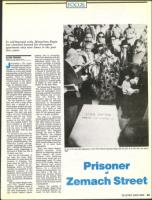
On one of his rare public appearances, former Prime Minister Menachem Begin visits the grave of his wife, Aliza, who died in
1982.
Prisoner
Zemach Street
THE DETROIT JEWISH NEWS
81