

CLOSE-UP
- FREE DELIVERY -
Dog_ Food I Cat Food
PURINA • SCIENCE DIET • IAMS
-SPECIAL This Week Only!
FREE Rawhide
with this week's order
SCIENCE DIET
$24.99 40 lb. maintenance
BELL PET FOOD & SUPPLIES
'20 lb. minimum
626-9515
Monkey Business
SAVE FROM
20% TO 50%*
MARV
SAYS
CUSTOM
WALL
MIRROR
SPECIALISTS
TUB & SHOWER
ENCLOSURES
MIRRORED
BIFOLD OR
SLIDING DOORS
.1
INSULATED
GLASS
REPLACED)
MOBIL
AUTO
GLASS
SERVICE
• TABLE TOPS
• STORM DOORS &
WINDOWS
• PATIO DOOR WALLS
REPLACED
• STORMS & SCREENS
REPAIRED
VISIT OUR
SHOWROOM
p
GLASS S. AUTO TRIM
CUSTOM WALL MIRRORS
TIRES & ACCESSORIES
SOUTHFIELD: 24777 Telegraph
-353-2500
Other locations: Wayne and Lincoln Park
'Suggested List Price
•
% oct
& Im ag
ai
t
I
Too.
es
• CARDS
• GIFTS
• PHOTO
• FINE COLLECTABLES •
• RIEDEL CRYSTAL, AUSTRIA •
• PARTY SUPPLIES, GAMES •
• DANKIN PLUSH TOYS •
• SWEATSHIRTS & T-SHIRTS •
r
, - .
ii -
a
.
,
J
I
-1
10% OFF
-
, -
_
COUPON
TOTAL
PURCHASES
OVER $10.00
See Clerk For Details
L
J
PROCESSING & PRINTING BY
IMAGES PHOTO LAB OR KODAK
— U.P.S. SHIPPING AVAILABLE —
COUNTRY RIDGE COMMONS
31150 HAGGERTY RD. AT 14 MILE RD.
FARMINGTON HILLS
661-9100
28
FRIDAY, JANUARY 29, 1988
throw a laser dot on an object that he
wants the monkey to fetch; the second is
a candy dispenser, which Herscu will be
able to activate in order to reward the
monkey for a task well done — in psycho-
logical terms, to reinforce appropriate
behavior.
Achieving the stage when a monkey will
respond to commands and rewards is a
long and arduous process. It takes about
three years to domesticate and socialize
the animals, and a further six months to
train them to perform the necessary tasks.
The adaptation of a particular monkey to
a particular paraplegic is relatively short
— a matter of weeks.
But the time and effort required to
prepare the monkeys for their new roles is
considered to be well worthwhile. For
although the monkeys do not begin their
work until they are almost four, they have
a life expectancy of between 30 and 40
years.
Carmella Burke had reservations about
just one aspect of the project: before the
monkeys are placed with quadriplegics,
their teeth are extracted so that they will
never be able to harm their charges.
She accepted the need for this because
a monkey could, for example, bite the back
of a quadriplegic without him being aware
of it and the injury might not be
discovered until it is dangerously infected.
Despite her initial qualms, however, she
found that within two hours of their teeth
being extracted,the monkeys were eating
a specially prepared soft food, which is im-
ported from the United States.
There was no apparent discomfort, nor
did they appear to suffer any long-term ef-
fects. It was, says Carmella Burke in the
jargon of her trade, "minimally distress-
ful."
In addition to assisting quadriplegics,
the monkeys have been found to perform
one unexpected function of immense im-
portance. For Sorin Herscu, the new
monkey-companion will provide something
he has craved — and been denied — for the
past 11 years: solitude.
From the instant of his injury, he has not
been left alone for a moment. Even when
he is asleep, an attendant is just outside
his door. Now he is able to contemplate the
prospect of being "alone" for about three
hours a day.
Not that the monkeys will replace the
human attendants, says Carmella Burke,
but they will enable quadriplegics to be left
to themselves.
"These few hours can be incredibly im-
portant," she says. "Sorin makes the point
that he has completely lost the ability to
be alone and that the constant companion-
ship is overwhelming."
Sorin Herscu's needs — and his atten-
dants — are all provided by the Israeli
Defense Ministry, but for those who do not
have such a framework of support, the
burden of caring for a quadriplegic can be
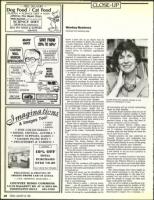
Photo By Hanoch Gu thmann.
Continued from preceding page
Carmella Burke trains capucine monkeys as com-
panions for quadriplegics in Israel.
all-consuming and an utterly exhausting
drain on their families.
Carmella Burke believes that the use of
a domesticated, trained monkey in such
circumstances would relieve the families of
a tremendous load, providing a few
precious hours a day when the level of
human attention can be reduced.
In the United States, where nine
monkeys are already "in service" and more
are in training, paraplegics with their
monkey aides are now being left alone for
up to nine hours a day.
Similar projects are also underway in
Canada, Germany and Argentina, but
Carmella Burke's project is rated second
to the United States in terms of the prog-
ress that has already been achieved.
Carmella Burke, herself a woman of un-
bounded vitality and acute vision, now has
a new dream: to set up such a project in
her native Australia.
So far, her "monkey business" has been
aimed exclusively at injured army veterans
(because the Defense Ministry is picking
up the tab), but she is convinced that there
would be a great demand among the wider
public.
She acknowledges that there might be
some initial resistance to the idea of en-
trusting a quadriplegic to the care of a
monkey, but she points out that it took
years for people to accept the idea that
dogs could guide the blind.
Just as she is making a significant con-
tribution to improving the quality of life
for Israelis whose world has become ex-
tremely confined, Carmella Burke is now
determined to export the revolution. ❑