

all of us to be here!' He mused that
had there been such an outpouring of
protest for the Jews of Europe in the
1940s, many may have been saved.
"But too many of us were silent then.
We are not silent today.
"We are here because we must be
here," he said, to "arouse compassion,
not confrontation; to tear down walls,
not to build them!' Wiesel said there
must be linkage between trade and
human rights and added that if Gor-
bachev wants to be trusted, he can
help prove he is worthy of our trust
by allowing all Jews who wish to
leave the USSR to do so.
Among the othei speakers were
Senate Minority Leader Robert Dole
of Kansas; Rep. Jim Wright (D-Thxas); .
Rep. John Lewis, representing the
civil rights movement; Helen
Jackson, widow of Sen. Henry
Jackson; Governor Kean of New
Jersey; William Atwell, chairman of
the Canadian Parliamentarians; Rev.
Arie Brouwer, General Secretary of
the National Council of Churches;
Bishop William Keeler, of the Na-
tional Conference of Catholic Bishops;
Rabbi Gilbert Kla.pperman, president
of the Synagogue Council of America;
Martin Stein, chairman of the United
Jewish Appeal; Robert Loup, co-
An Eloquent Wiesel
chairman of the Summit Task Force;
Perhaps most eloquent was Nobel and Sen. Paul Sarbanes (D-Md.) and
Peace Laureate Elie Wiesel, who Rep. Jack Kemp (R-N.Y.), co-chairs of
began by noting that "this is a day of the Congressional Coalition for Soviet
pride, but also a day of melancholy. Jews as introducers.
A number of refuseniks who have
We have been waiting for this day for
20 years, and it has taken 20 years for been released from the USSR lit
Moscow that day had been beaten.
"That's not glasnost;' he declared,
"that's Joe Stalin!'
And Yosef Mendelevich, whose
11-year imprisonment was the
longest of all refuseniks, spoke with
bitter passion when he declared that
Gorbachev "thinks he can trick you"
by releasing a few token Jews. He call-
ed on President Reagan to link trade
with human rights, and closed with
the only reference of the day to God
and Torah by asserting: "We are one
people with one Hashem (God), one
Torah and one land, Eretz Yisroel."
Some speakers linked the Soviet
Jewry struggle to the upcoming holi-
day of Chanukah. Israeli Ambassador
to the U.S. Moshe Arad expressed
Israel's "total solidarity" with the ral-
ly and referred to the Jews of the
USSR as "the modern-day Mac-
cabees."
Shoshana Cardin of Baltimore, co-
chair of the Summit Task Force, noted
that Chanukah teaches us that "each
generation must wage that struggle"
with the oppressor. "Let the word go
forth," she said, "that Jews have
gathered here in larger numbers than
ever before to re-dedicate that strug-
gle!'
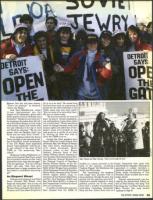
Mary Travers and Peter Yarrows: "Don't Let the Light Go Out"
candles on a giant menorah at the hand. Organizers were upset with
back of the podium, including Jack Kemp for allegedly violating his
Vladimir Slepak, Yuli Edelshtein, Ida agreement to simply introduce a
refusenik speaker, and with Gordon
Nudel and Sharansky.
Not surprisingly, the program Zacks, whose introduction of Vice
took longer than planned, with so President Bush sounded like a cam-
many speakers, though the pace was paign speech.
smooth and the speeches were brief.
Musical entertainment was pro-
Organizers worked mightily to keep vided by the Jewish band, Safam, as
partisan politics out of the event, well as Pearl Bailey, who sang "Let
given that a number of presidential My People Go:' and Peter Yarrows and
contenders (including Alexander Mary Travers, who sang several
Haig and Sen. Albert Gore) were on Continued on Page 26
THE DETROIT JEWISH NEWS
23