
Children Seek Origins Of Names
The sixth grade class of Cong.
Beth Shalom has written requesting
the origins of their names. Each
month I will include some of them.
Beier This name, of German
origin, came from an ancestor
whose occupation was smelting
lead.
Rosen/Rosenberg/Rosenbaum/
Rosenblatt/Rosenman/Rose/
Rosenfeld. These names are all
matronymic in origin, which means
that they came from a female
ancestor named Rose or Rosa.
These were very popular surnames,
since the Jewish people appreciated
names depicting flowers and trees
(Baum-Boim). Sometimes desirable
names had to be purchased from
the authorities. If one did not have
enough money, a ruthless naming
official often assigned names
meaning the German or Polish
equivalent of pig, dog or donkey.
Simony in Poland or Russia. The
Archives of the Leo Baeck Institute,
129 E. 73rd St., New York, N.Y.
10021, has extensive historical and
genealogical material about these
families, some dating from the Tenth
Century.
Israel/Israeli/Israels/
lsraelson. These are very old family
names of patronymic origin — son
of Israel of Azriel. The Israels were
a Mediterranean rabbinical family
with many prominent authors who
lived in Jerusalem, Egypt, Greece,
Russia, Germany, Spain, Holland
and the United States. Check the
various Jewish encyclopedias for
further historical and genealogical
material. You will also find reference
in Scattered Seeds, by George I.
Sackheim, and The Unbroken
Chain, by Neil Rosenstein.
family) from 1826 to 1870, have
survived. They are available locally,
by order, from the Mormon
Genealogical Library in Bloomfield
Hills.
Podolsky is a name derived
from a location — Podole. This city
is situated northeast of Tarnow in
Poland. At one time that area was
Galicia and part of the Austrian
Hungarian Empire.
Harelik is a variation of Ehrlich.
This was a German form of Aaron,
and indicated priestly origin.
Another interesting inquiry
came from Sylvia Adaskin. Adaskin,
is probably a variation of the names
Ashkenaz/Ashkenazi (meaning
German), used by a family of
German origin living in the Middle
East or Turkey. When they returned
to Europe in later generations they
kept the name or changed it to
Deutch — meaning German.
Richman was probably
Reichman, also a name of German
origins. It could have originated
from two sources. The first could
have come from a wealthy ancestor
or a Reich or Richman. It could also
have been from a female ancestor
named Rachel or Reichel, thus
Reichman.
Betty Provizer Starkman is the
past president and founder of the
genealogical branch of the Jewish
Historical Society of Michigan.
The Jewish Encyclopedia has
several articles about these family
inquired about the origin of her
How To Play The Dreidel Game
mother's maiden name, Lanienter.
names.
The name intrigued me since it is
Everyone in the game starts with 10 or 15 pennies (or nuts,
raisins, matchsticks, etc.).
Simon/Simmons/Simons/
Simonis/Simonshon. These family
names are patronymic in origin and
were derived from a male ancestor
named Simon or Shimon. This
name literally meant son of Simon.
Others adopting this name could
have originated in the towns of
TAB
Arlene Wenokur of Southfield,
so unusual. It probably originated in
Italy and was spelled Laniatore. This
family married into the Levi and
Halevi families. No other information
seems to be available. I did find,
however,that marriage, birth and
death records from Przasnycz,
Poland (former home of Lanienter
Each player puts one of these in the middle (called the pot).
Whether the player wins or loses depends on which face of the
driedel is up when it falls:
Nun means "nisht" or "nothing."
The player does nothing.
-
Gimel means "gantz" or "all."
The player takes everything in the pot.
Heh means "halb" or "half."
The player takes half of what is in the pot.
Shin means "shtel" or "put in."
The player adds two objects to the pot.
‘A"'
When only one object or none is left in the pot, every player adds
one.
When an odd number of objects are in the pot, the player rolling
heh takes half the total plus one.
When one person has won everything, the game is over.
SLOt A
co
►
0
_J
ta
JL
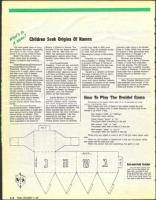
Cut-and-Fold Dreidel
You will need scissors and
paste. Cut out the dreidel. Cut
open Slot A and Slot B. Fold
along perforated lines. Insert Tab
A into Slot A and Tab B into Slot
B. Fold in tabs along bottom. You
may need to paste them together.
L-4
FRIDAY, DECEMBER 11, 1987
Scanned image of the page. Keyboard directions: use + to zoom in, - to zoom out, arrow keys to pan inside the viewer.
December 11, 1987 - Image 176
- Resource type:
- Text
- Publication:
- The Detroit Jewish News, 1987-12-11
Disclaimer: Computer generated plain text may have errors. Read more about this.