

CLOSE-UP
CONFRONTING
The Missionaries
A fledgling group is fighting back
against local 'Hebrew Christians'
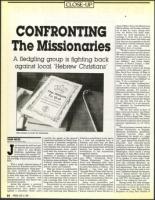
Some literature to counter the missionaries.
SUSAN WELCH
Special to The Jewish News
J
ust because the wolf can't get
through the door is no reason
to ignore it," says Ronnie
Schreiber, explaining why
he has spent his summer Fri-
day evenings distributing leaflets out-
side the Hope of Israel mission in Oak
Park.
With a small, informal group of
local activists, Schreiber and his wife
Batya are attempting to "bring near"
the Jews involved in Messianic
Judaism, or Hebrew Christianity, and
to alert both Jews and Christians in
Detroit to the dangers and
misrepresentations they believe the
movement presents.
Across the country, a growing
number of Jewish and Christian
organizations have spoken out
against a movement which, until
24
FRIDAY, OCT. 9, 1987
recently, few people in the general
community had heard of. Today, large-
ly because of televised evangelism,
the name of Messianic Judaism is
more familiar but even fewer people,
countermissionaries claim, unders-
tand what the movement really is.
Anyone glancing at Messianic
literature, or catching a glimpse of
Hebrew Christian broadcasts, could
be forgiven some confusion. The Stars
of David, menorahs, Hebrew names
and folk music suggest a pitch for
Jewish custom and tradition.
They are meant to. Legitimately
so, says Messianic advocates, since
Jesus was Jewish and since they
themselves are "completed Jews:'
with a heritage they wish to preserve
and a message they wish to take to
those Jews who have not been saved.
Fraudulently so, say countermis-
sionaries, since the symbols are
designed to lure potential Jewish con-
verts into believing that Messianic
Judaism is something it is not, name-
ly a valid and acceptable form of
Judaism, and since they are often
part of a bait-and-switch technique,
promising the preservation of Jewish
identity, but leading to eventual
assimilation in the mainstream
evangelical church.
Though their names and practices
may differ, "completed Jews,"
"Hebrew Christians," "Jews for
Jesus" and "Messianic Jews" share
certain fundamental beliefs: that they
are Jews; that Jesus, or Yeshua — the
Messiah — has come and that
"through Him all Israel shall be sav-
ed." To a greater or lesser degree, all
incorporate Jewish ritual, celebra-
tions, prayer and symbols in their ser-
vices or missionary activities.
Some wear yarmulkes and
tallitot. Some call their congregations
synagogues and their leaders rabbis.
Most prefer to use Hebrew names,
Yeshua instead of Jesus, Miriam in-
stead of Mary. Some, like Moishe (nee
Martin) Rosen, the founder and direc-
tor of Jews for Jesus, change their
own. All believe that these obser-
vances are valid expressions of a
heritage to which they are entitled
and which they share with Jesus and
that they are as acceptable as the dif-
fering styles of Greek Orthodox, black
gospel, or any other culturally-
distinctive form of worship.
"We don't want to be assimilated
into a predominantly gentile church.
We want to maintain our Jewish iden-
tity and to express our Jewish culture
and tradition — and to pass it on to
our children," says Loren Jacobs,
director of Shema Yisrael, a Mes-
sianic ministry in Oak Park.
"I am a Jew. I want to be Jewish
and believe in the Messiah," says Dr.
Ben David Lew, director of Hope of
Israel, who does not like to use the
words "converted" and "Christian." "I
was not converted. I was fulfilled;' he
says. "I am a completed Jew."
He is also, he says, "a telling Jew;'
which is the other fundamental
characteristic common to all Jewish
Christian groups. All pursue a
dedicated and determined missionary
effort which they believe is a
legitimate response to a basic Chris-
tian obligation to spread the Gospel
"to the Jew first and also to the
Greek" (Romans I,v), a view general-
ly endorsed by fundamentalist
evangelical ministries.
"We are very much in favor of
their work and ministry," says Pastor
Mike Kingsley of the Woodlawn
Church of God in Royal Oak. "Jesus
came to the world and He was Jewish.
The Jewish traditions have immense
spiritual significance to all Chris-
tians."
Not all ministers, however, look on
Hebrew Christianity so benignly.
Messianic proselytism, specifically
targeted - towards Jews and
"delineating the people of a major
religion as 'incomplete' or 'unfulfill-
ed; " goes "beyond the bounds of ap-
propriate and ethically-based
religious outreach;' says Rev. Clark
Lobenstine, executive director of the
Interfaith Conference of Metropolitan
Washington, which issued a strong
statement to that effect earlier this
year. Similar views have been express-
ed by leaders in most major tradi-
tional Christian denominations, who
have also criticized Messianic ap-
propriation of Jewish ritual, symbols
and observances. They are not only
misleading to those they seek to con-
vert, Lobenstine asserts, but also pro-
duce a "phony hybrid," the kind of
"unrecognizable porridge" deplored
by ABC-TV's Ted Koppel in his ad-
dress to the conference lasj year.
Strong words. But even stronger
come from Jews in all sections of the
community, to whom the movement
is "anathema:' says Rabbi Chaim
Bergstein of Cong. Bais Chabad of