
ARTS
FOR THE HOLIDAY SEASON
GIVE THE GIFT OF GOLD
LARGE INVENTORY OF
COIN JEWELRY SET, TO
CHINESE PANDAS
All Sizes • New United States Gold Eagle
• Canadian Maple Leafs •And Others!
20% OFF ALL COIN JEWELRY
WITH THIS AD
OPEN 6 DAYS: MONDAY-SATURDAY
SERVING FARMINGTON HILLS - SOUTHFIELD -
WEST BLOOMFIELD & SURROUNDING AREA
Rare Coin
Gallery
MEMBER
-- WE BUY & SELL --
• PLATINUM • DIAMONDS
• UNITED STATES GOLD COINS
• ESTATE JEWELRY & COINS
• GOLD BULLION COINS
• STERLING SILVER
• ALL SIZE SILVER BARS
* APPRAISALS * RARE COIN INVESTMENTS
855-0188
MSNS
6 Years Same
Location
31205 ORCHARD LK RD. • SOUTH OF 14 MILE
E MALL • FARMINGTON HILLS
IN HUNTERS SQ
N UARE ENTRANCE
MILLI & LES MOSS
are proud and pleased to announce
to all their friends and relatives in
Southfield that their son
RICHARD MOSS
is running for the
SOUTHFIELD CITY COUNCIL
Please vote for him on November 3, 1987.
A VERY HEALTHY AND HAPPY
NEW YEAR TO ALL!
78
FRIDAY, OCT. 2, 1987
New Witness
Continued from preceding page
The premier issue of
Witness finally debuted this
spring after nearly a year of
planning. Stine sees it as "a
literary journal with a slight-
ly extended purpose — and
that is to enlist some of our
finest literary talents to il-
luminate important social,
historical, political and
cultural issues of our time."
Stine admits the concept
may sound fuzzy, though he
says there's nothing really
new about it. "There is a long-
standing tradition of the
writer as witness:'
By way of explanation,
Stine writes in the editor's
comment in the Holocaust
issue: "Our premier issue is
dedicated to witnessing the
incomprehensible. Still, as
Harry Mulisch writes, we
must 'continue to speak of the
deaths of those millions of in-
nocents till the end of time!
Only this way can we proper-
ly commemorate them and
warn against a recurrence. In
the aftermath of such an
enormity, we are left with on-
ly the most essential and
powerful ingredient of
witnessing: the transforma-
tion of memory into act and
enshrinethent."
' But how does one go about
getting those top-quality
writers to agree to write for a
fledgling magazine, even
before the first issue comes
out? Stine admits he doesn't
know how others go abut do-
ing it, but he did it almost
solely by sending letters of
introduction.
Initially, Stine says, he con-
tacted everyone he knew who
had any literary connections.
"I picked brains and came up
with a list of 200 potential
contributors, then I added a
second list of at least 200
more. Then I sent off the first
batch of letters."
Stine says he worked long
and hard on that initial letter.
"It had to say everything, and
say it so well they would
know how others go about do-
they wanted to write for. But
it's hard at the start, because
they still don't know who we
are. We could be operating out
of the basement with a
mimeograph machine. So it
was an act of faith for any of
them to agree to submit
manuscripts. And I have to
say we were lucky early on."
A quick glance at the ti-
tle page of the premier issue
is proof enough that Stine is
right. He was lucky.
Lawrence Langer (whom
Stine calls "probably one of
the leading scholars on the
Holocaust") writes on
cultural resistance to
genocide. Sid Bolkosky's
essay, "Listening for the
Silences," captures the
Stine has big names lined up.
phenomenon of the poverty of
language among survivors at-
tempting to describe the
Holocaust experience. Gordon
Lish writes a short bit of fic-
tion comparing a boyhood
barber with barbers in the
death camps. Harry Mulisch
writes on Anne Frank, Ruth
Whitman writes on Hanna
Senesh, and Clara Asscher-
Pinkhofs "Star Children" —
so innocent, so unwary, so
pathetically eager to go on be-
ing children — tell their own
gripping stories.
Stine says the plan is for
every other issue to il-
luminate a single subject.
The fall issue, coming out
soon, is devoted to writings
from prison. Novelist Fielding
Dawson, a prison writings ad-
vocate, is guest editor.
Dawson has been involved for
many years with the Fortune
Society (named for the power-
ful 1971 prison movie, For-
tune and Men's Eyes), and
with the PEN (Poets,
Essayists and Novelists)
Prison Committee, two
groups whose volunteer
members encourage prisoners
to write, often working with
them after their release.
After Stine had accepted a
few of Dawson's pieces for
future publication, Dawson
wrote to him suggesting the
prison writings issue.
"So far we've gotten some
amazing stuff," Stine said of
the submissions. "From a
literary point of view, these
guys are right up there. You
can imagine the reservoir of
suppressed anger and bit-
terness — though it's not all
that kind of material. Writing
has traditionally been a way
of keeping yourself sane — of
creating a little bit of freedom
in your mind. This is power-
ful stuff."
Stine says future special
issues will focus on
evangelism and American
politics, nature writing, the
Sixties, computers and infor-
mation, and nuclear weapons.
The summer issue is on the
stands now with stories by
Joyce Carol Oates, Lynn
Sharon Schwartz, Lee K. Ab-
bott, Steve Heller, Leo Lit-
wak, Brenda Flanagan and
others.
❑
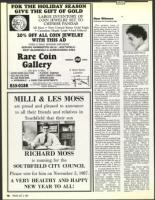
Scanned image of the page. Keyboard directions: use + to zoom in, - to zoom out, arrow keys to pan inside the viewer.
October 02, 1987 - Image 110
- Resource type:
- Text
- Publication:
- The Detroit Jewish News, 1987-10-02
Disclaimer: Computer generated plain text may have errors. Read more about this.