
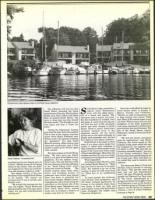

Condominiums have replaced hotels on the South Haven waterfront.
Sheila Fidelman: "An exciting time."
sonalized service her family gave its
visitors. "Mother knew all the eating
habits of the clients. This one didn't
eat chopped liver. That one loved her-
ring and potatoes cooked in milk."
She speaks bluntly of the anti-
Semitism which tainted South Haven
in its heyday. "We weren't too
welcome here. It was a terribly anti-
Semitic town.
"We brought the business into the
city;' she argues. "South Haven was
dead during the rest of the year. (Even
today) you can feel (anti-Semitism)
cutting you?'
The oldtimers will tell you that
South Haven attracted the finest
entertainers of the day. Martha Raye,
Buddy and Jerry Lester and David
Rose all plaYed South Haven. The
town in those days was dry, Donald
Horwitz recalls. "You brought in your
own liquor and kept it under the
table."
During the Depression, bootleg-
gers were the only Jews who could af-
ford to stay at the resorts, long-time
resort owner Sheila Fidelman says.
Others recall with genuine fondness
the "gangsters" who kept South
Haven's economy afloat during lean
times and occasionally used a little
muscle to stick up for Jewish rights
when needed.
Few Jews remain in South Haven
today. "We don't have one Jewish
child in our shul (First Hebrew Con-
gregation). It's the saddest thing;'
Patner says. The last full-time rabbi
the town had now joins the oldtimers
at the "South Haven Club" which
meets each winter in Florida. The
resorts, casinos, dance halls, steak
joints and boarding houses of
yesteryear have either been burned
down, torn down or converted into
year-round cottages. Modern luxury
condominiums were erected along the
waterfront on the former site of the
Silver Beach resort. Mendelson's, just
down North Shore Drive, covered
acres; now, in its place, a beehive of
condos runs down to the beach.
S
outh Haven today resembles a
typical small Midwestern
town, with the added attrac-
tion of a beach and marina. The
downtown area is quaint, but quiet.
But the beachfront is crowded, even
mid-week. A visitor from the big city
will find the pace of life noticeably
slower and more -relaxed in South
Haven. Dress is casual. Small-town
intimacy extends even to the
telephone service: All the town's
phones are on the same exchange, so
people need remember only the last
four digits of local phone numbers.
South Haven is no longer a resort
town; it is a place where people buy
condos to spend their summers or
their retirement within earshot of the
sound of the waves and within sight
of blue Lake Michigan. More than one
resident said that the city is no longer
interested in its potential as a resort.
What happened?
According to Ruth Horwitz, time
just passed South Haven by. "Years
ago, you lived in the city in an apart-
ment. You wanted to go out in the
country, to give the kids some fresh
air. There was no air conditioning
then!'
As years passed, she continues,
Jews became more prosperous, and
left those cramped apartments for
houses in the suburbs where there
was plenty of fresh air, light and
green spaces. Along with the suburbs
came mortgages and middle class
financial obligations.
Jews who could afford to began to
travel farther afield: to Europe, to
Mexico, Florida and California.
"Resorts, in order to keep going, had
to keep raising their prices," Ruth
says. Many of the resorts began to get
run down. What is more, the sons and
daughters of the hotel proprietors
were more interested in professional
pursuits than the resort business. The
last of the South Haven resorts,
Fidelman's, closed its doors just three
years ago.
"We still get letters and phone
calls for reservations," says Sheila
Fidelman. Her house stands on the
property of the resort which she and
her husband Iry ran together until
his death in 1978. "We were like an
enormous extended family:' she says
of her former customers. Vases of
flowers from that extended family dot
her living room. They send them on
the weeks they used to vacation, she
explains.
Her three sons, Barry, Chuck and
Michael, had no interest in running
the resort. "The last few years had
been bad and had disenchanted
them;' she says. The family recently
opened the Fideland Fun Park close
by. The resort, mismanaged by a
group of investors who bought it from
the Fidelmans, is now in the hands of
an Orthodox group in Chicago which
plans to use the facility for religious
retreats, a turn of events Fidelman
Continued on Page 30
THE DETROIT JEWISH NEWS
25