

The result, he says, was the Foundation
for Mideast Communication—set up as an
American organization to avoid the social
constraints that might limit its work in
Israel. Despite the American focus, it was
always Lame's intention to conduct work-
shops in Israel.
The workshops are generally two days
long. Groups vary in size from 25 to 80,
and the format is flexible; after initial in-
troductions, the group leader will simply
guide the discussion along lines deter-
mined by the participants and keep things
from getting out of hand.
"So sometimes we may focus on a ques-
tion like, 'What is the root cause of the con-
flict?' " Lame says. "We usually spend
some time talking about stereotypes, with
people expressing their own stereotypes
about Jews and Arabs. We discuss our pro-
posed solutions to the various conflicts. We
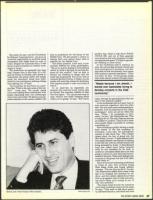
Michael Lame: Peace through conflict resolution.
look at predictions for the future of the
Middle East. We give people a chance to
express their own visions about what is
possible for the Middle East."
This latter question, Lame says, is par-
ticularly difficult for many participants.
"We are so used to dealing in hard political
reality, in 'what is the best we can hope for,
given all this conflict?' that we tend to
restrict our thinking to things that are
small and incremental. But if you look at
someone like Ben-Gurion, or Sadat, you see
people with some big visions for the future,
who inspired people to take some kind of
action."
In an interview, he repeatedly em-
phasizes this need for broad visions that
go beyond the everyday realities of that
war-torn region. "You can proceed step by
step, without ever really thinking about
where you're going," he says. "But there's
Photo By Barbara CoteII
another way, which is talk about WHAT
COULD BE, and out of that, generate
some projects and some programs to begin
moving towards peace. It's hard to get peo-
ple thinking in these terms."
In the workshops held in America, he
says, the cultural gap between Jewish and
Arab participants is enormous—but feel-
ings tend to lack the intensity that comes
from extensive personal experience. "What
you have," he says, "is two groups seeing
each other almost entirely through stereo-
"Maybe because I am Jewish, I
leaned over backwards trying to
develop contacts in the Arab
community."
types, through the generalizations that are
part of the political conflict."
In the workshops held in Israel, there is
more personal experience with the other
side—but not much more understanding or
empathy. And the experiences that shape
participants' views are all too often bad
ones. "When I do workshops in Jeru-
salem," he says, "the Palestinians say, 'This
is unique for us. The only Jews we ever see
are soldiers in uniform: That HAS to skew
what people think is possible in working
something out."
Most workshops quickly develop a single
basic theme. In the last workshop in
Jerusalem, Lame says, the participants
wanted to talk about fear. "The Israelis
talked about the fear of going into the
West Bank," he says. "A light skinned Arab
who spoke Hebrew was fearful of walking
in the Old City with his Jewish friends and
being attacked by Arabs. A dark-skinned
Iraqi Jew talked about being harassed
when he was mistaken for an Arab. A
mother in Jerusalem talked about her kids
going to school on a bus that had been at-
tacked in the past. These were feelings that
everyone in the group, Jew and Arab alike,
could relate to."
Some of the most interesting workshops
in Israel, he says, have involved young
West Bank Arabs and Israeli military
veterans. "The last time we did it," he says,
"the Palestinians talked about what it was
like to be stopped and searched by sol-
diers—and the soldiers talked about what
they're up against; what it's like not know-
ing what's likely to be coming at you. It
was very powerful."
The issues raised in both the American
and Israeli workshops tend to be the same,
he says. "They want to talk about securi-
ty, self-determination, individual and state
THE DETROIT JEWISH NEWS
47