

erent
Growing children and helping families
is The Orchards' quarter-century story
ELLYCE FIELD
Special to The Jewish News
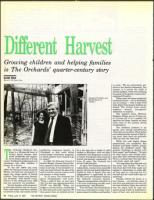
Suzanne Franklin and
Gerald Levin in
"Ixtlan."
in crisis. "We are particularly sen-
sitive to the Jewish community. Our
concern is to service the needs of
Jewish children, while never denying
the needs of the greater community,"
explained Franklin.
'May, there are three residential
treatment homes — two in Southfield,
one in Livonia — with a total of 24
beds. Eight of the present children are
Jewish. The Livonia home accom-
modates several youngsters'
adherence to kashrut.
The original home, Michael-
Rodecker House, serves 12 boys, six-
to 15-years old. It is a modest, but
spacious old home, located on three
acres close to the Livonia Jewish
Congregation.
The children's presence is ap-
parent even during mid-afternoon
when they are in school. Their games
are tucked into the corners of the liv-
ing room; their boots are patiently
lined up near the back hall.
While the cook begins dinner
preparations, two counselors, Ron
Jackson and Mark Chafetz, quietly
discuss the children's needs. "My
greatest challenge is dealing with
their anger," said Jackson. "I'm here
for their return each Sunday after-
noon after their weekend visits home.
This is a critical time. The kids often
come back, upset and angry."
"It's important they feel safe and
free here," said Chafetz. "We try to
help them deal with their anger and
express it. Sometimes, it seems like
all they need is a big hug, but I've
learned that for some kids hugs are
upsetting."
Outside, behind the house, is a
boy's dream — an intricate maze of
tree forts and platforms the boys call
the land of Ixtlan. Ixtlan has evolved
over the years, built by each suc-
cessive group of boys. It symbolizes a
place of their own, and serves as an
.
.
r
e Orchards Children's Ser-
ices is a 25-year-old story of
broken family dreams, shat-
tered childhoods and neglect-
ful or abusive parents. It is also
a story of dedicated professionals and
volunteers who offer children a
chance for a future.
"In the late 1950s and early
1960s, the National Council of Jewish
Women surveyed our community to
assess the unmet needs of Jewish
children. They found a very distress-
ing situation," said Gerald Levin,
_ director of The Orchards since 1966
and now executive vice president.
"Jewish families with emotional-
ly disturbed children had two choices. .
They could either send their children
out-of-town to the only nearby Jewish
44
Friday, June 12, 1987
residential treatment facility, in
Cleveland, or they could utilize
church-based community programs,
in which children were required to go
to chapel."
In 1962, the National Council of
Jewish Women, Greater Detroit Sec-
tion, opened its first residential care
home in Livonia. It was licensed to ac-
cept nine boys between the ages of six
and 12 who for various reasons could
not remain in their homes.
"In 25 years, The Orchards has
grown tremendously," said Levin.
"From a staff of four, we now have
100. Our first year appropriation from
NCJW was $45,000. Today, our
budget is over $4 million, contributed
by both state and county agencies. We
have grown from an isolated service
THE DETROIT JEWISH NEWS
for a few boys into a leader in child
welfare in Michigan, with two other
residential care programs, as well as
a variety of programs that touch the
Jewish and general community." In
those 25 years, The Orchards has
served 3,000 families.
In April, The Orchards became an
independent, incorporated, non-profit
agency with its own board of directors,
headed by Dale G. Rands. This new
independence is applauded by the
NCJW, Levin and Suzanne Franklin,
The Orchards' executive director.
"Separate incorporation will allow us
to do more fundraising and offer more
programming," said Franklin.
Over the years, The Orchards has
built up an impressive number of pro-
grams aimed at children and families