

The Jewish Home's
financial woes have
long-term
implications for the
elderly and
the community
RED II\11(
FOR G RAY
RUTHAN BRODSKY
Special to The Jewish News
I
he Jewish Home for Aged's
$600,000 deficit this year may
become a chronic malady for
Detroit's Jewish elderly and
the broader JeWish community
supporting the agency.
An aging and more disabled
population, disputed Medicaid reim-
bursement rates, rising medical costs,
and increasing competition from
private, "Jewish style" nursing homes
are causing a long-term shift in the
type of patient seeking residence at
the three facilities of the Jewish
Home for Aged. These factors are also
leading to increasing concerns about
Jewish communal resources needed to
take care of an aging Jewish popula-
tion here.
Nationally, just over 11 percent of
all Americans are over 65. The
Detroit Jewish community has an
even greater percentage of aged
relatives to its total population —
almost 14 percent (10,000-12,000).
National census data indicate the
fastest growing population is the old
elderly — those over 74 years. These
are the persons who need the most
assistance. Although only two percent
of - persons 65-74 are in nursing
homes, and seven percent of those
75-84, more than 23 percent of those
85 and older are institutionalized.
According to Larry Ziffer, planing
director for the Jewish Welfare
Federation of Metropolitan Detroit,
the Home for Aged and others pro-
viding services to the elderly are in-
creasingly catering to the frail elder-
24
Friday, May 15, 1987
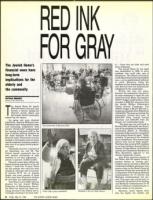
The lunchroom at Borman Hall.
Celia Lefton plays basketball. .
THE DETROIT JEWISH NEWS
Kickball is fun for Nelly Brown.
13r — those who are older and need
more assistance.
The Jewish Home for the Aged
was established in 1905 to serve
residents who could take care of
themselves. The Detroit community
could afford this kind of intermediate
care — not too sophisticated, technical
or costly. Moreover, either the
residents or their families paid for the
care. Services were not substantially
subsidized by the community.
Within the last ten years,
however, the community has provid-
ed more assistance to cover the cost
of services at the Home. The agency's
1976-77 budget was $4 million, which
included a $229,000 allocation from
the Jewish Welfare Federation's
Allied Jewish Campaign. The
1986-87 budget is $8,417,000 and in-
cluded an allocation from Federation
of $846,000. This does not include the
emergency grants this year of
$300,000 from United Jewish
Charities and $300,000 from the
Home's own endowment funds.
"Ten years ago you could walk in
Borman Hall and maybe see 20 per-
cent of the residents in wheelchairs,"
commented Robert A. Steinberg,
chairman of the executive committee
of the Jewish Home for Aged. "Today,
probably 75 percent of the residents
are' in wheelchairs. That means more
staff to help care for these people:'
The Home has a total of 400 residents
in its three facilities: Borman Hall in
Detroit, Prentis Manor in Southfield
and the new Fleischman Residence in
West Bloomfield adjacent to the
Jewish Community Center.
Alan Funk, executive director of
the Home, sees the agency facing a
gradual decline in "private pay"
residents and an increase in Medicaid
reimbursed residents, placing an even
greater strain on the Home's financial
resources. Private pay accounts for 28
to 29 percent of the funding, Medicaid
reimbursement for 70 percent and
Medicare reimbursement two per-
cent. Five years ago, private pay ac-
counted for 32 percent of the funding
and Medicaid reimbursement for 65
percent. Medicare reimbursement re-
mains steady at two percent.
Moreover, recent figures show
that the higher the number and