
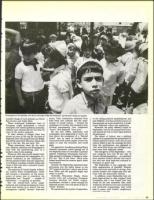

The emergence of the Sephardim, who tend to have larger families than Ashkenazim, alarmed Israel's liberals and socialists.
socialist image of such pioneers as David
Ben-Gurion and Golda Mein
These archetypal Ashkenazi Jews of
European origin maintained a virtual
monopoly over Israel's political, economic,
military and cultural life for the first 30
years of the state's existence.
In their scheme of things, there was
almost no room at the top for the mass of
Sephardi Jews who poured into the fledgl-
ing Jewish state from Morocco, Yemen and
Iraq in the late '40s and early '50s.
These newcomers were, for the most
part, illiterate, destitute and ill-equipped to
cope with the hard-driving pace of a
modern state-in-the-making.
Moreover, they were mostly deeply tradi-
tional and perceived the renaissance of a
Jewish homeland as the fulfillment of
Divine promise rather than the opportuni-
ty to fashion a modern socialist utopia and
create a New Jew with a romantic attach-
ment to the soil.
The response of Israel's largely Ashken-
azi, Labour Party establishment, which
had secured a monopoly on the instru-
ments of power, was to transform the
Sephardim into "Israelis" -- models of
themselves — as quickly as possible.
But the hastily-built urban neigh-
borhoods and outlying development towns
which were thrown up to absorb the new
immigrants rapidly became dead-end
slums. Their inhabitants alienated from
both their own cultures and the main-
stream of Israeli society — formed the
underlayer of a society that seemed to have
divided permanently into Ashkenazi
"haves" and Sephardi "have nots".
By the late 1960s, politicians and
sociologists were beginning to worry out
loud about the emergence of a "Second
Israel" and to warn of terrible inter-
communal strife unless urgent action was
taken to close the economic and social
gaps.
An aggressive, headline-grabbing Black
Panther movement which sprang out of
the Sephardi slums of Jerusalem to protest
against Ashkenazi domination and priv-
ilege seemed a harbinger of things to come.
But the "War of the Jews," which some
feared would tear the country apart, never
materialized.
Instead, the Sephardim deposited their
grievances into the ballot boxes: in the
1977 general elections, Labour was driven
from office and the populist Begin was
swept to power.
Ironically, Menachem Begin, whose
courtly style' and scrupulous European
manners betrayed his Polish origins,
nonetheless touched a chord among the
Sephardi masses, who still speak of him as
"Abb a" (Father).
He represented the symbol of opposition
to the ruling political establishment and
had skillfully used his powerful oratory to
demonstrate an acute sensitivity to tradi-
tional Sephardi values and aspirations.
Moreover, his party offered a home to
Sephardim, such as the young David Levy,
and opened the way to their rapid political
advancement.
The defeat of Labour was a political
upheaval of unprecedented proportions in
Israel's political history. And, just in case
Labour failed to get the message the first
time, the performance was repeated in
1981, when fully 80 per cent of Begin's sup-
port came from Sephardi voters. •
The emergence of the Sephardim — who
now comprise just over 60 per cent of
Israel's Jewish population — as a political
force alarmed Israel's liberals and social-
ists who saw their hard-won national in-
heritance at grave risk.
The Sephardim, it was supposed, had
little appreciation of pluralist Western
values and were attracted to strong, char-
ismatic leaders who might play fast and
loose with the democratic niceties.
In addition, many Sephardim had suf-
fered deprivations in their original Arab
homelands and it was feared that they
would be far less amenable than their
Ashkenazi brothers to the sort of political
and territorial compromises that could
lead to peace with Israel's neighbours.
Continued on next page
23