

1111111111101111111111111110 101WIMINIMPIMMPOSOMIOW
CLOSE-UP
The Covenant
- Continued from Page 5
ethical, religious decision,"
argues Rabbi Norman T.
Roman of (Reform) Temple
Kol Ami. "Does this one act
bring the family closer to the
community? This may be the
first step in their affiliation."
In Rabbi Roman's opinion,
it should be a person's lifes-
tyle, rather than his certifica-
tion, that determines if he is
a Jew. And while he would
"have no problem" with the
institutionalization of a
follow-up after a brit, the
status quo does not bother
him. "If (the parents) don't do
their part, (the brit) reverts
to a surgical procedure (and
the mohel is) relieved of re-
sponsibility."
How long does one wait, he
muses, before one can con-
clude that the boy is not
going to the mikveh and the
brit is invalid? "What hap-
pens if they don't go to the
mikveh for ten years? It's not
a brit for those ten years, but
when there is a mikveh, it is
a brit."
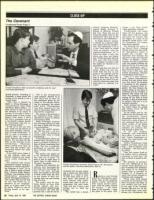
Cantor Greenbaum fills out Jacob's certificate with Dr. Joel
and Susan Berenbeim.
Jewish parents. According to
Halachah, a home where the
mother is not Jewish is not a
Jewish home.
This view is shared by
Rabbi A. Irving Schnipper of
(Conservative) Cong. Beth
Abraham Hillel Moses. "A
baby should be able to make
the decision if he wants to
convert. If you take it from a
halachic point of view, it just
doesn't hold water. I don't
feel that a youngster, born of
a non-Jewish woman, should
be circumcised with the in-
tent of being Jewish."
If left up to his own free
will, "what are the chances of
this child actually convert-
ing?" he asks rhetorically. "A
brit in such a situation is
usually done "in order to
pacify someone, like a grand-
parent. It's not done for the
sake of the mitzvah of the
circumcision. Otherwise,
(they) would have seen at
least that the mother was
converted before the baby
was born."
If the child never makes it
to the mikveh, then the
brachot recited by the mohel
"were really blessings in
vain."
Are mohelim like Cantor
Greenbaum merely turning a
blind eye to reality and utter-
ing blessings in vain? "In no
way is there a sense of fraud
here," declares Rabbi Morton
Leifman, vice president of the
Conservative movement's
Jewish Theological Seminary.
"The mohel does his job and
we can only follow up on
members of our congrega-
tions, or if they come to us
for advice. There's no way of
forcing people to do any-
thing."
26
Friday, April 10, 1987
Nor is the circumcision
"just surgery" dressed up to
look like a brit, he says. On
the certificate given by the
mohel to the parents follow-
ing the ceremony, the mohel
must write, "Circumcision
was done properly for the
sake of conversion. Mikveh is
required for completion."
The intent of the parents is
the important thing, Cahtor
Greenbaum argues in defense
of his leap in faith.
Rabbi Schnipper proposes
the following solution to both
the leap of faith and the gap
in accountability: ,
"Have the mohel circum-
cise (the boy) now not as a
ritual — and if he chooses to
convert later, have a ritual
bloodletting."
In this procedure, known as
hattafat dam, the glans of the
penis is pricked to produce a
drop of blood, simulating brit
milah. The rite is generally
performed on converts who
have already been circum-
cised.
One mohel, who asked not
to be identified, dismisses
this idea out of hand. "To
have a brit at eight days is
easier than to take blood at
13 years," he argues.
Delaying the ceremony, he
believes, may discourage the
boy from ever converting, for
fear of the pain. Turning
down the parents at the time
of birth could close the door
on any chance of their con-
verting their son and raising
him as a Jew.
The mohel says he per-
forms britot on boys with
Jewish fathers and non-
Jewish mothers despite pangs
of conscience. He tells the
parents that a mikveh will be
THE DETROIT JEWISH NEWS
Cantor Greenbaum restrains Jacob's legs as Dr. Berenbeim
and his father, Abraham Berenbeim, look on.
necessary but, he says, check-
ing to make sure they follow
through is a waste of time.
"If they don't want to do it,
they don't." The parents al-
ways indicate they under-
stand their part of the ar-
rangement, but with some,
"they nod, but I have a gut
feeling not to hold my
breath."
"The mohel has a moral,
elatives and friends
crow the Berenbeim's small
living room as the ceremony
begins. Cantor Greenbaum
first cleans Jacob's penis,
then, with his probe, loosens
the mucosa — the lower
layer of the foreskin — from
the glans of the penis. This
raises a cry from Jacob,
which gradually subsides.
Traditionally, the mohel
takes off the prepuce, the
upper layer, with his scalpel
and tears the mucosa with
his fingers in a part of the
operation called periah. Can-
tor Greenbaum will remove
both layers together.
He instructs the party to
say Baruch Haba! , blessing
Jacob's arrival into the world.
Dr. Berenbeim's father is
named the sandak, the
supervisor who oversees the
operation from the honored
"Chair of Elijah." Tradi-
tionally, the brit is performed
with the sandak holding the
baby on his lap. It is not a job
for the squeamish, and "I
give them the option," if they
want to do it this way, says
Cantor Greenbaum, "because
I'm thinking of the baby."
Clad in a- blue medical
coat, Cantor Greenbaum's
six-foot five-inch frame leans
over tiny Jacob. He attaches
a hemostat to the prepuce-
mucosa, clamping them to-
gether. He then fastens the
magen clamp so the glans is
protected and the foreskin is
exposed. The clamp will also
limit the bleeding without
cutting off the flow of blood
entirely. A drop of blood must
be spilled if the brit is to be
executed correctly.
Jacob clenches his fists as
the mohel takes his scalpel
and neatly slices off the
baby's foreskin.
As the mohel and Dr. Be-
renbeim say the brachah over
the circumcision, Cantor
Greenbaum stems the flow of
blood with a piece of gauze. It
was customary that the met-
zitzah, suction of the blood,
was done by mouth. Many
mohelim now perform this
step through a glass tube.
In all, the surgery,
blessings and hemostasis
have taken a minute and a
half. Cantor Greenbaum re-
moves the instruments and
bandages Jacob.
Cantor Greenbaum leads
kiddush and then names the
baby — first in Hebrew, then
in English — the final step in
the ritual.
"Now let's return Jacob to
his mother who is anxiously
awaiting to hold him," he
says as Jacob is passed to Su-
san.
The practice of circumci-
sion was widespread in the
ancient world, generally as a
rite of passage into manhood.
The origin of its distinctly
Jewish form is recorded in
Chapter 17 of Genesis, in
which God reveals Himself to
Abraham and commands:
"Every male child among
you shall be circumcised. You
shall circumcise the flesh of
your foreskin and that shall
be the sign of the covenant
between Me and you. At the
age of eight days, every male
among you throughout the ,