

cated in 1884, New York's Montefiore
Hospital was a tiny, box-like, two story
frame house on East 84th Street and York
Avenue. Detroit's first Jewish clinic con-
sisted of eight rooms in the-basement of a
building on Hastings Street. When the
clinic moved in 1922 to Westminister
Avenue, its new quarters consisted of two
adjoining stores recently vacated by a
kosher chicken market. "In three days,"
writes Saltzstein, the chicken feathers
were cleaned out, the premises mopped
and painted," and six examining cubicles
installed.
The year 1926 saw the founding of the
North End Clinic on Holbrook Avenue,
which by 1930 had a staff of 80 physicians •
and handled 72,000 patient visits a year.
Today, Sinai of Detroit is a 622-bed facility
with 900 medical and dental staff and
nearly 3,000 employees.
All across the country, the growth of
Jewish hospitals was equally mpressive.
By the early 1960s, Mt. Sinai of New York
had grown into an institution with more
doctors than the state of Vermont. Many
Jewish hospitals, fueled by a bent for re-
search and teaching among Jewish doc-
tors, became affiliated with major medical
schools, as Sinai of Detroit did with Wayne
State and Beth Israel of Boston did with
Harvard, or otherwise emerged as re-
search institutions several cuts above the
typical community hospital. When it
comes to education," says Irving Shapiro,
executive vice president of Sinai of De-
troit, comparable "non-Jewish institu-
tions just don't have that same thirst."
In a sense, then, Jewish hospitals be-
came the flagships of the Jewish institu-
tional presence in America.
But are they, today, still really
Jewish?
And will they be around tomorrow?
Talk off the record to one Jewish fed-
eration official and what you hear is that
Jewish hospitals may not survive in to-
day's more open, more genuinely pluralis-
tic society. Through mergers, acquisitions,
and take-overs, he says, Jewish hospitals
will disappear; already their number, at
about two dozen, is but a third of what it
was a half-century ago. Others will limp
along, scrounging for patients with
"boutique" services, such as fitness clinics,
offered through satellite centers — an ap-
proach taken by, among others, Sinai of
Detroit. Today's Jewish patient, he says,
seeks a hospital that's close, cheap, and
good; a mezuzzah on the doorpost of his
room counts for little. Their end, he pre-
dicts, "will not be a purely rational proc-
ess; there's so much invested— families
'who have contributed millions . . . But in
five or ten years we'll see it."
And how does he greet the prospect? "I
see it," he says, "as positive."
I
t started as sort of a bUll session kind
of thing," recalls David Gee, president
of Jewish Hospital of St. Louis. Didn't
Jewish hospitals around the country share
certain problems? Might it not be good for
their presidents to get together periodi-
cally and, briefly freed from crises back
home, meet for a few days and compare
notes on their problems? And so they did.
It was the late 1960s. Then, and into
the early 1970s, when this group of Jewish
hospital executives came into its own, was
an era of uncertainty for Jewish hospitals,
a period when they seemed to lose their
way. As a 1974 paper for the Institute for
Jewish Policy Planning and Research put
it, they suffered from "an identity crisis."
Decried as too Jewish by some of their new
constituents, many of them blacks, they
were hardly Jewish at all to some Jews.
Meanwhile, Medicare and Medicaid now
imposed a host of new rules and regula-
tions, and Jewish federation support had
declined. Spencer ("Spike") Foreman, re-
cently moved to Montefiore Hospital in the
Bronx, recalls a sense of directionlessness
at the time he took the helm of Baltimore's
Sinai Hospital in 1973. His successor, act-
ing president B. Stanley Cohen, remem-
bers Sinai at such a low ebb then that good
Jewish interns could scarcely be recruited.
It was during this period that the
Jewish hospital executives began to take
an annual respite from the pressure cooker
and try to make sense of it all. They had
met for the first time in 1966 in Los
Angeles, maybe seven or eight of them. By
now, in the 1970s, it had become an annual
three or four day get-together for more
than 20 of them. "It was a pretty haimishe
crew," remembers Mitchell T. Rabkin,
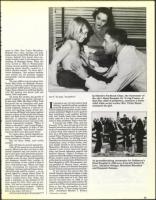
In Detroit's Northend Clinic, the forerunner of
the city's Sinai Hospital, Dr. Irving Posner, at
that time chief of pediatrics, examines a foster
child while social worker Mrs. Victor Baum
reassures the girl.
At groundbreaking ceremonies for Baltimore's
Sinai Hospital in 1956 were, from left, Robert H.
Levy, Abraham Krieger, He nrietta Blaustein
and Benjamin Katzner.
_
Continued on next page
23