
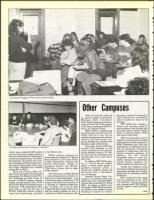

The Student Struggle for Soviet Jewry meets at Hillel.
Other Campuses
A weekly editorial board meeting at "Consider!'
(which alone netted, $11,000 profit)
can cover the many smaller ones that
don't pay for themselves. That kind of
success is self-generating. The better
the programs, the greater the num-
bers of people-and dollars they draw.
And some of those people will be ones
who might otherwise have resisted
setting foot in Hillel.
There are, of course, other, out-
side sources of support that keep the
place going. The Detroit Jewish Wel-
fare Federation provides almost 30
percent of Hillel's regular ongoing
budget, and the national office of the
B'nai B'rith Hillel Foundations gives
20 percent. U-M organizations offer
some help as well, and the rest of
Hillel's $420,000 annual budget
comes from fund-raising, primarily
in. the Detroit area.
Hillel's cultural programs are
almost entirely student-run. "Most of
these students in a few years will be
in their communities, working with
Jewish) federations, sitting on
synagogue boards," says Brooks.
They have to learn how to make
things happen."
The red-haired, youthful Brooks
— whose idiosyncracies include a re-
fusal ever to be photographed — cuts
a distinctive figure around the U-M
campus,-and his personal charisma is
an element in "making things hap-
pen" at Hillel. He is one of those
People Who Seem to Know Everyone,
and the student soldiers he has re-
cruited to run Hillel's programs often
With two full-time staff and
an annual budget of $120,000,
Michigan State University's
Hillel in East Lansing reaches be-
tween 500 and 700 of the campus'
2,000 Jews, according to Hillel di-
rector, Dr. Sheldon Gellar.
. MSU's Hillel is . emphasizing
the performing arts this year, Dr.
Gellar went on to say, but its
schedule of programs also contains
cultural and educational pro-
- grams, Shabbatons, speakers and
Saturday night coffee houses.
How many attend individual
events? Tha-t depends on the
event. Twenty-five or 30 regularly
attend Shabbat dinners, Dr. Gel-
lar said, but the screening of the
feminist film, Not A Love Story,
drew 150.
In addition, MSU Hillel spon-
sors a United Jewish Appeal
group, a Soviet Jewry group, a
graduate students' group, a
Jewish law students' group, and
the Jewish Voice, a four-time-a-
year- newspaper.
Because Wayne State Uni-
versity is a commuter school, the
Hillel there has a radically differ-
ent face than its sisters at U-M and
MSU. According to Rabbi Louis
Finkelnian, WSU Hillel's director,
his facility in the Student Center
Building is tailored to "drop-in
business" as well as for outreach to
other Detroit-area universities;
and for teachers as much as for
students.
WSU Hillel has a lounge, a
library and meeting rooms for
those professors and students who
have some time to spend at Hillel
before or between classes. Hillel
also serves lunch daily.
"We're trying to find out if it's
possible to set up Jewish student
organizations on other campuses,"
Rabbi Finkelman said. One such
organization at Oakland Univer-
sity has sponsored a Holocaust
program in conjunction with the
school's Armenian students. In
addition, the OU faculty
Chanukah party is very suc-
cessful, because the university's
Jewish faculty members are
rather isolated, he went on to say.
Jewish law students at the
University of Detroit sponsored an
appearance of Judge Avern Cohen
which drew 50, according to Rabbi
Finkelman.
He is unsure just how many
Jews his programs touch. With
two full-time, several part-time
and volunteer staff, WSU Hillel's
annual budget is under $100,000,
he said.
—D.H.