

FEELING GOOD
eart disease is
the leading cause of death in the
United States, accounting for nearly
50 percent of all deaths annually re-
ports the American Heart Association
(AHA).
The good news is that research is
closing in on the secret of preventing
heart attacks and that Americans
seem to have a greater appreciation of
risk factors for heart disease. This is
evident by the increase in work-out
and exercise centers and the burgeon-
ing interest in good nutrition.
Your cardiovascular system will
benefit most from exercise if it gets
your heart rate up to a target heart
rate for exercise, which in between 60
and 80 percent of maximum heart
rate. A general rule for determining
your maximum heart rate is to sub-
tract your age from 220 and multiply
that number by 60 or 80 percent. The
AHA recommends that when you
begin your exercise program, that you
aim for the lower part of your target
zone (60 percent) during the first few
months and build up to the higher part
of your target zone.
Each exercise session should last
about 40 minutes and include five
minutes of warm-up, 25-30 minutes of
sustained aerobic exercising in your
target zone, and five minutes for cool-
ing down. This exercise program
should be carried out at least three
times a week to achieve a cardiovascu-
lar fitness level.
Mileage, laps, pace, and target
heart rate are suggested goals accord-
ing to Joyce Weckstein, fast walking
class instructor at the Jewish Com-
munity Center and racquet ball in-
structor at Franklin Racquet Club. If
you want to know exactly what your
target heart rate should be you have to
go through a series of tests similar to
the ones they offer at Sinai's Fitness
Center. But even more importantly, a
person should challenge himself or
herself, do what's comfortable and
what they enjoy without overdoing it."
David Wrisley, M.D., Director of
Sinai Hospital's Cardiovascular Fit-
ness and Rehabilitation Program, also
believes that the best way to prevent
cardiac disease is to promote a life
style that reduces the primary risk
factors such as high blood pressure,
smoking, a sedentary life style, and
high serum cholesterol. In fact, an in-
dividualized exercise program plays a
large part in recovering from cardiac
illness.
"As part of our rehabilitation pro-
gram for cardiac patients, we have de-
veloped a recreational and gymnastic
program that is carried out at the
Jewish Community Center," says
Wrisley. "It's primarily an exercise
and education program for patients
with coronary heart disease who are
44
Friday, January 2, 1987
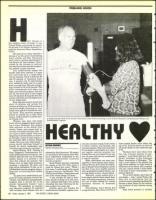
A blood pressure check at the Jewish Community Center before exercising is part of Sinai Hospital's Cardiovascular Fitness and
Rehabilitation Program.
A M ,
RUTHAN BRODSKY
Special to The Jewish News
referred by their physician. We assign
our patients to this program after they
have sufficiently progressed at the
hospital's continuously monitored
exercise program."
Sarah Swartz has been attending
the classes at the JCC three times a
week for almost four years. "When I
first came, I could barely walk around
the gym even once," said Swartz. "Now
I feel so much better. Coming here was
one of the wisest things I've done."
"I just wouldn't be able to disci-
pline myself at home to do this exer-
cise," explains Bob Noble who started
attending the class following his by-
pass surgery five years ago.
Experts agree that besides the
cardiovascular benefits, regular exer-
THE DETROIT JEWISH NEWS
cise also increases energy levels, helps
to relieve tension, tone muscles, and
increase stamina. They also insist that
if you decide to participate in a vigor-
ous regular exercise program you
should first see your doctor if you are
over 45 years old and not accustomed
to regular exercise.
Some individuals are more sus-
ceptable to heart disease than others.
Joshua Wynne, M.D. Chief of Cardiol-
ogy at Harper-Grace Hospitals, points
out that if you have healthy parents
and a good family medical history, you
are less likely to have a heart attack.
Moreover, young women have a
lower death rate for heart attack than
men. Following menopause, however,
the rate of heart disease for women
increases because of hormonal
changes.
Nevertheless, heart disease has
no age barriers. More than one-fifth of
heart attack deaths occur before the
age of 65. And one person in seven of
all stroke deaths is also under the age
of 65.
"Smokers have more than twice
the risk of heart attacks of non-
smokers," said Albert Sparrow, M.D.,
former president of the American
Heart Association of Michigan. "The
risk is even higher if the smoker has
high blood pressure or high levels of
cholesterol in the blood. And, a smoker
who has a heart attack is more likely
to the from it than a non-smoker," ex-
plained Sparrow.
"If you don't smoke, don't start. If
you smoke — stop," warns Wynne. He
feels this is particularly true for
women because cigarette smoking has
become a major factor for the increas-
ing incidence of heart disease among
women.
High blood pressure is another